

Electricity carbon footprint calculator
Enter the electrical load, its operating hours and the country it runs in, and get the annual and lifetime CO2 emissions — using real grid carbon intensity data for 55+ countries, with a comparison chart. Works for any electrical load: a fan, a whole AHU, a compressor, a pump — not fan-specific.
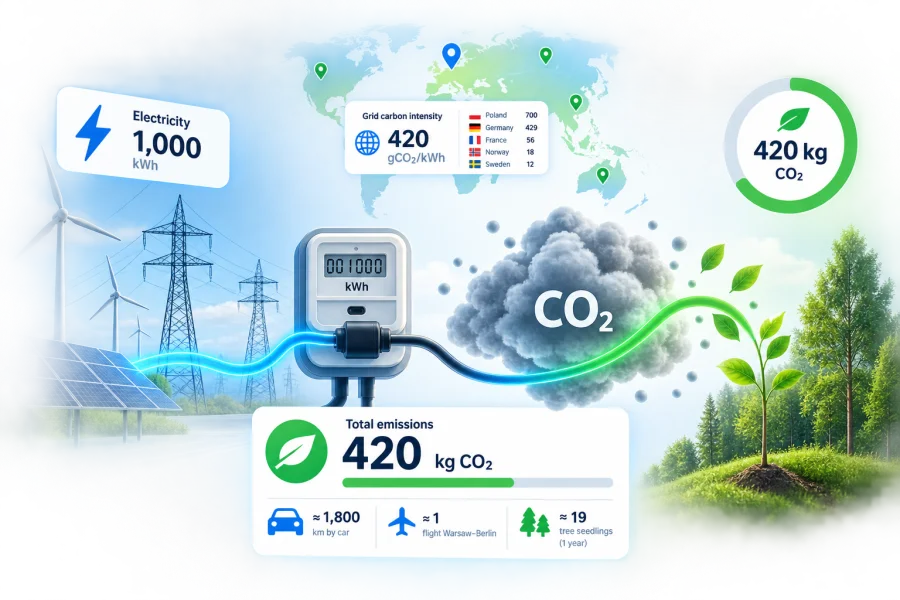
How to use this calculator
- Enter the electrical load and its operating hours per year.
- Pick the country — grid carbon intensity and T&D losses auto-fill from real data.
- Optional: enter an equipment lifetime for a lifetime total.
- Read the annual and lifetime CO2 emissions, with the country comparison chart.
How this calculator works
The math is straightforward — no fan or motor physics involved, it works for any electrical load:
Annual energy (consumed)    E  = P · h                  (kWh/year, P in kW, h in hours/year)
Annual energy (generated)   G  = E / (1 − L)             (L = grid T&D loss fraction)
Annual CO2                   m  = G · I / 1000             (kg CO2/year, I = grid intensity in gCO2/kWh)
Lifetime CO2                 M  = m · N / 1000             (t CO2, N = lifetime in years)
The variable that actually matters is I, the grid's carbon intensity — and it varies by a factor of 25× or more between countries, purely because of what's generating the electricity (hydro and nuclear vs. coal and gas). The same 15 kW fan running the same hours emits roughly 14× more CO2 on Poland's grid than on France's. That's why this tool needs a country, not just a number.
The load only consumes E at the point of use — but the carbon intensity figures below are generation-based (CO2 per kWh generated), and more than E has to be generated to cover what's lost in transmission and distribution on the way there. Skipping that step understates the footprint, so this calculator scales consumption up to a generation-equivalent, G, using the grid's T&D loss percentage — auto-filled per country but editable, in case you have a better local figure.
Grid carbon intensity values are from Ember's Yearly Electricity Data, accessed via Our World in Data (downloaded 2026-08-18) — the most recent year available per country, which varies from 2022 to 2025 depending on how current that country's reporting is. These are location-based grid averages (all generation feeding that country's grid, not import/export-adjusted, and not a specific plant or tariff), so treat the result as an order-of-magnitude estimate, not an audited emissions factor for regulatory carbon reporting — those need the specific national methodology (e.g. GHG Protocol location- vs market-based, or a supplier's residual mix). Grid transmission & distribution loss percentages are the World Bank's EG.ELC.LOSS.ZS indicator, 2023 data (downloaded 2026-08-18).
The vehicle and tree-seedling equivalents use the US EPA's Greenhouse Gas Equivalencies Calculator constants: 4.29 t CO2e per gasoline passenger vehicle per year, and 0.060 t CO2 per urban tree seedling per year of a 10-year growth average — published, citable figures, not our own estimate.