

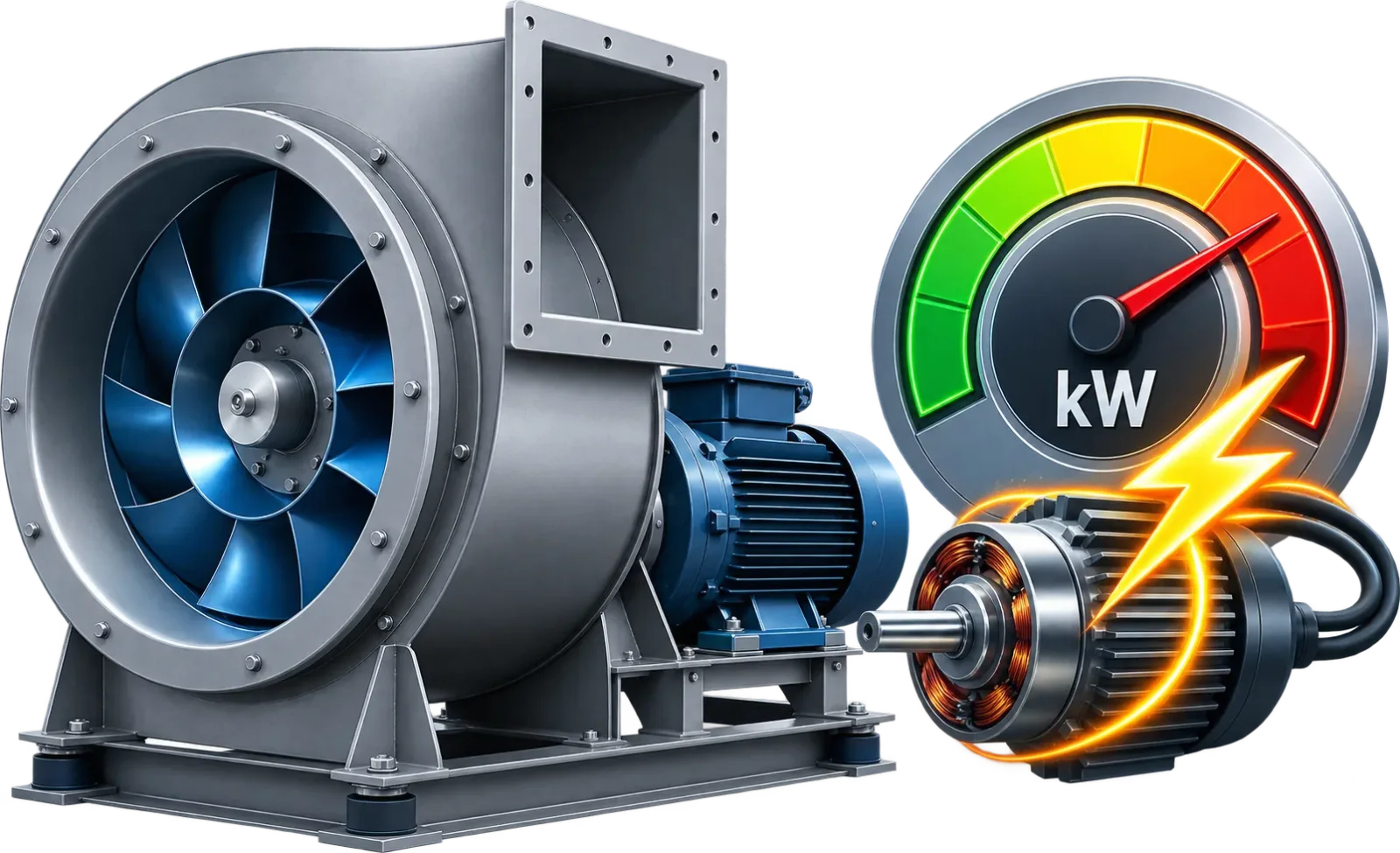
An HVAC system that was perfectly sized and selected on day one can still be quietly wasting a large share of its running cost five years later — not because anything broke, but because small, individually reasonable-looking inefficiencies stack up. None of them show up as a fault on a control panel. All of them show up on the electricity bill.
Here's where that energy actually goes, and which levers move the needle the most.
Where HVAC energy actually goes
Three things consume the overwhelming majority of HVAC energy: moving air (fans), moving heat (heating and cooling), and the electric motors driving both. Everything else on this list — filters, scheduling, setpoints, sizing — doesn't consume energy directly. It changes how much of it those three big consumers need.
Fan power: the one that compounds
Fan power follows directly from airflow and pressure: P = Q × Δp / η. Every inefficiency elsewhere in the system — a dirty filter, an undersized duct, a badly selected fan — shows up here, as extra pressure the fan has to fight, all day, every day the system runs. Fan energy is also the one place where a single, well-known intervention delivers genuinely outsized returns:
That's the physical reason variable-speed drives (VFDs) are consistently at the top of every HVAC energy-saving list. Under fan-law conditions, reducing fan speed by 20% can reduce fan power by approximately 49% (0.8³ ≈ 0.51, so about 51% of the original power remains).
Heating, cooling, and the equipment driving them
Heat pumps, chillers and boilers are usually the single largest energy line item in a building, and their efficiency depends heavily on matching capacity to the real, current load rather than the worst-case design load the system was sized for. A heat pump oversized for mild weather cycles on and off instead of modulating smoothly — and short-cycling is measurably less efficient than steady operation.
Motors and drives
An IE3 or IE4 premium-efficiency motor costs more upfront than an older IE1 unit, and pays that difference back through years of slightly lower losses on every kilowatt the fan or pump draws. On a motor that runs continuously, that difference is not trivial — it's the same logic as the fan speed example above, just applied to the conversion step instead of the airflow step.
Pressure losses: death by a thousand cuts
Every elbow, damper, filter, and undersized duct section adds pressure the fan has to overcome — and because fan power is directly proportional to pressure, every one of those losses has a direct, permanent line to the energy bill. This is why duct sizing and system design (not just equipment selection) genuinely matter for operating cost, not only for capital cost.
Dirty filters: the maintenance item that's actually an energy cost
A clogged filter doesn't just restrict airflow — it adds pressure drop that the fan has to make up, continuously, until someone changes it. A filter left in service well past its service life can quietly add a meaningful fraction of a system's total fan energy, for weeks or months, with no fault ever raised.
Oversizing: the mistake made at design time, paid for every year after
An oversized fan or piece of heating/cooling equipment doesn't just cost more to buy — it spends its entire operating life running well below its best-efficiency point, throttled or cycling to avoid over-delivering. The US Department of Energy's own guidance on fan system efficiency specifically flags operating close to the best-efficiency point (BEP) as one of the highest-value actions available — right alongside variable-speed control and clean inlet flow conditions at the fan.
Heat recovery: capturing energy that's already been paid for
Exhaust air leaving a building is carrying heating or cooling energy that was already purchased. An air-to-air heat recovery device transfers a meaningful share of that energy into the incoming outdoor air before it ever reaches the heating or cooling coil — reducing the load those systems have to meet in the first place, not just running them more efficiently.
Schedule and setpoint: free savings that require no hardware
Running a system on a schedule that matches real occupancy — rather than continuously "to be safe" — and setting temperature setpoints to the edge of comfort rather than the middle of it, cost nothing to implement and directly reduce the load every other system on this list has to meet. They're consistently the highest return-on-effort item on any energy audit, precisely because there's no capital cost at all.
What this looks like added together
Take one fan, real formula, real assumptions stated plainly: 10,000 m³/h, running continuously (8,760 h/yr) at €0.15/kWh. Before: 900 Pa (dirty filter, oversized margin) at 55% overall efficiency, full speed throughout. After: 650 Pa (clean filter, better-sized ductwork), 68% efficiency (better-matched selection), and a VFD trimming average speed to 85% of full to match real demand most hours:
No single change here is dramatic on its own. Combined, and compounded by the cube-law effect on the speed trim specifically, they add up to a real, defensible two-thirds reduction — for one fan, in one system, over one year.
Frequently asked questions
What is the most effective way to reduce HVAC energy consumption?
There is no single solution for every HVAC system. The largest savings usually come from matching system output to actual demand, reducing unnecessary pressure losses, using variable-speed control where appropriate, selecting efficient equipment and avoiding excessive operating hours. The best opportunities depend on where the system currently wastes energy.
How much energy can a VFD save on an HVAC fan?
The potential savings can be substantial when airflow demand varies. According to the fan affinity laws, fan power changes approximately with the cube of fan speed. In idealized conditions, reducing speed from 100% to 80% reduces power to about 51% of the original value. Actual savings depend on the system curve, efficiency and operating profile.
Does reducing fan speed save more energy than using a damper?
Usually, yes, when the required airflow can be controlled by fan speed. A damper reduces airflow by adding resistance while the fan continues operating at high speed. A VFD reduces the fan speed itself, which can significantly reduce required power. The actual benefit depends on the fan and system characteristics.
Do dirty air filters increase HVAC energy consumption?
They can. As a filter becomes loaded with dust, its pressure drop generally increases. The fan must then operate against greater system resistance to maintain airflow. In systems with airflow control, this can result in increased fan speed and power consumption.
Does an oversized HVAC system use more energy?
It can. Oversized fans may operate far from their efficient operating region or require throttling to control excess airflow. Oversized heating and cooling equipment can also experience inefficient part-load operation or cycling. Correct sizing helps equipment operate closer to the conditions for which it was selected.
How does duct pressure loss affect HVAC energy consumption?
Every additional pressure loss must ultimately be overcome by the fan. Fan power can be expressed approximately as P = Q × Δp / η, so reducing unnecessary pressure losses from ducts, fittings, filters and dampers can directly reduce the power required to move air.
Does heat recovery reduce HVAC energy costs?
Yes, when the operating conditions make heat recovery beneficial. A heat recovery system transfers energy between exhaust and incoming outdoor air, reducing the heating or cooling load that must be supplied by the HVAC equipment. The actual saving depends on airflow, temperature difference, efficiency, operating hours and climate.
Should HVAC systems run continuously?
Not necessarily. In many buildings, reducing operation during unoccupied periods can significantly reduce energy consumption. However, schedules must still satisfy ventilation, humidity, temperature, process and building-protection requirements.
How can I make an existing HVAC system more energy efficient?
Start by measuring how the system actually operates rather than immediately replacing equipment. Check airflow, fan pressure, fan speed, filter pressure drop, operating hours, temperature setpoints and equipment loading. These measurements can reveal opportunities such as reducing fan speed, replacing dirty filters, adjusting schedules, correcting excessive airflow or improving control strategies.
Work out your own numbers
CloudAir has calculators for most of the levers above: Fan Power & annual cost, Fan Laws (for speed-trim savings), Heat Recovery Efficiency, Heat Pump Sizing, Motor Efficiency, EC vs AC Motor Payback, and Electricity Carbon Footprint. All free, no sign-up.