
One platform behind your technical products
Product data, engineering logic and every digital channel connected in one system.
CloudAir is a modular engineering product platform for HVAC and technical manufacturers. Manage the product once, then use the same structured information across selection software, your website, APIs, catalogs and partner systems.
One product database. Every output connected.
Each of these reads the same records. None of them keeps its own copy of your technical data.
Selection software
Your catalog as an engineering tool for customers and sales.
Website & shop
Product pages, filters and technical data rendered from the records.
Dynamic catalogs
Complete technical PDFs generated from the current data.
Administration
Where your team enters, checks and publishes everything.
Product data API
Technical data for partners, scoped per company.
Data channels
CSV, XML or JSON feeds shaped for one recipient.
Selection API
A duty point in, calculated results out, from somebody else’s software.
DLL / SDK
The same engine inside a local desktop application.
The same product, described in seven places
Most technical manufacturers maintain their product information several times over. Not because anyone wants to — because each channel grew its own copy.
Where the same figure usually lives
- Specifications in spreadsheets
- Performance curves in engineering files
- Images on a shared drive
- A PDF catalog maintained separately
- Website data in a CMS
- Selection software on its own database
- Partner exports prepared by hand
- And the one person who knows which is current
Change the product once, and every connected output uses the updated record.
What the platform is made of
Product Information Management
The structured source behind everything
Hierarchy, categories and series, technical parameters, performance curves, dimensions, acoustic data, images, documents, translations, accessories, related products, certifications and regulatory data — held once, in a structure built for technical products rather than retail SKUs.
Explore PIMProduct Data Administration
Where your team actually works
Product and series editors, bulk grids, a curve editor, dimension drawings, accessory compatibility, media and document libraries, translations, data-quality checks, drafts and approvals, change history with rollback, permissions and usage analytics. Every change recorded and attributed.
Explore administrationSelection Software
The catalog as an engineering application
Customers enter the conditions they need and see the products that meet them, with the operating point, pressure, power, efficiency, acoustics, FEI, ErP status, energy cost, dimensions, motor data and compatible accessories calculated from the same records.
Explore selection software45+ platform modules
Build the system your product needs
Catalog, parametric selection, charts, comparisons, projects, multiple duty points, acoustics, energy, FEI, ErP, accessories, dimensions, CAD, technical files, unit conversion, multilingual interfaces, user management, PDF generation, APIs and DLL integration — combined differently for every manufacturer.
See all modulesWhere the value actually shows up
A single database becomes worth having the moment more than one thing reads from it — and each of these reads a different slice.
Online catalog
Structured product pages, filters, series and technical data published straight from the database.
Selection software
Customers and sales engineers working on the same records your engineers maintain.
Technical catalogs
Complete PDFs generated from current data: product pages, tables, curves, dimensions, accessories and QR codes.
Product data API
External systems reading the technical data they are entitled to, and nothing else.
Data channels
CSV, XML or JSON feeds shaped for one distributor, delivered as a file or a live link.
Selection API & DLL
Your selection engine running inside a partner’s web platform or desktop application.
Each recipient is scoped individually — by product range, categories, series, languages, access level, validity period and daily limit — so the same source serves everyone without giving anyone the whole catalog.
Projects and users
The platform is also the working environment around selection. Users create projects, save selections, come back to earlier calculations, compare products, keep generated documents and share technical information internally.
Administrators, editors, sales teams and external users each get their own access level, so the same system serves people with very different rights.
Multilingual by design
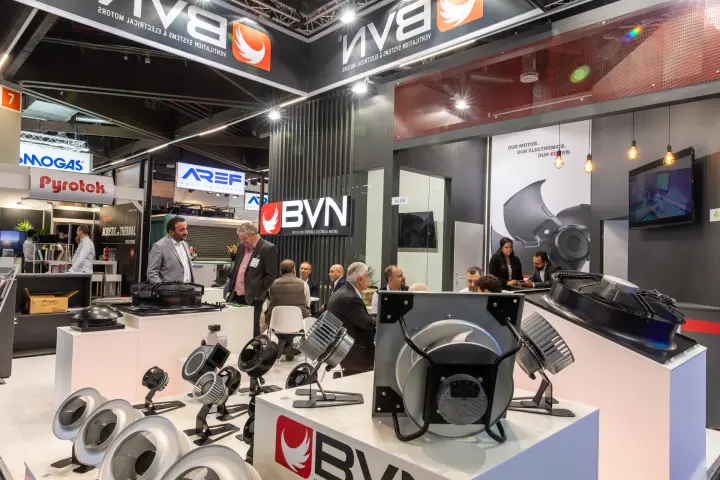
Interfaces, product names, descriptions, technical labels, documentation, catalogs and API data can all be translated. Right-to-left layouts are supported where they are needed — BVN’s program runs a complete Arabic interface.
One product structure serves every market instead of a separate database per country.
One platform, different products
CloudAir started with fan selection, but the architecture was never limited to fans. The data model, the calculations and the interface are adapted to the product; the platform underneath stays the same.
The parts were designed together
This is the difference between a platform and a collection of tools that happen to be sold together.
- The PIM is not a separate database from the catalog.
- The API does not need another export system behind it.
- The generated catalog does not keep its own technical tables.
- The selection program does not need a second set of performance curves.
- The website is not a hand-made copy of any of them.
Enter the technical information once and reuse it everywhere. That is the whole design.
You do not implement all of it at once
A manufacturer can begin with selection software and add PIM, administration, projects, APIs, catalogs and a DLL afterwards. Or start with product-data management and bring the customer-facing side later.
The order follows your digital strategy, not our module list.
Built for long-term ownership
Your team updates the data independently. New modules can be switched on later, new product families added, new languages introduced, new partners connected through APIs, documentation regenerated from the same source.
The platform is meant to grow with the catalog rather than be replaced in five years.
Common questions about the platform
Is CloudAir a PIM or a selection platform?
Both, and that is the point. The PIM stores and structures the product information; the selection software, the catalogs, the APIs and the generated documents all read from it. They are parts of one system rather than separate products that have to be kept in step.
Do we need every module?
No. The platform is modular. A project starts with the functionality you need now and gains the rest later, without rebuilding what already works.
Can the platform work with our existing website?
Yes. It can run entirely on its own, be linked from your current site, or exchange data with it through the product data API. Replacing your website is never a precondition.
Can our own team manage the data?
Yes. Products, technical data, curves, files, translations and accessories are all maintained from the administration platform. Nobody needs to touch source code to publish a new model or correct a figure.
Can external companies use our product data?
Yes, on your terms. Each partner gets an API key or a data channel scoped to the products, fields, languages and access level you choose, with its own validity dates and limits, and every call is logged.
Can the same data generate PDFs?
Yes. Datasheets and complete technical catalogs are generated from the same product records the selection engine calculates on, so a printed page and an online selection cannot disagree.
Is the platform only for fans?
No. Fans are the most developed case, but the architecture suits any product that needs structured technical data, configuration or engineering calculations — air handling units, coils, silencers, diffusers, pumps, motors, gearboxes and more.
Can we start small?
Most implementations do. One product family or one channel first, then more families, more languages, more partners and more outputs as they make sense.

All built around the same product
Whichever part you start with, it reads the same records as everything you add later. Twenty minutes is enough to work out which part is worth starting with.