

Fan vibration & resonance analyzer
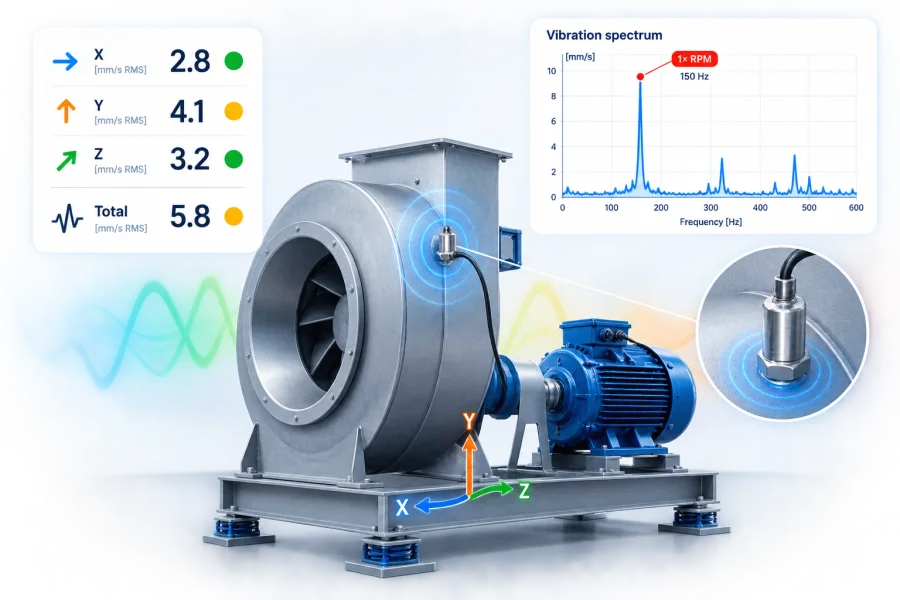
Not just PASS/FAIL — this tool helps find out why. AMCA 204-05 balance category, required balance grade, permissible unbalance and correction mass (AMCA 204 or ISO 21940), a Simple or per-point/per-axis vibration severity check, blade-pass and shaft-order frequency analysis, a reference vibration spectrum, a resonance and RPM-sweep (Campbell-style) chart, and a dominant-frequency diagnostic that suggests likely causes — unbalance, misalignment or aerodynamic excitation.
How to use this calculator
- Pick the fan application — it sets the AMCA balance/vibration category, editable.
- Enter the driver power and rotor mass/speed.
- Pick the mounting and test/in-situ condition.
- Enter a measured vibration velocity to check it against the permissible limit.
- Read the required balance quality grade, permissible residual unbalance and the pass/fail check.
How this calculator works
AMCA 204-05, "Balance Quality and Vibration Levels for Fans", sorts fans into five Balance/Vibration (BV) categories by application and driver power (Table 4.1), then gives each category a required balance quality grade (Table 5.1, based on ISO 1940/ ANSI S2.19) and vibration velocity limits for factory tests (Table 6.2) and for in-situ operation (Table 6.3).
Permissible residual unbalance (SI, per AMCA 204 Section 5.2):
e_per = 1000 · (G / ω)              (µm, ω = 2πN/60, N in rpm)
U_per = M · e_per                     (g·mm, M = rotor mass in kg)
The Balance/Vibration category also sets which vibration limit table applies — pick the mounting (rigid or flexible, per AMCA 204 Section 6.2: rigid means the support system's natural frequency is above running speed, flexible means below), the test condition, and enter a measured velocity to check it against the standard's limit.
The resonance chart is not from AMCA 204 — the standard only defines rigid/flexible qualitatively. The chart adds the quantitative picture: the classical single-degree-of-freedom forced-vibration amplification factor,
MF(r,ζ) = 1 / √[(1−r²)² + (2ζr)²] r = running speed / natural frequency
plotted for a few typical damping ratios (illustrative, not measured — real damping depends on the specific structure). It shows why AMCA 204's rigid/flexible line sits at r=1: that's resonance, where amplification is highest. It also marks r=√2, the classical vibration-isolation threshold — between r=1 and r=√2 a flexible mount actually amplifies vibration rather than isolating it, so isolators are normally designed for r well above √2.
This page checks one fan at a time. CloudAir's selection programs can surface performance and compliance data for every fan in your catalogue automatically. See how CloudAir handles it →