

Air density calculator
Enter temperature, altitude and relative humidity and get the actual air density — plus the correction ratio against the standard 1.204 kg/m³ most catalogues are rated at, ready to plug into the fan laws calculator.
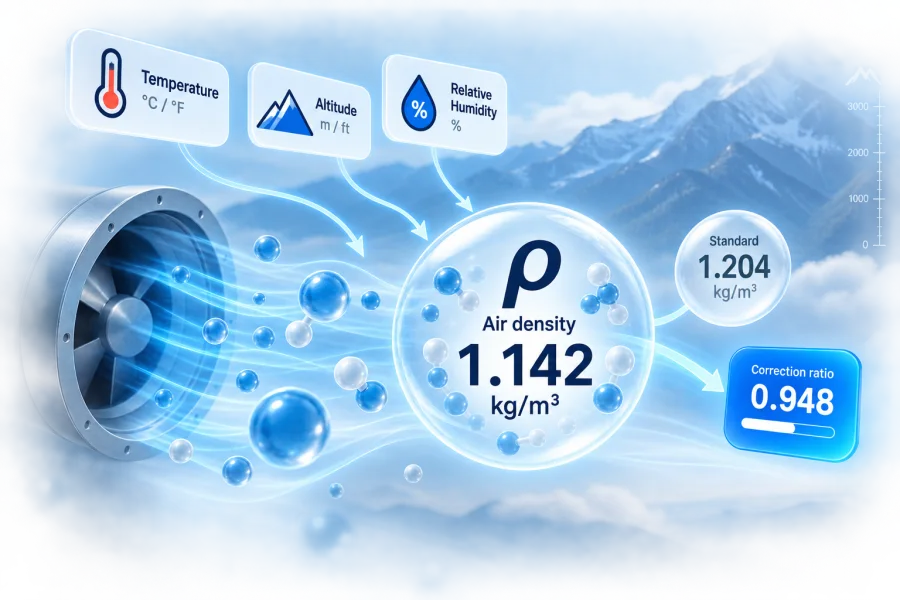
How to use this calculator
- Enter the air temperature.
- Enter the altitude, or override the sea-level pressure directly.
- Enter the relative humidity.
- Read the actual air density and its correction ratio against the standard 1.204 kg/m³.
How air density is calculated
Air density affects pressure and power in the fan laws — the same fan moving the same volume of air needs more pressure and power at sea level in winter than at altitude in summer. Getting it right starts with the atmospheric pressure at your actual altitude, using the barometric formula:
P(h) = P₀ · exp( −M·g·h / (R·(T+273.15)) )

P₀ = sea-level pressure, Pa      h = altitude, m
M = 0.0289644 kg/mol (molar mass of air)   g = 9.80665 m/s²
R = 8.314463 J/(mol·K)
Humid air is less dense than dry air at the same pressure and temperature, because water vapour molecules are lighter than the nitrogen and oxygen they displace. The saturation vapour pressure is estimated with the Arden Buck / Magnus formula, then combined with the dry-air partial pressure via the ideal gas law for each component:
Psat = 611.21 · exp( 17.502·T / (T+240.97) )      T in °C, Psat in Pa
Pv   = RH/100 · Psat
Pd   = P − Pv

ρ = Pd / (Rd·(T+273.15)) + Pv / (Rv·(T+273.15))

Rd = 287.05 J/(kg·K) — dry air     Rv = 461.495 J/(kg·K) — water vapour
The ratio this calculator reports is exactly the ρ₂/ρ₁ input the fan laws calculator needs — work out the density here, then carry it straight over to rescale pressure and power for the new site conditions.