

Mollier (h-x) diagram calculator
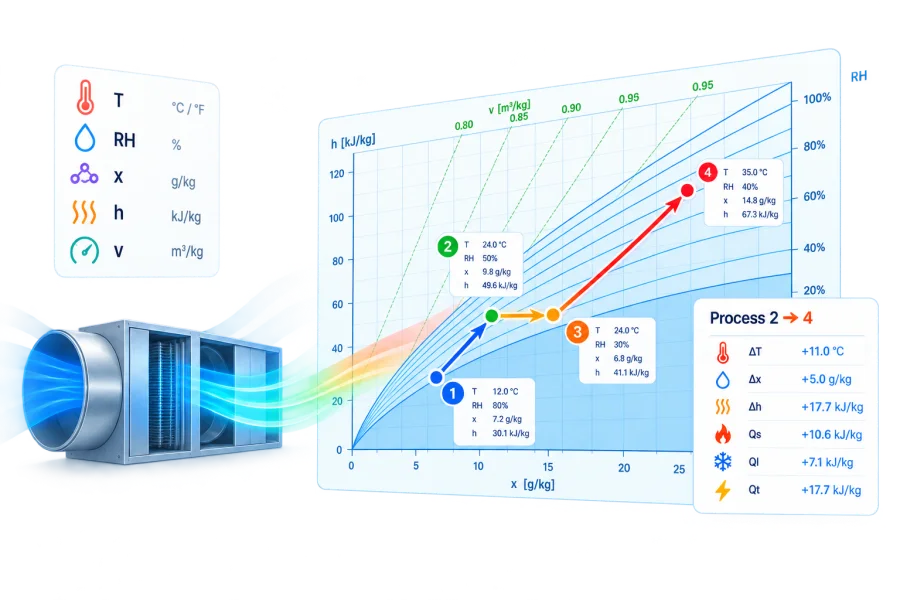
Add as many state points as your process needs — heating, cooling, humidification, mixing — and get the full psychrometric state at each one, the process between every consecutive pair (Δt, Δx, Δh, sensible/latent/total heat), and all of it plotted on a real Mollier h-x chart with RH% and specific-volume lines.
How to use this calculator
- Set the altitude, or override sea-level pressure directly.
- Add a state point: temperature and either relative humidity, wet-bulb, dew point or absolute humidity.
- Add as many further points as your process needs.
- Optional: add an airflow to a point to get process heat/moisture loads.
- Read each point's full psychrometric state and the process between consecutive points.
What the Mollier diagram shows
The Mollier h-x chart plots every state of humid air on two axes — enthalpy (h) and humidity ratio (x) — with dry-bulb temperature, relative humidity, wet-bulb temperature and dew point all readable as curves and lines across the same chart. It's the standard way to size cooling coils, humidifiers and mixing processes in central air handling units. This calculator gives you the same seven numbers a chart reading would, computed directly.
Humidity ratio and enthalpy
Psat(t) = 611.21 · exp( 17.502·t / (t+240.97) )      Arden Buck, Pa
Pv = RH/100 · Psat(t)

x = 0.622 · Pv / (P − Pv)               humidity ratio, kg water / kg dry air

h = 1.006·t + x·(2501 + 1.86·t)          enthalpy, kJ/kg dry air
x is the mass of water vapour carried per kilogram of dry air — the number that determines how much moisture a coil needs to remove, or a humidifier needs to add. Enthalpy is the total heat content of that moist air, dry air plus its water vapour, and is what actually sizes a cooling or heating coil.
Dew point and wet-bulb temperature
Dew point is the temperature at which the air's actual vapour pressure would equal the saturation pressure — the point condensation starts on a cold surface — found by inverting the Arden Buck equation. Wet-bulb temperature is solved from the ventilated-psychrometer equation (the Ferrel/WMO relationship used by a properly aspirated sling psychrometer), not a curve-fit approximation:
Pv = Psat(tw) − A·P·(t − tw) A = 0.000662 K⁻¹, solved for tw
The air density this page reports is the same value the fan laws calculator and air density calculator use for ρ₂/ρ₁ — humid air is measurably less dense than dry air at the same temperature and pressure.