
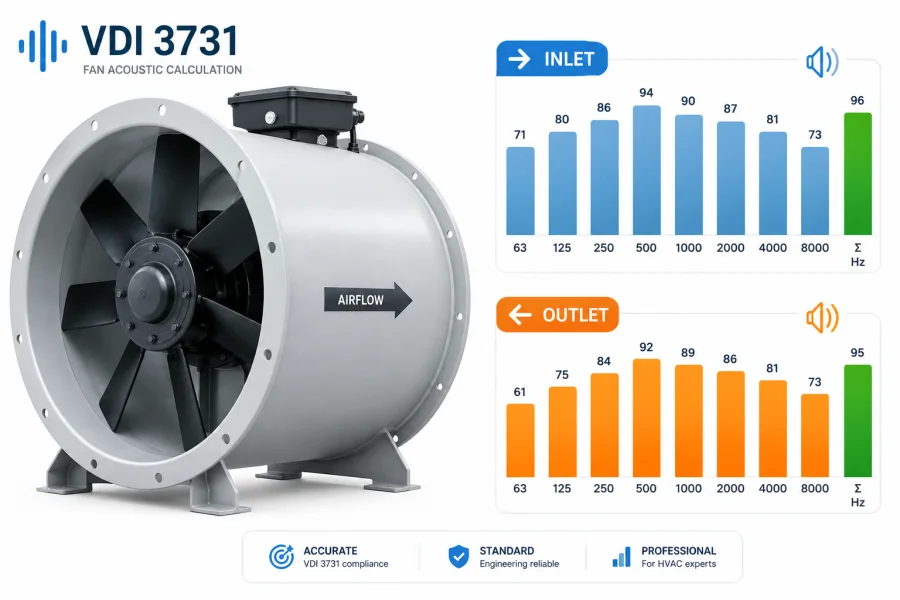
Fan noise calculator — sound power per VDI 3731
Enter the duty point and geometry of a fan and get its octave-band sound power spectrum, the overall A-weighted sound power at inlet and outlet, and the resulting sound pressure level at a given distance — using the VDI 3731 Strouhal-number spectrum method.
How to use this calculator
- Pick the fan construction type — it sets which VDI 3731 correlation applies.
- Enter the fan geometry: rotor and duct/hydraulic diameter, blade count, rotor speed.
- Enter the duty point: volume flow, total pressure and absorbed power.
- Set the medium temperature if it isn't standard air.
- For a sound pressure level, add the distance from the source and, if indoors, the room absorption area.
- Read the octave-band spectrum and the overall sound power/pressure results.
How this calculator works
VDI 3731 estimates a fan's sound power from its aerodynamic duty point rather than requiring a measured spectrum. A base sound power level is calculated from the rotor tip speed, the air power (volume flow × pressure) and the fan's total efficiency, using a reference level and a Mach-number exponent that depend on the fan construction type. That base level is then spread across the eight octave bands using a correction curve — also specific to the construction type — expressed as a function of the Strouhal number of each band.
LW BASE = LWS + 10·m·log₁₀(u/c) + 10·log₁₀(Q·Δp) + 10·log₁₀(1/η − 1)

u  = rotor tip speed, m/s        c = speed of sound at medium temperature
Q  = volume flow, m³/s            Δp = total pressure, Pa
η  = total efficiency (fraction)
Two more corrections are applied per octave band before the result is A-weighted: a +4 dB tone correction in whichever band lands closest to the blade-pass frequency (number of blades × rotor speed), and a distance/duct outlet attenuation that grows with frequency and duct diameter, giving a lower spectrum at the outlet than at the inlet.
Sound pressure at a distance
The optional distance panel converts the overall sound power level into a sound pressure level using the standard combination of a direct and a reverberant field:
Lp = LW + 10·log₁₀( Q/(4πr²) + 4/A )

Q = directivity factor (2 for a source against one reflecting surface)
r = distance from the fan, m       A = room absorption area, m² (0 = free field)