

Sound source summation calculator
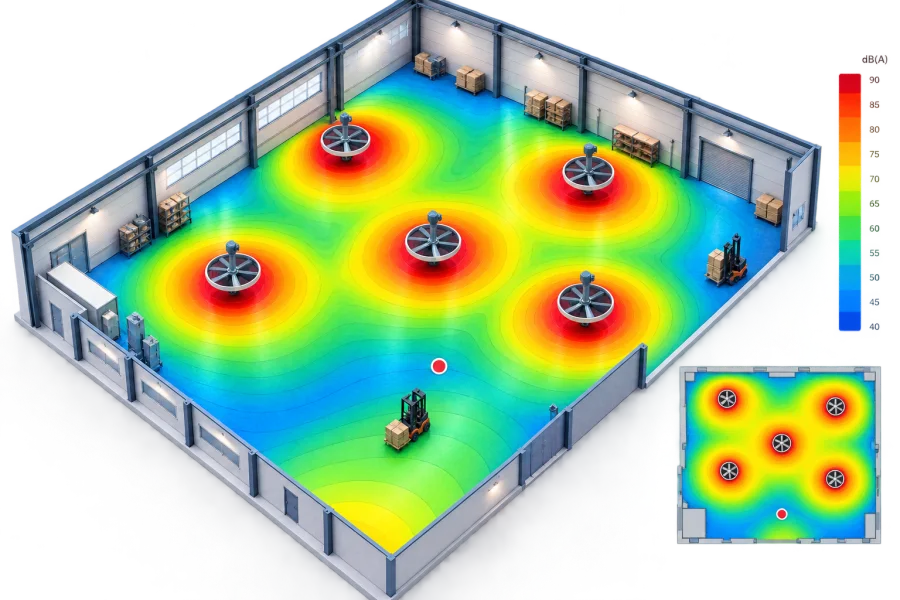
Add every noise source in a plant room or equipment yard — fans, AHUs, compressors — as a single dB(A) value or a full octave-band spectrum, then combine them into the total sound pressure level at one receiver point. Place sources on the room plan below and distance and directivity are worked out automatically from where you drop them.
Sound sources 2 sources
Room plan
Drag a source or the receiver onto the plan — distance and directivity (Q) update automatically in the table above.
Total sound pressure level at receiver
— dB(A)
- Dominant source
- —
Link copied — it reopens with these exact inputs.
How to use this calculator
- Enter the room dimensions if you want a sound pressure level, not just combined sound power.
- Add each noise source as a single dB(A) value or a full octave-band spectrum.
- Add as many sources as the plant room or yard has.
- Read the combined total sound power and, if room dimensions were given, the resulting sound pressure level.
How this calculator works
Each source's sound power level is converted to a sound pressure level at the receiver using the standard free-field radiation equation, then all sources are combined logarithmically — sound levels in decibels never simply add.
Lp = LW + 10·log₁₀( Q / (4πr²) )

Ltotal = 10·log₁₀( Σ 10^(Lp,i/10) )

Q = directivity factor          r = distance from the source, m
If a source's sound power is given as an octave-band spectrum, each band is A-weighted (IEC 61672-1) before the bands are summed logarithmically into that source's overall dB(A) contribution — the same approach used in the VDI 3731 acoustic calculator.
Directivity factor Q
Q accounts for reflecting surfaces near the source concentrating its radiated sound into a smaller solid angle. On the room plan, Q is set automatically from how close a source sits to the walls (a floor-mounted source always reflects off the floor, so the baseline is 2, not 1):
- Q = 2 — away from any wall (floor reflection only)
- Q = 4 — against one wall
- Q = 8 — in a corner, against two walls
- Q = 1 — true free field, no reflecting surface (manual entry only — an elevated or outdoor source away from any surface)
This page checks one receiver point with a simplified geometry model — it doesn't account for room absorption, reverberant build-up or barriers between source and receiver. CloudAir's selection programs run the same underlying acoustic engine across a full catalogue and generate the datasheet automatically for every product. See how CloudAir handles it →