
HVAC Selection API for manufacturers
Put your selection engine inside any external application.
An AHU manufacturer's software sends 12 000 m³/h and 650 Pa. Your catalog answers with the fans that can do it — each with its working point computed on its own measured curves: speed, shaft power, efficiency, FEI, acoustics. Not a product list — a fan selection API that runs the same calculation your own selection software does.
- operating point on the curve
- speed, frequency, regulation
- shaft power and efficiency
- FEI and ErP 2026
- octave-band sound
- performance curves
One fan selection API call, a finished selection
Airflow and pressure are the only parameters the API insists on. Everything else narrows the search or describes the conditions the fan will actually work in.
- Static or total pressure, with the outlet taken into account
- Density given directly, or computed from temperature, humidity and altitude
- Regulated automatically to the point, left on the rated curve, or set by hand
- Narrowed by motor type, regulation type, phase, series, category or ErP 2026
- Filtered on the computed point itself — minimum efficiency, maximum power, maximum sound
GET /v1/select_fan
  ?volume=12000&pressure=650
  &temperature=20&motor=EC
  &min.efficiencyStatic=60
  &max.Lwa=85&sort=efficiency

{
  "data": [
    {
      "product": { "id": 4812, … },
      "point": {
        "volume": 12040,
        "pressureStatic": 652,
        "power": 3180,
        "efficiencyStatic": 64.8,
        "speed": 1285,
        "Lwa": 83.1
      },
      "regulation": { … },
      "sound": { … }
    }
  ]
}
Everything the product card shows, as data
Each result is a fan plus the point it was computed at — the integrator does no engineering of their own.
The working point
Airflow, static and total pressure, shaft and input power, static and total efficiency, speed, frequency, current, FEI, SFP and energy use — every variable of the operation group, keyed exactly as in the dictionary.
The regulation that gets there
Type, mode, the control value and its unit — the inverter frequency, EC voltage or speed the fan has to run at to hit the point.
Sound in octave bands
Spectra at inlet, outlet and casing from the product's measured acoustics, or estimated by VDI 3731 from the fan's design and working point when it has none — flagged, never silently guessed.
Compliance and warnings
The stored ErP 2026 status, and warnings such as a motor overload or a point outside the measured part of the curve.
The product itself
Nominal variables and tags, the same shape the catalog endpoints return, so a result can be shown or stored without a second call.
Why the others fell out
Rejected candidates come back with their reason — the difference between "nothing in the catalog fits" and "the filters were too tight" is visible, not guessed.
Ranked the way an engineer would rank them
A score, not an accident
Results are scored on static efficiency, FEI and power, each scaled between the worst and the best candidate for that duty point — so the ranking reflects this selection, not a fixed table.
Or your own order
Sort by efficiency, power, sound, speed or FEI instead, when the application cares about one of them above the rest.
A fit you define
A fan qualifies when its computed airflow lands inside the tolerance around the required one — ±10% by default, tightened or widened per call.
Who integrates a product selection API
AHU manufacturers
The unit configurator computes the duty point of the section and asks the API which of your fans delivers it.
Configurators and webshops
A customer enters airflow and pressure on a partner's site and is offered your fans, with real numbers behind them.
In-house engineering tools
The spreadsheet or internal program your own engineers use stops being a separate source of truth.
Distributor systems
A quoting tool selects and prices from the same catalog your own selection software publishes.
The same fan selection engine your own catalog runs
The API does not re-implement the selection. It runs the engine your fan selection software runs, on the product records your PIM holds — regulation, density correction, shaft power, motor efficiency, FEI and sound, computed exactly as on the product card. Change a curve in the admin platform and both answers change together.
Each integrator selects only from what you let them see
The selection API is reached with the same key as the rest of the catalog, and carries the same scope: chosen categories, series and single products, up to an access level and in chosen languages. A fan outside the scope is never selected, never ranked and never mentioned.
Per-company keys
One key per integrator, with its own assortment, end date and daily limit.
Every call logged
When, result, endpoint, address and calling program — refusals included.
Never exposed
Prices and internal notes are not part of the API, whatever the scope says.
Try it before you write a line of code
Every parameter and the full response are documented, and each endpoint has a Try it panel that calls the live API. Without a key it answers from the CloudAir demo catalog, so an integrator can see the shape of a selection result before you issue them anything.
Open the Select fans documentation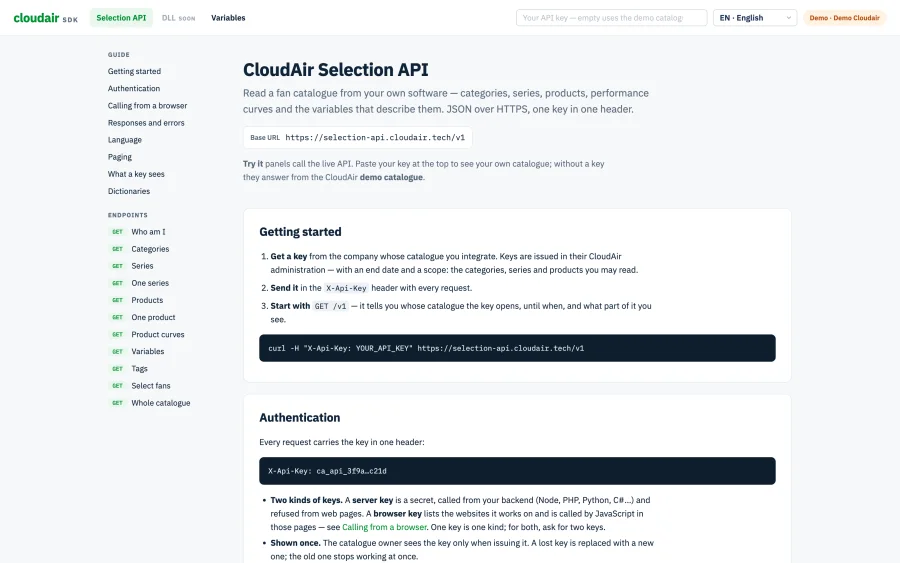
Common questions about the selection API
What does the selection API actually return?
For one duty point it returns the fans that can deliver it, ranked, and for each one the full working point computed on its own measured curves: airflow and pressures, shaft and input power, static and total efficiency, speed, frequency or control voltage, current, FEI, SFP, energy use, sound power and sound pressure. Not a product list — a calculation.
Is it the same calculation as your selection software?
Yes, the same engine on the same database. Regulation, density correction, shaft power, motor efficiency, FEI and sound are computed exactly as on the product card in your online catalog, so an integrator's result and your own catalog can never disagree.
How do we send the operating conditions?
Airflow and pressure are the only required parameters. On top of those you can send static or total pressure, air density — or temperature, humidity and altitude and let the API compute it — the regulation mode, motor and regulation type, phase, ErP 2026 compliance and the airflow tolerance you accept.
Can we restrict which fans an integrator may select from?
Yes. The API key carries its own scope — chosen categories, series and single products, up to an access level and in chosen languages. A fan outside that scope is never selected and never appears in the results.
What happens to the fans that did not fit?
They are reported. Every response carries a list of rejected candidates with the reason, so the integrator can tell the difference between "nothing in the catalog fits" and "the filters were too tight".
Do we get acoustics even for products without measurements?
Yes. Octave-band spectra at inlet, outlet and casing come from the product's measured acoustics; when a fan has no measurement, the spectrum is estimated by VDI 3731 from its design and working point and flagged as estimated — the same rule the selection software follows.
Where is the technical documentation?
At sdk.cloudair.tech — every parameter, the full response and a Try it panel that calls the live API against a demo catalog without a key.
Pricing scoped to how your catalog is used
How many integrators, how much of the range each one selects from, and how heavily they call it — tell us who needs to select your fans from their own software and we will put together a concrete quote.
Get a Quote
Let's talk about your integration
No sales deck, no pressure — just a 20-minute meeting to see what it would take to put your selection engine inside someone else's software.