

One product database. Every channel fed from it.
Stop maintaining specs in a spreadsheet, images on a shared drive and a PDF catalog that's always one revision behind. Enter your product data once — CloudAir's PIM feeds your online catalog, PDF datasheets, selection API, DLL and website from the same structured source.
What is Product Information Management (PIM)?
Product Information Management (PIM) is a system for centralizing, structuring and distributing product data — technical specifications, images, documents, pricing and translations — from a single database to every sales and marketing channel: a website, an online catalog, PDF datasheets, a partner API or a distributor's own software.
For a manufacturer, that means the specification sheet, the product page on your website, the PDF datasheet a customer downloads and the data a distributor pulls through an API all come from the same record — instead of four separate files that drift out of sync the moment one of them is updated.
Every manufacturer already has product data. Few have it in one place.
Specs live in Excel, images sit in a shared drive, the PDF catalog is a designer's InDesign file, and the website is updated separately by whoever remembers to. CloudAir's PIM replaces that with a single structured database — categories, series, models, technical parameters, files and translations — that every customer-facing output is generated from.
Update a spec once in the database, and your catalog, datasheets, API responses and website all update with it — no chasing four separate files.
From raw product data to every channel, in four steps
Your product data comes in
Bulk import from your existing files, entered one by one for messy or mixed sources, or added directly by your team through the admin platform.
It's structured into the database
Categories, series and models with full technical parameters — mapped once, consistent across your entire range.
Files, media and translations attach to it
Images, CAD files, certificates and language versions live next to the exact product they belong to.
Every channel reads from the same source
Catalog, PDF datasheets, selection API, DLL and website — all generated from one record, always in sync.
Everything a manufacturer's product data needs
Bulk product import
Send your existing product files and we import the full technical data, specs and dimensions in bulk.
Individual & self-service entry
Messy or mixed sources are entered by hand and checked; from there, add or edit any product yourself through the admin platform.
Category & series structure
Your full product hierarchy — categories, series and models — mapped into the database before you touch a thing.
Central file library
Documentation, CAD files, certificates and approvals attached directly to the exact products they belong to.
Multi-language content
Add interface and product-content languages one at a time, each fully translated including technical labels and units.
Automatic catalog generation
Full series datasheets — tables, technical data and performance curves — generated straight from the database.
REST API & DLL distribution
A JSON/XML API and a custom DLL expose your product data to distributors' and integrators' own systems directly.
Full admin platform
Bulk editing, copy/paste records and process automation for teams managing thousands of products, not dozens.
Roles & access levels
Add admins, editors and analysts with their own permissions, so the right people can edit without full admin rights.
Full change history
Every edit any administrator makes is logged, with one-click rollback if something needs undoing.
Quick search
A fast search across products, documentation, series and graphics — find a model or datasheet by name or article number instantly.
Usage analytics
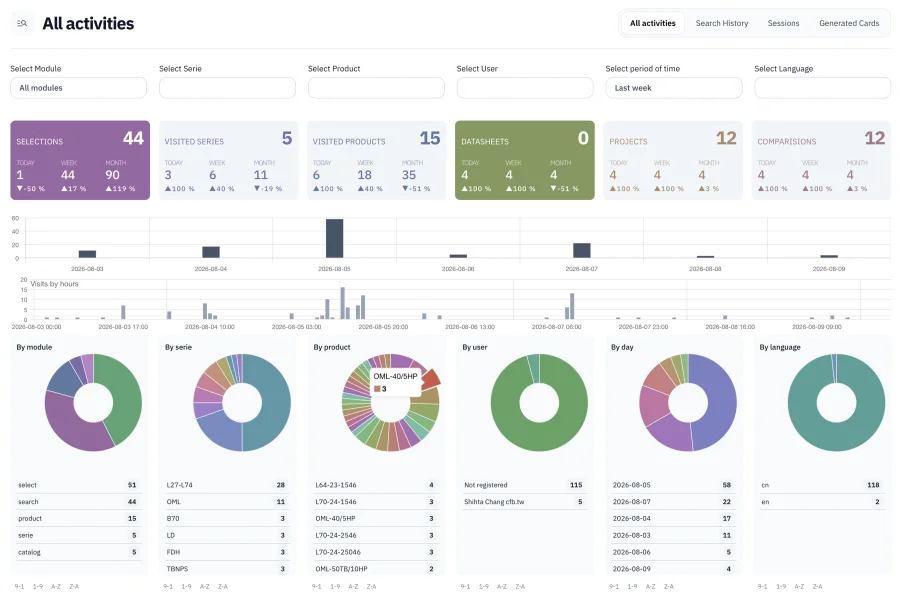
See page views, completed selections and generated datasheets per product — real demand data, not guesswork.
One admin system, your whole product range
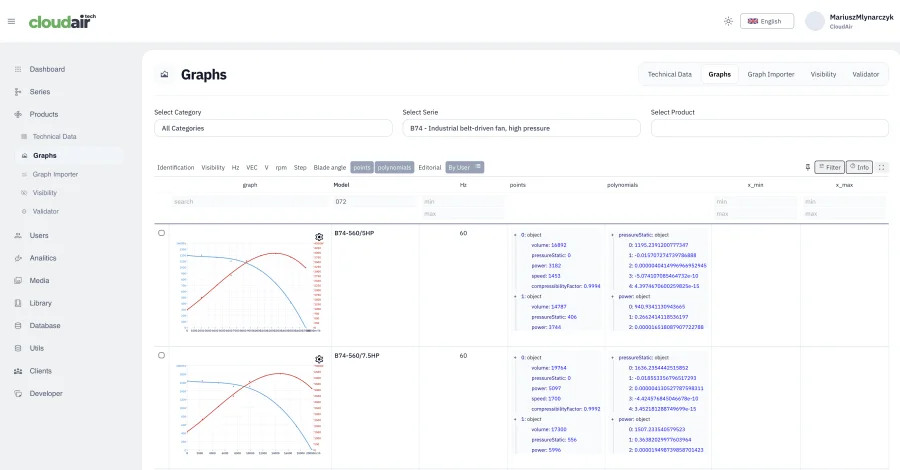
Every product record — specs, files, translations, pricing — is managed from a single admin platform. No separate CMS, no developer required to publish a new model or fix a typo in a datasheet.
- Add and edit products, series and technical data directly
- Bulk-edit thousands of records without touching each one by hand
- Draft, review and publish changes before they go live
- Roll back any change, any time, from the full edit history
Enter it once, publish it everywhere
The database is the single source of truth — every customer-facing output is generated from it, so nothing ever drifts out of sync.
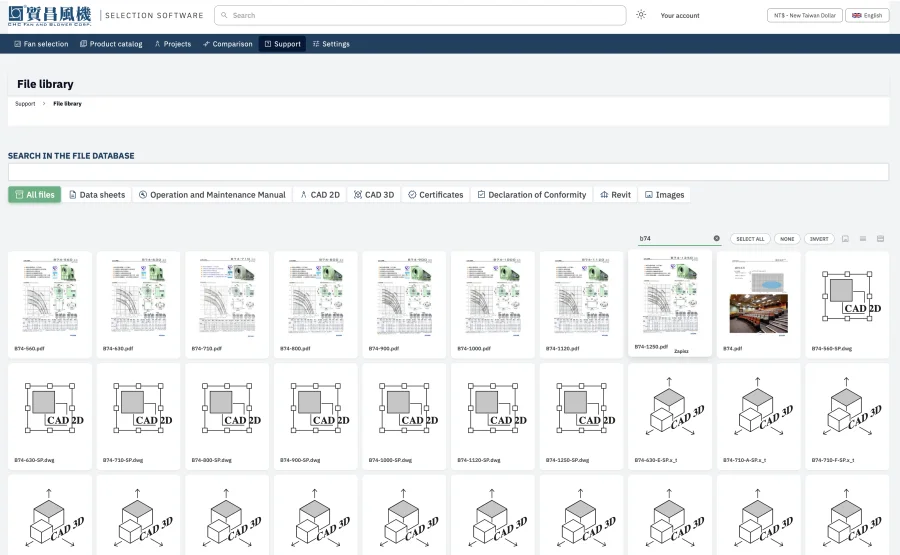
Every file, attached to the product it belongs to
CAD files, certificates, manuals and images live next to the exact product they describe — searchable, versioned, and never sent out of date by accident.
- Full-text search across every document
- Attached directly to the relevant product or series
- Version history so an old datasheet never goes out by mistake
Product content in every market you ship to
Full translation of interface and product content, including right-to-left layouts for Arabic and other RTL languages — added one language at a time as you expand.
Your product data, protected and always recoverable
Encrypted connections
All traffic served over HTTPS by default.
Daily backups
Synced to an external server, so a single point of failure never means lost product data.
Role-based access
Control exactly who on your team can edit what.
Monitored uptime
Infrastructure monitored continuously, with fast response to issues.
Why manufacturers trust us with their product data
Built for technical products, not generic SKUs
Performance curves, engineering parameters and compliance data — not just name, price and photo.
Live in weeks, not years
A structured database built from your existing technical data, fast.
You own the data, we run the platform
No lock-in on your product data — export it any time.
The same database powers selection, too
Your PIM and your fan selection engine run on one platform, one login.
Ongoing support, not a handoff
We keep building modules and fixing edge cases as your catalog grows.
Direct access to the person building it
You talk to the Managing Director, not a support queue.
From scattered files to a live product database
Discovery call
We learn how your product data is currently scattered, and what "structured" should look like for you.
Scoped proposal
A concrete module list and quote — no generic package.
Data migration
Your existing specs, files and images are structured into the database.
Channel setup
Catalog, datasheets, API and DLL configured to publish from the same records.
Review & testing
You verify product data against your own records before anything goes live.
Launch & ongoing support
Live for your customers, with continued module development after launch.
Common questions about CloudAir's PIM
What is Product Information Management (PIM) software?
PIM software is a system that stores a manufacturer's product data — specifications, images, documents, pricing and translations — in one structured database, then distributes it to every channel that needs it: a website, an online catalog, PDF datasheets, a REST API or a distributor's software.
How is CloudAir's PIM different from a generic PIM tool?
Generic PIM platforms are built for retail SKUs — name, price, photo. CloudAir's PIM is built for technical products: performance curves, engineering parameters, compliance data and CAD files, structured the way a fan or HVAC manufacturer's catalog actually works.
Can the PIM feed our existing website and catalog?
Yes. The database is the single source of truth, and your online catalog, PDF datasheets, REST API and DLL all publish from the same product records, so nothing drifts out of sync when a spec changes.
Do you migrate our existing product data into the system?
Yes. Bulk files are imported directly; messy or mixed sources are entered by hand and checked one by one. Either way, your full category and series structure is mapped into the database before you touch anything.
Does the PIM connect to fan or product selection software?
Yes. CloudAir's PIM and its fan/product selection engine run on the same platform and the same database, so selection results always reflect the current product data.
How long does implementation take?
Most catalogs go live within weeks, not years, once your existing technical data is migrated — the exact timeline depends on catalog size and how many channels it needs to feed.
Pricing scoped to your product range
Every catalog is different — pricing depends on product count, modules and how many channels you need it to feed. Tell us about your range and we'll put together a concrete quote.
Get a Quote
Let's talk about your product data
No sales deck, no pressure — just a 20-minute meeting to see what a structured product database could look like for your catalog.