
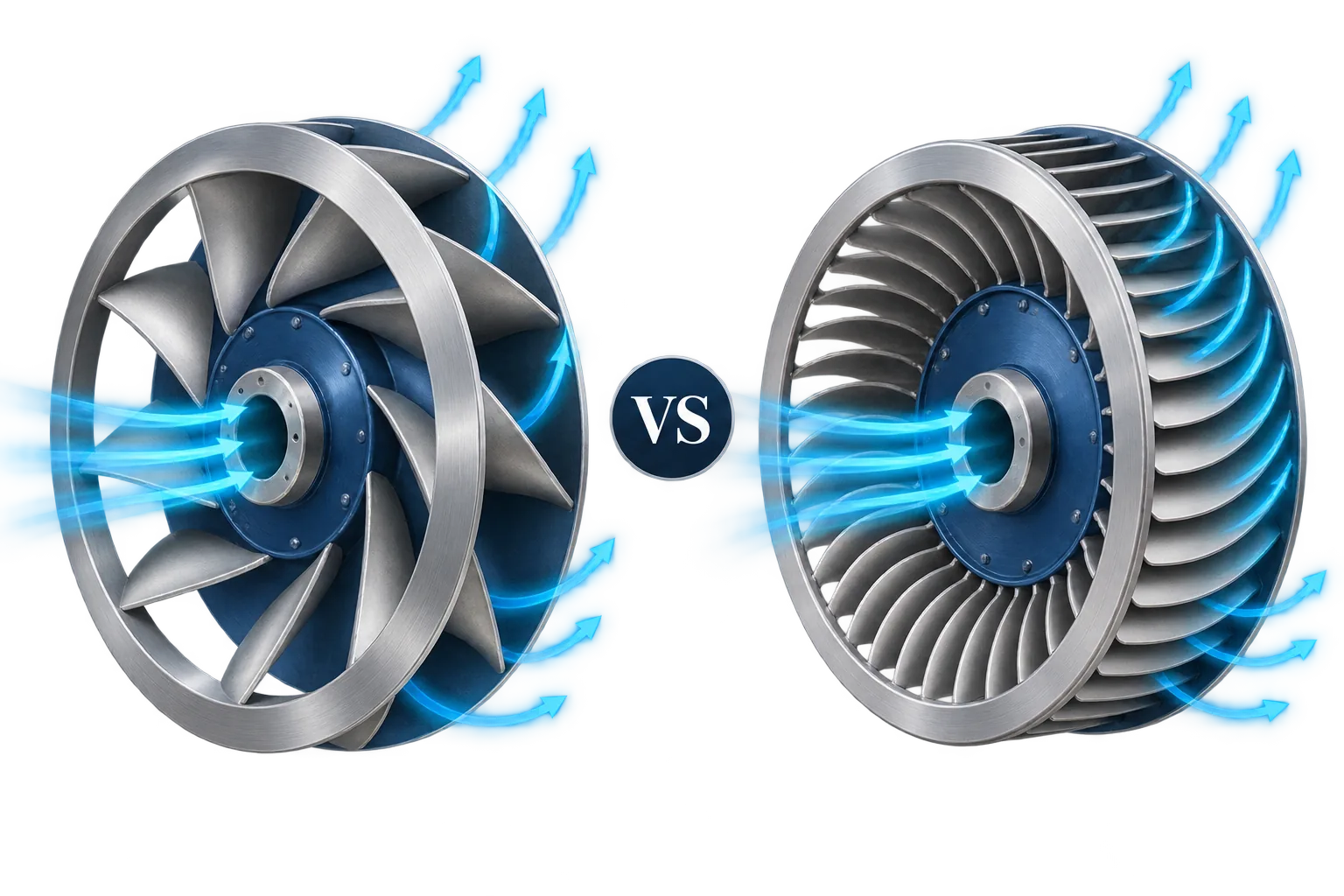
Open two AHU spec sheets with the same duty point — same airflow, same static pressure — and you can end up with two completely different fans inside them: one with a compact wheel full of shallow, forward-tilted blades, the other with a larger wheel carrying fewer, deeper blades curved the other way. Both move the required air. Only one of them is usually the right choice once you look past the duty point at efficiency, power behaviour and how the fan ages in service.
The difference comes down to which way the blades curve relative to the direction of rotation — forward-curved or backward-curved — and that one geometric choice drives almost everything else that follows: efficiency, noise, motor sizing risk, and how well the fan tolerates a dirty airstream.
Forward-curved: many shallow blades, moving with rotation
A forward-curved wheel — the "squirrel-cage" design, from its resemblance to an exercise wheel — packs many shallow blades around a relatively small-diameter wheel, each tilted in the same direction the wheel spins. That geometry lets the fan reach a given airflow at a smaller wheel diameter and lower tip speed than a backward-curved design, which is exactly why it dominates compact, low-pressure equipment: fan coil units, small package AHUs, residential range hoods, air curtains — anywhere the airflow requirement is modest, the available pressure is low, and cabinet space is tight.
The trade-off is aerodynamic. Forward-curved wheels typically peak at 55–70% total efficiency, well below what a good backward-curved wheel achieves, and — the detail that actually causes field problems — their power curve keeps climbing as the operating point moves toward free delivery (lower system resistance than designed). If the actual installed ductwork ends up less restrictive than assumed at selection time, a forward-curved fan can pull the motor into overload. It's also the more dirt-sensitive geometry: narrow blade spacing on a shallow curve loads up with particulate faster than a backward-curved wheel's wider passages, which is why you essentially never see forward-curved wheels in dust collection or process exhaust duty.
Backward-curved: fewer, deeper blades, moving against rotation
A backward-curved (or backward-inclined) wheel uses fewer, larger blades curved opposite to rotation. It needs a larger wheel diameter and higher tip speed to hit the same duty point, but converts input power to airflow more effectively — well-designed backward-curved and airfoil wheels routinely reach 78–85%+ total efficiency. The blade passages are wider and less prone to fouling, which is the practical reason this geometry dominates AHUs, industrial ventilation, dust collection and process air handling.
The characteristic that matters most for reliability, though, is the power curve shape: backward-curved wheels are non-overloading — absorbed power rises to a peak somewhere near the design operating point and then falls as flow increases toward free delivery, instead of continuing to climb. That means a backward-curved fan is inherently more forgiving of a system that ends up with less resistance than the design assumed (a common real-world outcome once ductwork is actually built) — the motor doesn't get pushed further into overload the way a forward-curved fan's would.
Reading the curves side by side
Side-by-side comparison
| Forward-curved | Backward-curved | |
|---|---|---|
| Typical peak efficiency | 55–70% | 78–85%+ |
| Wheel diameter for a given duty | Smaller | Larger |
| Power curve toward free delivery | Rises — overload risk | Falls — non-overloading |
| Static pressure capability | Low to medium | Medium to high |
| Dirt / particulate tolerance | Poor — narrow passages | Good — wider passages |
| Typical duty | Fan coils, small AHUs, air curtains | AHUs, industrial ventilation, dust collection, process air |
What this costs over the life of the fan
Efficiency differences that look small on a datasheet compound fast at continuous run hours. Take a modest AHU supply duty — 8,500 m³/h at 800 Pa static — and compare a forward-curved wheel at 65% total efficiency against a backward-curved wheel at 82%, running 6,000 hours a year (a typical commercial building schedule):
Air power = Q × Δp = (8,500/3,600 m³/s) × 800 Pa ≈ 1.89 kW
Forward-curved shaft power = 1.89 / 0.65 ≈ 2.91 kW
Backward-curved shaft power = 1.89 / 0.82 ≈ 2.30 kW
That's a 0.61 kW difference at the same duty point — ≈3,660 kWh/year at 6,000 running hours. At a typical commercial electricity rate, that's a meaningful annual number before you've even accounted for the demand charge or carbon cost of the extra draw, and it repeats every year the fan runs. Run your own duty point through the fan power calculator to get shaft and electrical input power for both options, and check the CO2e side of the comparison with the electricity carbon footprint calculator using your local grid factor. Over a 15-year service life, that gap alone often exceeds the entire price premium of the more efficient wheel — the "cheaper" fan is frequently the more expensive one once it's actually running.
Noise: it's the operating point, not just the blade type
Blade geometry affects noise mainly through the speed needed to hit a given duty. In low-pressure work, forward-curved fans often run quieter simply because they reach the required airflow at a lower tip speed. In higher-pressure systems, a well-selected backward-curved fan can end up quieter overall, because it reaches the same duty at a better efficiency and doesn't need to be pushed as hard. Either way, sound power is driven far more by where the fan sits on its curve — and by tip speed specifically — than by curvature alone; check actual sound power at your real duty point with the fan acoustics calculator (VDI 3731) rather than assuming one geometry is inherently quiet.
Where each one belongs
| Forward-curved | Backward-curved |
|---|---|
| Fan coil units | Air handling units |
| Residential ventilation | Industrial ventilation |
| Air curtains | Dust and fume collection |
| Compact package AHUs | Smoke extraction |
| Tight cabinet space, low pressure | Cleanrooms, process air, heat recovery units |
Common selection mistakes
- Selecting on airflow alone, without checking where that point falls on the pressure curve — including the low-flow dip some forward-curved wheels show
- Assuming the installed system resistance will match the design calculation exactly — a forward-curved fan punishes an over-optimistic (too-low) resistance estimate with an overloaded motor; a backward-curved fan doesn't
- Specifying forward-curved for dusty or particulate-laden air because it was cheaper, then fighting fouling for the fan's whole service life
- Comparing purchase price only, without running the lifecycle energy calculation above
- Oversizing "for margin" on a forward-curved fan, which just moves the operating point further toward the overload region instead of away from it
Conclusion
Forward-curved and backward-curved impellers aren't a better-vs-worse pair — they're suited to different jobs. Forward-curved earns its place in compact, low-pressure equipment where upfront cost and cabinet size are the binding constraints. Backward-curved is the default for anything running long hours, at real static pressure, in air that isn't perfectly clean — which describes most industrial and commercial HVAC duty. Check the actual numbers for your duty point rather than defaulting on habit: model the impeller and duty point with the centrifugal fan designer, confirm the resulting operating point with the fan operating point calculator, and the efficiency difference between the two geometries stops being an abstraction and becomes a number you can put in front of a customer.
This is also exactly the comparison a proper selection program automates across your whole catalog — matching duty points to the right impeller family automatically instead of relying on habit or whichever curve is on top of the pile. If that's the kind of tool you're specifying fans without, see what CloudAir's fan selection software does.