

Most HVAC systems don't waste energy because of one dramatic failure — they waste it through a handful of small, individually-forgivable design decisions that compound. None of the ten below is exotic. Every one of them shows up repeatedly in real installations, and every one has a straightforward fix at the design stage.
1. Oversized fans and the wrong operating point
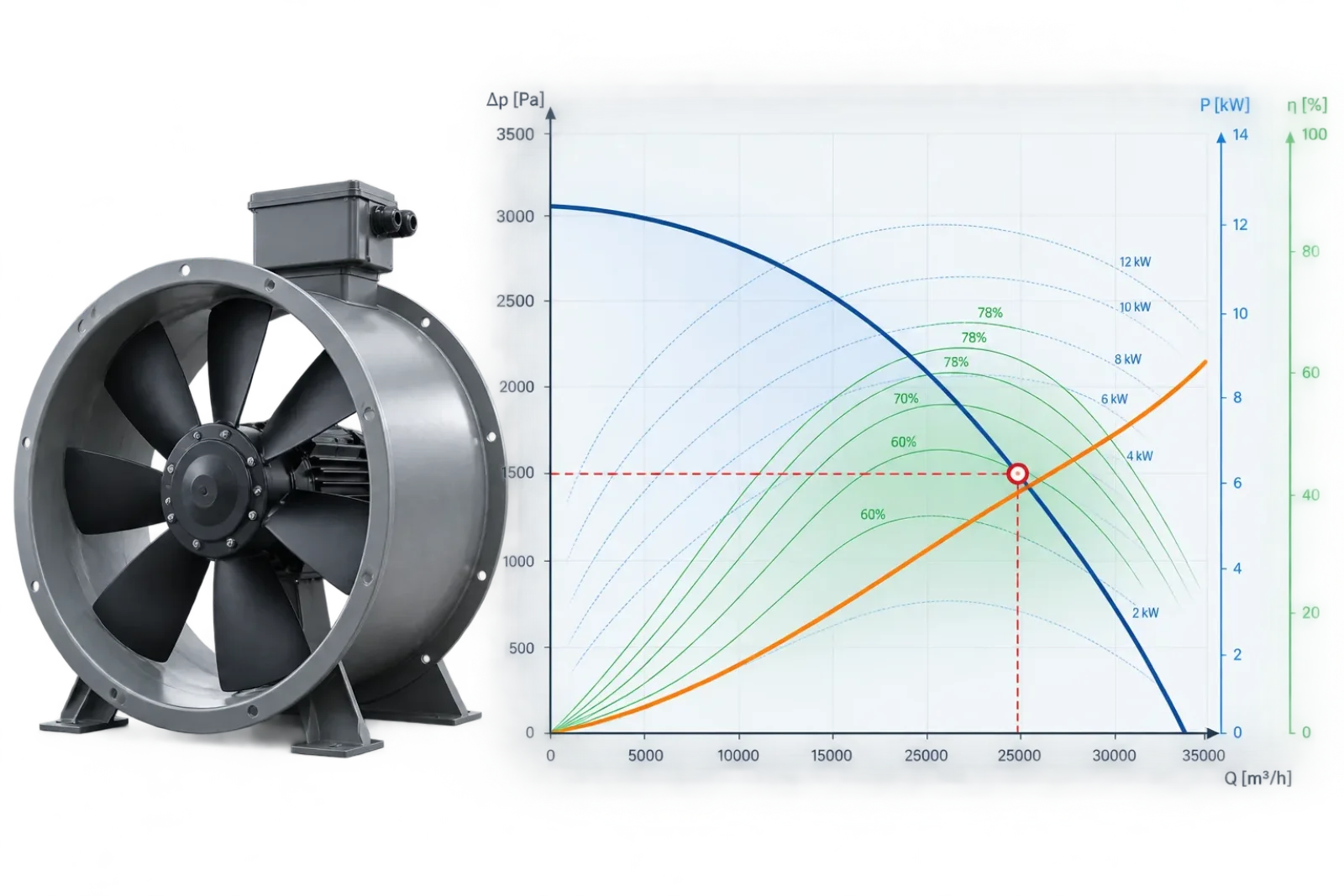
A fan doesn't run at its rated point by default — it runs wherever its own curve intersects the system's actual resistance curve. Select a fan that's comfortably larger than the job needs "to be safe," and the real operating point usually sits off to the side of the fan's best-efficiency region, delivering more airflow than needed at worse efficiency than the datasheet's headline number suggests. Right-sizing against the real system curve, not a padded one, is one of the highest-leverage decisions in HVAC system design. Check it directly with the Fan Operating Point calculator.
2. Undersized ducts and excess velocity
Smaller ducts cost less material and take up less space — and cost more forever after, because pressure loss rises with roughly the square of velocity. A duct sized 20-30% too small isn't a 20-30% pressure-loss penalty, it's closer to 50-70%, paid every single hour the fan runs. See the numbers side by side in How to Calculate HVAC Duct Size and size it properly here.
3. High pressure losses left unaudited
Friction is only part of a system's resistance — fittings, transitions, dampers and terminal devices (K-factor losses) frequently add up to more than the straight-duct friction itself, and they're the term most often under-counted at the design stage. How to Reduce Pressure Loss in HVAC Ductwork breaks down a real component-by-component example.
4. System Effect ignored at the fan connection
An elbow, damper or obstruction close-coupled to a fan's inlet or outlet imposes a real, AMCA 201-documented pressure penalty that a standard duct takeoff never captures — because it isn't a duct fitting loss, it's a fan-specific penalty for disturbed approach flow. It's frequently the single largest unaccounted term behind a fan that "should" deliver its rated airflow and doesn't. Full mechanism in Why Is My Fan Not Delivering the Expected Airflow?.
5. No VFD — throttling instead of speed control
A damper held partly closed to cut airflow wastes exactly the energy the fan spent producing the pressure the damper then destroys. Because fan power scales with roughly the cube of speed, slowing the fan down to reduce airflow costs far less than throttling it — a fan at 80% speed draws about half the power of one at 100% speed and dampered back to the same flow. A VFD can provide substantial energy savings compared with throttling when airflow demand varies.
6. Dirty filters treated as someone else's problem
A filter's rated pressure drop is a clean-condition figure. Loaded resistance climbs steadily through its service life, quietly pushing the whole system's operating point in the same direction as an undersized duct would — less delivered airflow, more fan power for what is delivered. It's a maintenance issue with a design-stage fix: size the system with a realistic average filter condition in mind, not the clean-filter number alone.
7. Duct leakage
Leaking joints between the fan and the terminal devices don't reduce what the fan moves — they reduce what actually reaches the space, which is what commissioning measures. The US Department of Energy's own guidance is a useful gut-check on scale: roughly 5% extra airflow the fan has to produce to compensate for leakage translates to roughly 16% more fan power, a direct consequence of the fan cube law (1.05³ ≈ 1.16). Small leakage percentages are not small power percentages.
8. Wrong motor selection
An oversized motor spends its life at low partial load, exactly where induction motor efficiency and power factor are weakest — a decision made once at design time that quietly costs money for the system's entire service life. The mechanics of getting this right — sizing margin, IE efficiency classes, AC vs EC, direct vs belt drive — are covered in How to Choose the Right Motor for a Fan.
9. No heat recovery
Exhausting conditioned air straight outside while simultaneously heating or cooling incoming fresh air is one of the largest and most fixable energy losses in a ventilation system — a heat recovery unit recovers a substantial share of that energy for a one-time equipment and pressure-drop cost. Worth checking with the Heat Recovery calculator on any system running significant outdoor air.
10. Wrong ACH assumptions and no annual cost check
Two design-stage habits that don't show up as a single dramatic failure but shape everything else: applying a generic air-change-rate guideline without checking whether it actually fits the room's real occupancy or process load (see What Is a Good Air Change Rate for Different Types of Rooms?), and never running an annual energy cost estimate at the design stage at all. Without that number, every other decision on this list — fan size, duct size, motor class, VFD or not — gets made on capital cost alone.
Why cheap to install isn't cheap to run
Take one 50 m duct run carrying 5,000 m³/h: sized at 400 mm it runs at roughly 11 m/s and costs less sheet metal, but the extra friction alone costs enough fan power that the difference in electricity bill overtakes the material saving in a little over two years:
This is one contributing factor among the ten above, in isolation — real installations stack several of these mistakes at once, and the running-cost gap compounds accordingly.
Frequently asked questions
What is the most common HVAC design mistake that wastes energy?
One of the most common mistakes is oversizing equipment and designing the system with excessive safety margins. Oversized fans, motors and ducts operated away from their intended design conditions can increase energy consumption and reduce overall system efficiency.
How can HVAC energy consumption be reduced during the design stage?
Start by accurately determining the required airflow and pressure, sizing ducts for reasonable velocities, selecting fans close to their best-efficiency region and minimizing unnecessary pressure losses. Variable-speed control, efficient motors and heat recovery should also be evaluated before the system is built.
Does oversizing a fan increase energy consumption?
It can. An oversized fan may operate away from its best-efficiency region and produce more airflow or pressure than the system actually requires. If excess airflow is then controlled by dampers, a significant amount of fan energy can be wasted.
Why does reducing fan speed save so much energy?
According to the fan affinity laws, airflow is approximately proportional to speed, pressure to the square of speed and power to the cube of speed. As a result, reducing fan speed by 20% can theoretically reduce fan power to about 51% of the original value, assuming comparable system conditions.
Can larger HVAC ducts reduce operating costs?
Yes. Increasing duct size reduces air velocity and typically lowers friction losses. This reduces the pressure the fan must generate and therefore its power consumption. The optimum duct size is a balance between higher initial material cost and lower lifetime energy cost.
How much energy can poor HVAC design waste?
There is no single percentage that applies to every system because the result depends on airflow, pressure losses, equipment efficiency, controls and operating hours. However, relatively small design errors can have disproportionately large effects. For example, requiring a fan to deliver 5% additional airflow can theoretically increase fan power by approximately 16% under fan-law conditions.
Why should HVAC systems be evaluated by lifecycle cost instead of purchase price?
HVAC equipment can operate thousands of hours every year for many years. A design that saves money on smaller ducts, cheaper motors or simpler controls may therefore cost considerably more over its lifetime through increased electricity consumption. Comparing initial cost with annual energy cost provides a better basis for design decisions.
Check your own system
CloudAir's calculators cover every item on this list: Fan Operating Point, Duct Sizing, Duct Pressure Drop, System Effect, Motor Efficiency, Heat Recovery and Air Changes. Free, no sign-up.