

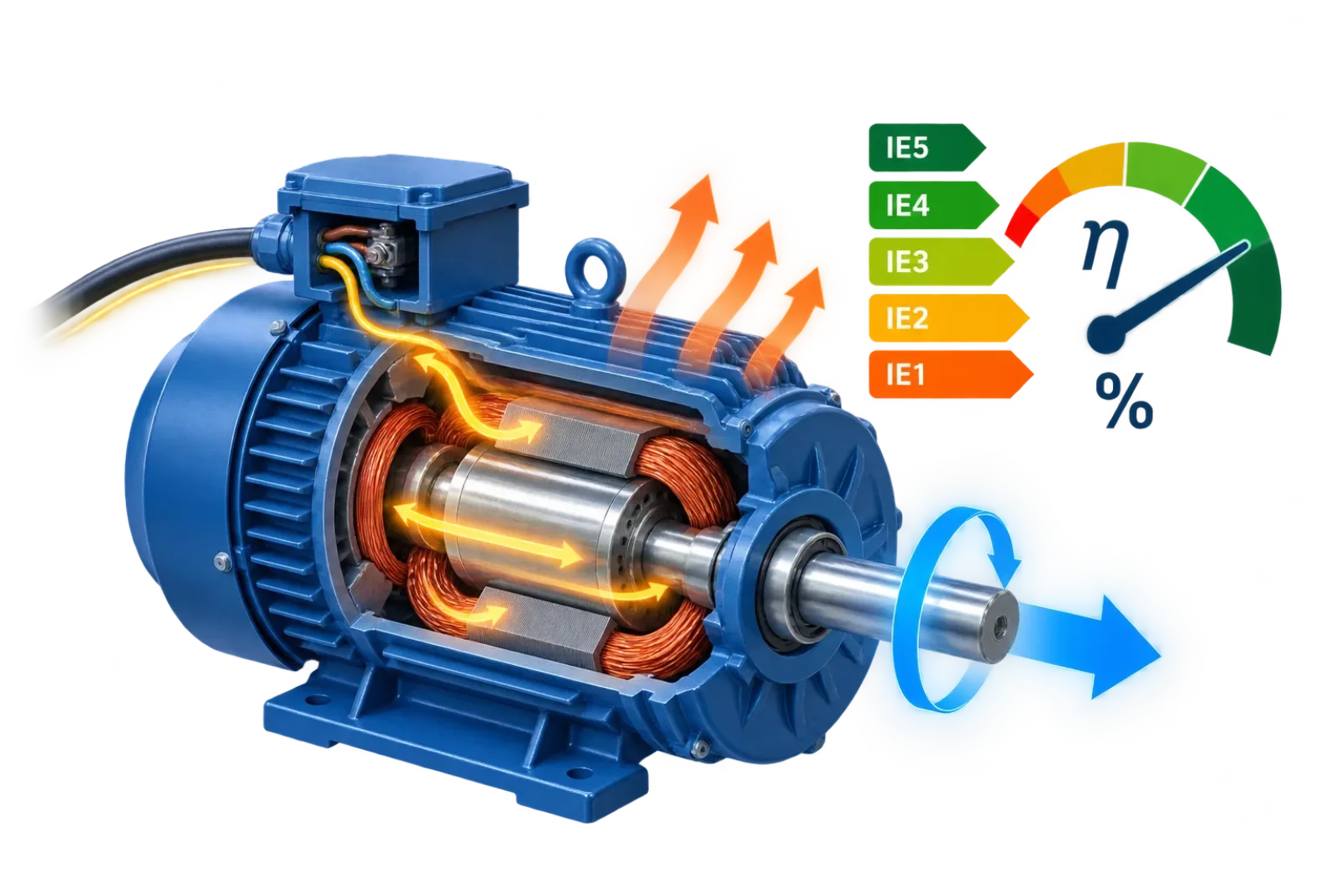
The fan curve gets all the attention during selection, and the motor gets whatever's "next size up." That's backwards often enough to be worth fixing: the motor decides how efficiently the fan's power gets delivered, how the system starts, how it survives an overload, and a meaningful share of the running cost for the system's entire life. Here's what actually matters when choosing one.
Shaft power vs motor power — they're not the same number
Shaft power is what the fan itself needs at its duty point — pure aerodynamic work, taken straight off the fan curve. Motor power (the nameplate rating) has to cover that shaft power plus drive losses (a belt drive typically costs 2-5% here; direct drive costs nothing) plus a safety margin.
That margin matters more than it looks. Too small, and normal day-to-day variation — a slightly dirtier filter, a damper nudged more open, a site that runs a bit denser air than the design condition — pushes the motor into continuous overload. Too large, and the motor spends its life at low partial load, which is exactly the region where efficiency (and power factor) is worst — see the chart below. A common, reasonable rule of thumb is sizing the motor for roughly 110-115% of the calculated shaft power at the duty point, not simply jumping to the next catalogue frame size, which can easily mean 30-50% headroom for no good reason.
IE2, IE3, IE4, IE5 — what the letters mean
IE (International Efficiency) classes, defined by IEC 60034-30-1, rank induction motors purely by how much of the electrical input actually reaches the shaft as mechanical power — IE1 is the oldest, least efficient class still seen in service; IE5 is the newest and most efficient. In most of the world today IE3 is the practical minimum for motors sold new in the mainstream power range, with IE4 and IE5 increasingly required at the top end or chosen voluntarily for their running-cost advantage. The efficiency gap between classes is a few percentage points at the nameplate's 100%-load rating — small-sounding, but it applies to every kWh the motor draws for its entire service life, which for a continuously-running fan motor is a lot of kWh.
AC induction motor vs EC motor
A conventional AC induction motor runs at a fixed speed set by supply frequency and pole count, unless paired with a separate VFD to vary that speed. An EC motor (electronically commutated — brushless DC, permanent-magnet, with the drive electronics built into or directly onto the motor) is speed-controllable by design and typically reaches its best efficiency at partial load rather than only at 100%, which suits fan duty especially well, since fans very often run below full speed. EC motors cost more upfront and are usually only available in smaller power ranges; AC induction plus a separate VFD scales to any size and lets the drive be replaced independently of the motor. Our EC vs AC motor payback calculator works out which one actually pays back faster for a specific duty cycle and running hours.
Direct drive vs belt drive
Direct drive couples the motor shaft straight to the impeller — no slip, no belt maintenance, no belt-related efficiency loss, but the fan speed is locked to whatever the motor's pole count and (if fitted) VFD frequency give you. Belt drive, through a sheave ratio, lets one motor/fan combination be re-tuned to a different duty point just by swapping pulleys — useful where the exact required RPM isn't known until commissioning, or where standardizing on one motor across several fan sizes matters. The tradeoff is a small but real efficiency loss, belt tension maintenance, and one more thing that can fail. Use our belt drive calculator to check sheave ratio, belt speed and tension for a specific combination.
Poles, RPM, and why they're linked
An AC induction motor's synchronous speed is fixed by its pole count and supply frequency: n = 120 × f / p (f in Hz, p = number of poles). At 50 Hz that gives roughly 3000 rpm for a 2-pole motor, 1500 rpm for 4-pole, 1000 rpm for 6-pole, and 750 rpm for 8-pole — actual running speed is a few percent below that figure due to slip. Fewer poles means a smaller, cheaper, lighter motor for a given power, but a higher base speed the fan (or the drive between motor and fan) has to work with; more poles gives a lower, often more fan-friendly speed straight off the shaft, at the cost of a physically larger motor for the same power rating.
Starting: DOL, star-delta, soft starter, VFD
- Direct-on-line (DOL) — full supply voltage straight to the motor at start. Simplest and cheapest, but starting current typically runs 5-8× the motor's rated current, which can be a real problem for the local supply or for anything else on the same circuit.
- Star-delta — starts the motor wired in star (reduced voltage, reduced torque and current) then switches to delta for normal running. Cuts starting current to roughly a third of DOL, at the cost of reduced starting torque and a brief transition transient.
- Soft starter — ramps voltage up electronically over a set time, giving a smooth, controllable start with adjustable current limiting — no mechanical switching transient at all.
- VFD — ramps frequency (and so speed) up from zero, which is inherently the gentlest start of all, since the motor is never asked for more torque than the ramp calls for. If a VFD is already in the design for speed control, it typically handles starting as well, and no separate starting method is needed.
Our Motor Starting calculator compares starting current and torque across all four methods for a given motor — see our density and altitude article and the dedicated motor starting methods article for more on why that first second matters.
Overload and why oversizing isn't a free safety margin
A motor running above its rated power for long enough overheats — insulation life is roughly halved for every 10°C of sustained overtemperature, which is why persistent overload quietly shortens motor life even when nothing trips immediately. Thermal overload relays and motor protection relays exist specifically to catch this before it becomes a burnt winding.
The instinct to fix this by buying a noticeably bigger motor "to be safe" backfires in a different way: an oversized motor spends its working life at low partial load, where induction motor efficiency and power factor are both at their worst — visible directly in the chart above, where every curve drops off sharply below about 25% load. Better safety margin comes from sizing correctly against the real duty point plus a sensible 10-15% allowance, not from doubling the frame size and living with permanently poor part-load efficiency for the system's entire lifetime.
Frequently asked questions
How much bigger should a fan motor be than the required shaft power?
A margin of roughly 10-15% over the calculated shaft power at the duty point is normally enough to cover belt losses and everyday variation like a dirtier filter or a nudged damper. Jumping straight to the next catalogue frame size often means 30-50% headroom, which just pushes the motor into the poor-efficiency low-load region for no benefit.
Is an EC motor better than an AC motor for a fan?
EC motors are usually more efficient at partial load, which suits fans well since they often run below full speed — but they cost more upfront and are mostly limited to smaller power ranges. AC induction plus a separate VFD scales to any size. Which wins on total cost depends on running hours and duty cycle; use a payback calculation rather than assuming.
Should I use a VFD with a fan motor?
If the fan needs to run at varying speed or load, yes — a VFD lets speed track demand instead of throttling with a damper, which saves energy under the fan cube law. If the fan genuinely runs at one fixed duty point continuously, a VFD adds cost and complexity without much benefit, though it can still provide the gentlest available starting method.
What motor efficiency class should I choose?
IE3 is the practical minimum in most markets today for new motors in the mainstream power range, with IE4 and IE5 increasingly required or chosen for their running-cost advantage. For a motor that runs many hours a year, the higher upfront cost of IE4/IE5 is usually paid back quickly through lower energy use over its service life.
What happens if a fan motor is oversized?
An oversized motor spends its working life at low partial load, which is exactly where induction motor efficiency and power factor are worst — it doesn't fail, it just runs inefficiently for its entire service life. Persistent overload in the other direction shortens insulation life instead, since insulation life roughly halves for every 10°C of sustained overtemperature.
Check your own selection
CloudAir's Motor Efficiency calculator compares IE1-IE5 at your actual load ratio, the Motor Starting calculator checks starting current and torque across DOL, star-delta, soft starter and VFD, and the Belt Drive calculator and EC/AC payback calculator cover the drive-type decision. Free, no sign-up.