

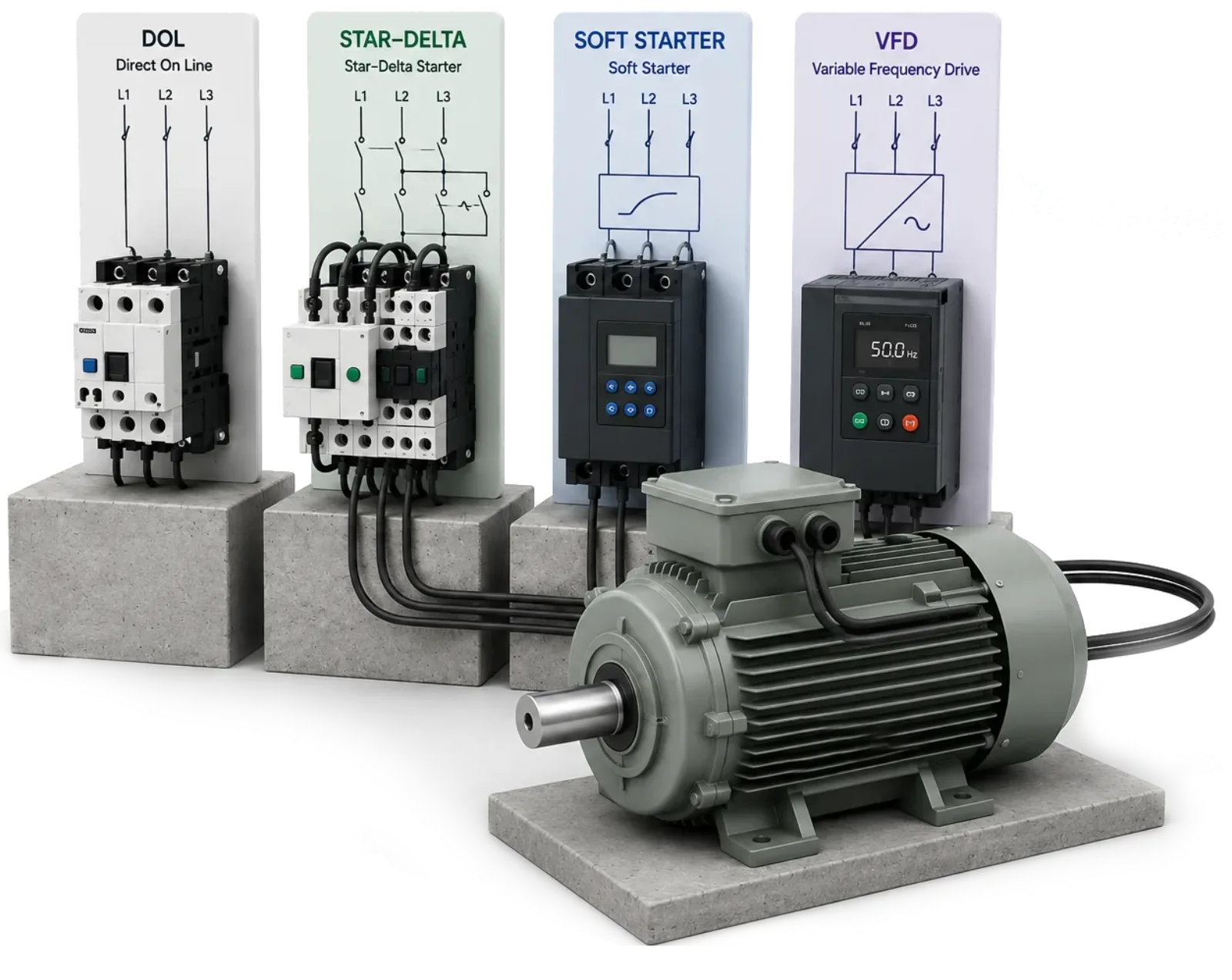
The most dangerous moment in an electric motor's entire life isn't while it's running flat out — it's the first second after you switch it on. That single second decides how much your lights flicker, how hard the coupling and gearbox get slammed, and how many years the motor actually lasts. Yet it's the part almost nobody thinks about.
Here's why that first second is such a big deal, and the five common ways engineers control it.
Why starting a motor is harder than it sounds
Picture pushing a stalled car. The hardest part isn't keeping it rolling — it's getting it moving from a dead stop. A motor faces the same problem, except instead of muscle, it uses electric current, and instead of a gentle push, the simplest method throws the full punch at once.
When a standard motor is switched straight onto full power from a standstill, it briefly pulls 6 to 8 times its normal running current — for less than a second, but that spike is real, and the electricity supply has to deliver it. At the same moment, the motor's shaft can suddenly demand 2 to 3 times its normal turning force (torque), slamming into whatever it's connected to — a belt, a gearbox, a pump, a conveyor.
Multiply that by how often a motor starts — some run for years without stopping, others start and stop dozens of times a day — and that "first second" problem becomes something engineers have to design around, not ignore.
Why it actually matters
Three real consequences, in plain terms:
- The electrical grid feels it. A big current spike briefly pulls the supply voltage down — which is why lights can flicker or dim for a moment when a large motor (an air conditioner compressor, a workshop machine) kicks in. Utilities often set hard limits on how much starting current a customer is allowed to pull, especially for bigger motors — go over it, and the connection simply isn't approved.
- The mechanical parts feel it. A sudden 2-3x torque jolt is like snapping a rope taut instead of pulling it tight gradually. Belts slip or snap, couplings wear out early, gearbox teeth take repeated shock loading. On a motor that starts often, this adds up into real, expensive maintenance.
- The motor's own windings feel it. High current for even a second or two generates real heat inside the motor's copper windings. One start is nothing. Thousands of hard starts over a motor's life measurably shorten it.
None of this means DOL starting is "wrong" — for a small motor that starts once and runs for years, it's genuinely the simplest, cheapest, most reliable option. The problem only shows up as motors get bigger, or start more often, or drive something mechanically delicate.
What that first second actually looks like
Here's real data from a 30 kW motor switched directly onto full power — speed (green), current (orange) and torque (blue), all through that first second:
That's the whole problem in one picture: an enormous, brief spike in both current and torque, arriving almost instantly. Every other starting method exists purely to flatten that spike — trading a slower start for a gentler one.
The five ways to start a motor, explained simply
Direct-on-line (DOL) — just a switch. Full voltage, all at once, from the very first instant. Cheapest and simplest by far, but delivers the full current and torque spike shown above with no control over it at all.
Star-Delta (Y-Δ) — a clever wiring trick. The motor's windings are first connected in a lower-power arrangement ("star") for the first second or two, then switched over to the full-power arrangement ("delta") once it's spinning. Cuts the current spike significantly for very little extra cost — but that switchover moment itself causes a small second jolt, since it briefly disconnects and reconnects the motor.
Autotransformer — uses a transformer to feed the motor a reduced voltage for the first few seconds, then steps it up to full voltage once the motor has picked up speed. Smoother than Star-Delta, and the reduced voltage level can be tuned to the job — at the cost of a bigger, pricier piece of equipment.
Soft starter — an electronic device that ramps the voltage up gradually over a few seconds, like slowly turning up a dimmer switch instead of flicking a light on. No mechanical switching step, fully adjustable ramp time, and once the motor is up to speed the soft starter gets bypassed and the motor runs normally.
VFD (variable frequency drive) — the most capable option. Instead of just controlling voltage, it controls both voltage and electrical frequency together, which means it can start a motor almost perfectly smoothly — and keep controlling its speed continuously afterwards, not just during starting. The most expensive option, but the only one that also gives you variable speed as an ongoing, everyday feature, not just a gentler start.
The real numbers, side by side
All five methods, starting the same motor and load — this is what "gentler" actually looks like in numbers:
| Method | Peak current | Peak torque | Time to full speed |
|---|---|---|---|
| Direct-on-line (DOL) | 630% of normal | 276% of normal | 0.9 s |
| Autotransformer | 266% of normal | 117% of normal | 1.8 s |
| Star-Delta (Y-Δ) | 210% of normal | 92% of normal | 2.5 s |
| Soft starter | 207% of normal | 103% of normal | 5.3 s |
| VFD | 101% of normal | 101% of normal | 8.0 s |
The pattern is consistent: the gentler the start, the longer it takes to get to full speed. There's no free lunch here — you're always trading time for smoothness. A VFD starts this motor with essentially zero extra stress on the electrical supply or the mechanical load, but takes almost 9 times longer to get there than switching it on directly.
So which one should you actually use?
- Small motor, starts rarely, drives something rugged (a simple pump, a fan) — DOL is usually fine. It's cheap and there's little to protect.
- Medium motor, cost-sensitive project — Star-Delta is the classic middle ground: real current reduction for a small extra cost.
- Delicate mechanical load, or utility current limits (conveyors, geared equipment, anything with belts or couplings worth protecting) — a soft starter is usually the sweet spot: smooth, adjustable, no mechanical switching shock.
- You also want to run the motor at variable speed day-to-day (not just start it gently once) — a VFD earns its higher cost back through both the gentle start and genuine energy savings from running at the speed you actually need, not always at full speed.
Frequently asked questions
What is the best starting method for an electric motor?
There is no single best method for every motor. DOL is simple and economical for smaller motors, while star-delta reduces starting current at low cost. Soft starters provide smoother acceleration, and VFDs are usually the best choice when both smooth starting and variable-speed operation are required.
What is the difference between a soft starter and a VFD?
A soft starter mainly controls motor voltage during startup and shutdown to reduce current and mechanical stress. A VFD controls both voltage and frequency, allowing it to regulate motor speed continuously after startup as well.
How much current does a motor draw during startup?
A motor started direct-on-line can typically draw several times its rated running current for a short period. The actual value depends on the motor and load. Star-delta, soft starters, autotransformers and VFDs can significantly reduce the peak starting current.
Does star-delta starting reduce motor starting current?
Yes. Star-delta starting initially connects the motor windings in star configuration, reducing the voltage across each winding. This lowers starting current, but also reduces available starting torque, so it is not suitable for every load.
Is a VFD better than a soft starter for a fan?
For a fan that needs variable airflow, a VFD is usually more useful because it provides both smooth starting and continuous speed control. If the fan always operates at full speed and only needs a gentler startup, a soft starter may be a simpler and less expensive solution.
Can a large fan motor be started direct-on-line?
Technically it may be possible, but the electrical supply, allowable voltage drop, motor characteristics and driven load must all be considered. For larger motors, the high inrush current and mechanical shock of DOL starting often make a reduced-current starting method preferable.
See it on your own motor
CloudAir's motor starting calculator runs this exact simulation on your own motor and load — pick a starting method and watch speed, current, torque and winding temperature play out over time, or compare methods directly to see the real trade-off before you specify anything. Free, no sign-up.