

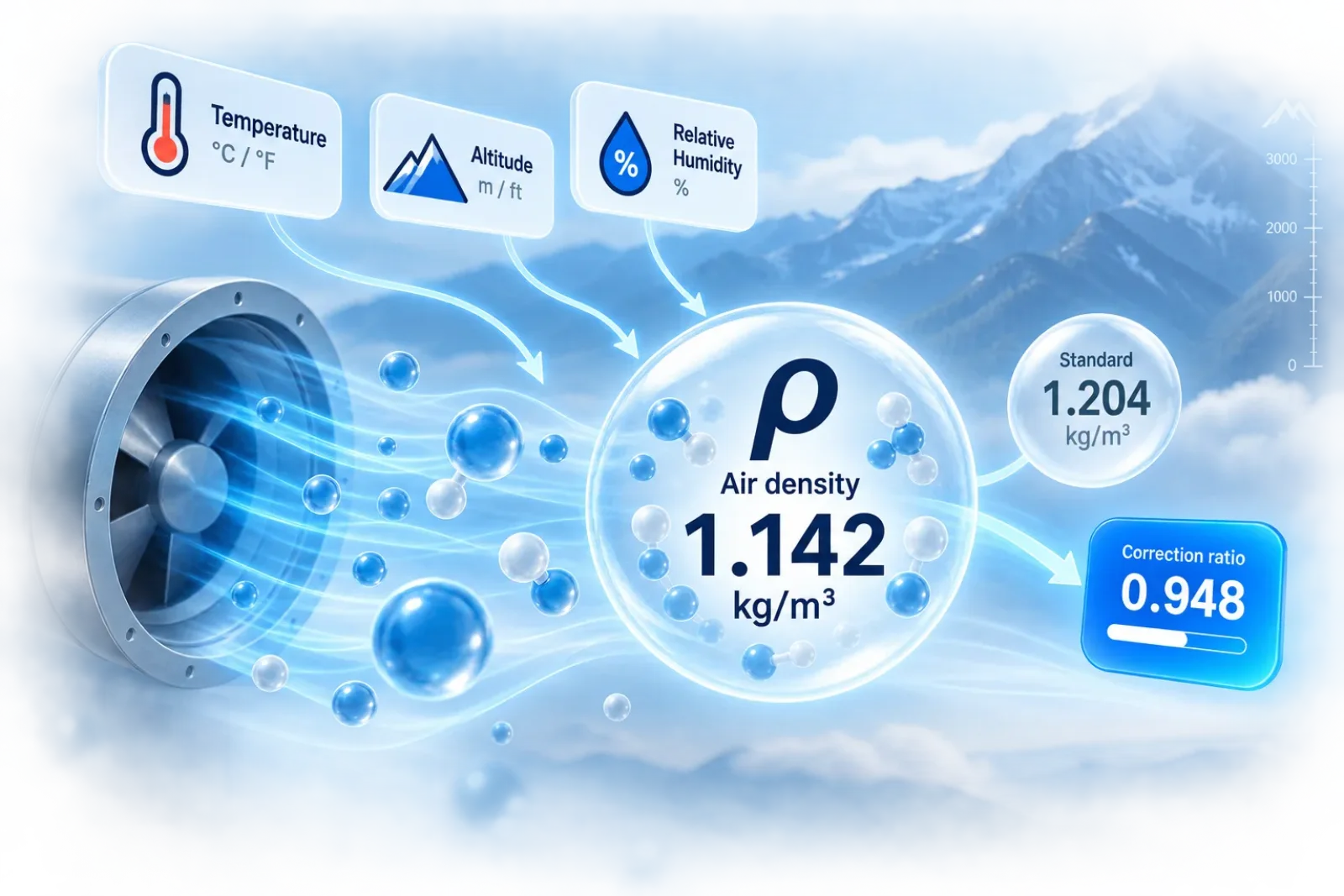
A fan rated on a manufacturer's datasheet was almost certainly tested at sea level, on a mild day. Install that exact same fan on a rooftop plant deck in a heatwave, or in a facility at altitude, and its pressure and power no longer match the standard-density catalogue values — not because anything is wrong with the fan, but because the air itself has changed. Lighter air, same fan, different result. Here's the physics behind that, and how to correct for it.
What air density actually is
Air density is simply how much mass is packed into a given volume — kilograms per cubic metre. It isn't fixed. Air is a gas, and like any gas it expands when heated and thins out under lower pressure. Hot air, high-altitude air, and humid air are all measurably lighter than cool, sea-level, dry air — same gas, fewer molecules squeezed into the same space.
Every fan catalogue rating has to assume some fixed reference density to be a meaningful, comparable number. That reference is standard air: 20°C, sea level, 0% relative humidity, 1.204 kg/m³. Every performance curve you've ever read off a datasheet was measured — or corrected back to — that one specific condition.
The four things that change it
- Temperature. Hot air expands and thins out. This is the single biggest everyday factor for most projects — a hot plant room or a summer heatwave measurably reduces air density.
- Altitude. Less atmosphere sitting above you means less atmospheric pressure squeezing the air, so it's less dense — the same relationship that makes cabin pressure and oxygen a real concern on a high mountain.
- Atmospheric pressure. Altitude is the biggest driver of this, but day-to-day weather systems shift it too, by a smaller amount.
- Humidity. Counter-intuitively, humid air is slightly lighter than dry air at the same temperature and pressure — a water molecule is lighter than the nitrogen or oxygen molecule it displaces. The effect is real but small compared with temperature and altitude.
Density with altitude
Atmospheric pressure falls off with height in a predictable, well-established way — the barometric formula:
P(h) = P0 · exp( −M·g·h / (R·(T+273.15)) )
Run that through the full moist-air density equation and here's the real shape of the curve, from sea level up to 4,000 m:
Density with temperature
Temperature has just as large an effect, over a range every plant room and rooftop unit actually experiences:
What stays the same, and what doesn't
This is the part that actually matters for selecting and specifying a fan, and it trips people up because it's slightly counter-intuitive: a fan is, to a good first approximation, a constant-volume machine. At a fixed speed and blade angle, it moves essentially the same volume of air (m³/h) whether that air is dense winter air or thin, hot summer air — the impeller sweeps the same physical volume every revolution, regardless of how much mass happens to be in it.
What changes is everything downstream of that volume:
- Airflow (Q) — stays essentially constant. Same fan, same speed, same swept volume.
- Pressure — scales directly with density. Thinner air means less mass being accelerated, so the fan generates less pressure for the same volume moved.
- Power — also scales directly with density, for the same reason. Less mass to accelerate means less power needed.
So thinner air is, in one sense, "easier" on the fan — lower pressure, lower power draw. The catch is that the system the fan is feeding (ductwork, a coil, a filter) was very likely sized assuming standard air too, and its own pressure losses scale with density in the same direction. Whether thinner air is good or bad news for a specific installation depends on which side of that trade-off dominates — which is exactly why the correction has to be calculated, not guessed.
Correcting a rating for real site conditions
The correction itself is simple once you have the ratio. Work out actual density at the real site condition, divide by the standard 1.204 kg/m³, and that single ratio scales both pressure and power directly:
pressuresite = pressurecatalogue × (ρsite / ρstandard) powersite = powercatalogue × (ρsite / ρstandard)
Two real examples
Warsaw versus altitude. Warsaw sits close to sea level (roughly 100 m) — its air density is essentially standard, about 1.5% above 1.204 kg/m³ at a mild 15°C. Move that exact same fan to a site at 1,500 m and density drops to roughly 85% of standard; at 2,500 m, roughly 76%. A fan selected without correcting for altitude at either site will under-deliver on both pressure and, misleadingly, look like it's saving power — for the wrong reason.
A hot day versus a mild one. The same fan at sea level, running at 20°C versus a genuinely hot 60°C (a real condition in some industrial exhaust or rooftop applications): density drops from 1.204 to about 1.060 kg/m³ — a 12% reduction. Pressure and power both fall by roughly that same 12%, for the same fan at the same speed.
Both examples, and the standard sea-level case, side by side:
| Conditions | Density | Pressure factor | Power factor |
|---|---|---|---|
| 20°C / 0 m (standard) | 1.204 kg/m³ | 1.000× | 1.000× |
| 40°C / 0 m | 1.127 kg/m³ | 0.936× | 0.936× |
| 20°C / 2,000 m | 0.954 kg/m³ | 0.792× | 0.792× |
Pressure and power always move together, by exactly the density ratio — that symmetry is the one thing worth remembering even without the formulas.
Frequently asked questions
Does altitude affect fan airflow?
At the same fan speed and blade setting, volumetric airflow (m³/h or CFM) remains approximately the same as altitude increases. However, air density decreases with altitude, so the fan develops less pressure and requires less power. Mass airflow also decreases because the same volume contains less air mass.
Does temperature affect fan performance?
Yes. As air temperature increases, air density decreases. At the same fan speed, volumetric airflow remains approximately constant, while fan pressure and absorbed power decrease roughly in proportion to air density.
How does air density affect fan pressure?
Fan pressure is directly proportional to air density when fan speed and geometry remain unchanged. If actual air density is 90% of the reference density, the fan will develop approximately 90% of its rated pressure at the same airflow.
How does air density affect fan power?
For the same fan speed and operating conditions, fan power scales approximately with air density. A 10% reduction in air density therefore results in roughly a 10% reduction in absorbed power.
Does a fan move less air at high altitude?
Not necessarily in terms of volume. A fan operating at the same speed can move approximately the same m³/h at high altitude, but the air is less dense. Therefore, mass airflow, pressure and power are lower. This distinction between volumetric and mass airflow is important in HVAC and industrial applications.
How do I correct fan performance for altitude?
First calculate the actual air density at the installation altitude and temperature. Then determine the density ratio: density ratio = ρsite / ρreference. Fan pressure and power can then be corrected approximately by multiplying their reference values by this ratio, while volumetric airflow at the same fan speed remains approximately unchanged.
Does humidity affect fan performance?
Yes, although usually less than temperature or altitude. Humid air is slightly less dense than dry air at the same temperature and atmospheric pressure because water vapour has a lower molecular mass than the nitrogen and oxygen it replaces.
Why does a fan produce less pressure at high altitude?
At high altitude, atmospheric pressure and air density are lower. The fan therefore accelerates less air mass for the same volumetric airflow. Because fan pressure is proportional to air density, the pressure developed by the fan decreases as altitude increases.
Work it out for your own site
CloudAir's air density calculator runs the full barometric and moist-air formulas for any temperature, altitude and humidity, and reports the ratio against standard air ready to carry straight into the fan laws calculator to rescale a catalogue rating for a real site. Free, no sign-up.