

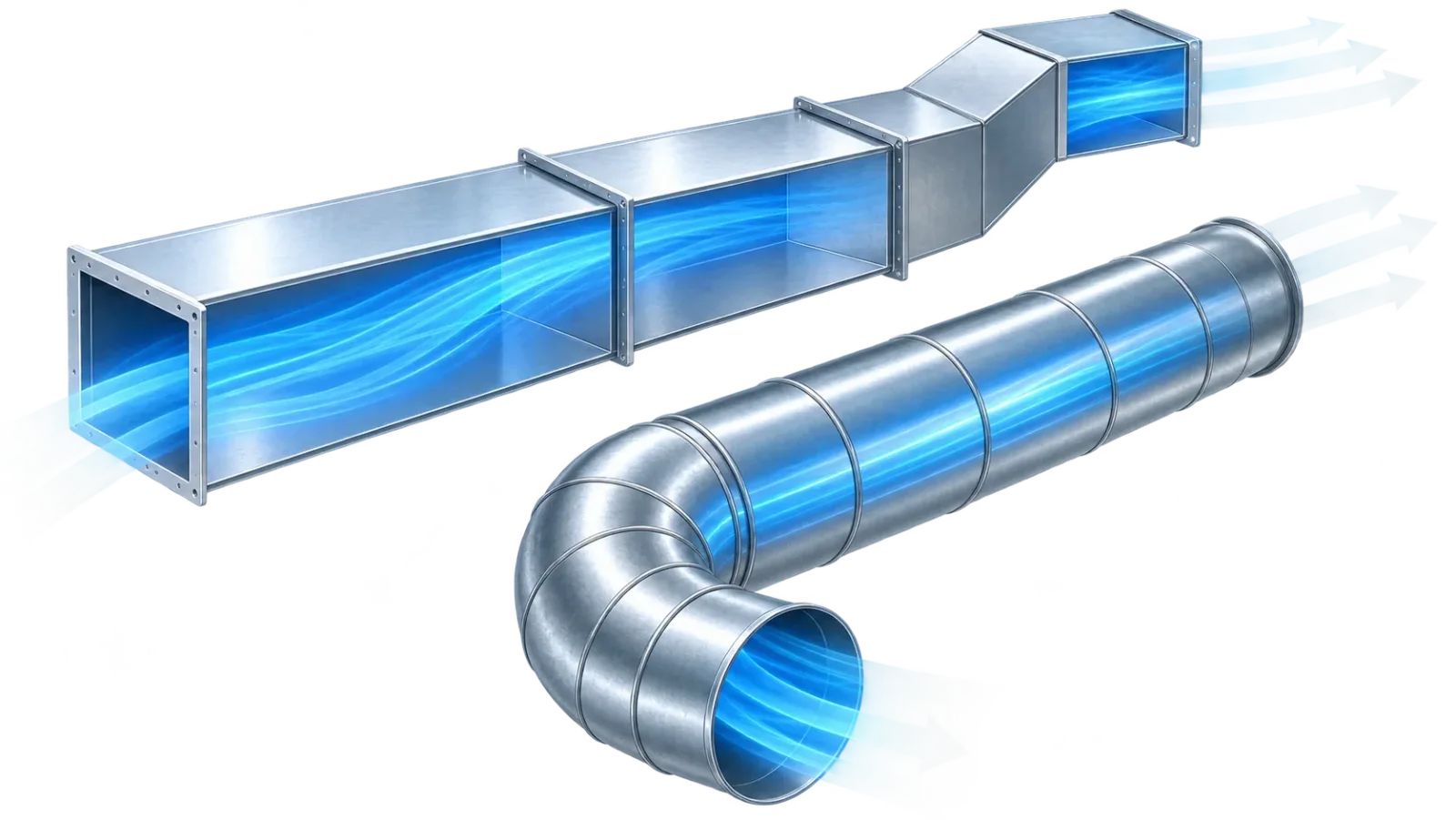
Pick a duct too small, and the air moving through it hisses, whistles, and forces the fan to work harder for every hour the system runs — for the entire life of the building. Pick one too large, and you've spent money on metal and ceiling space you didn't need. Duct sizing is really just finding the sweet spot between those two mistakes, and it comes down to three numbers that are all connected: airflow, velocity, and pressure drop.
The one equation that explains everything
Think of air moving through a duct the same way water moves through a garden hose. The amount of water coming out (litres per minute) depends on both how fast it's moving and how wide the hose is. Squeeze the hose narrower and, to deliver the same amount of water, it has to move faster through the smaller opening.
Ducts work exactly the same way:
Airflow = Velocity × Cross-section area
If you know how much air you need to move (from a ventilation or heat-loss calculation) and you pick a target velocity, the required duct size follows directly. Pick a small duct, and the air has to move fast to deliver the same airflow. Pick a bigger duct, and it can move slowly.
Why velocity is the number that actually matters
Airflow is fixed by the building's needs — that number doesn't move. Velocity is the number you're actually choosing when you size a duct, and it drives almost everything else:
- Noise. Fast-moving air rubbing against duct walls and fittings is genuinely noisy. Push velocity too high in an occupied space and you'll hear it.
- Pressure drop (and fan energy). Air moving faster loses more energy to friction against the duct wall — and that friction loss is not proportional to velocity, it's roughly proportional to velocity squared. Double the velocity and pressure drop roughly quadruples.
- Fan running cost, for the life of the building. Every bit of pressure drop the duct adds is pressure the fan has to make up, every single hour it runs. A duct sized too small doesn't just cost more in year one — it costs more in electricity every year after that too.
That's why "target velocity" is usually the actual design decision, not airflow (which is fixed) or duct size (which just falls out of the other two).
What that trade-off looks like in real numbers
Take a real example: 1,000 m³/h needs to move through a round duct. Here's what happens to the pressure drop as the duct gets bigger:
That's the whole story in one curve: pressure drop falls off steeply as the duct gets a little bigger, then flattens out. The first few sizes up from "too small" buy you the most benefit per millimetre of extra duct.
Round or rectangular?
For the same airflow and the same target velocity, a round duct and a rectangular duct end up close in performance — but not identical. Sizing the same 1,000 m³/h duct both ways at a 4.0 m/s target:
| Round | Rectangular | |
|---|---|---|
| Selected size | Ø315 mm | 375 × 200 mm |
| Actual velocity | 3.56 m/s | 3.70 m/s |
| Friction rate | 0.49 Pa/m | 0.67 Pa/m |
| Cross-section area | 0.078 m² | 0.075 m² |
Two things worth knowing here. First, round duct is aerodynamically more efficient than rectangular — less internal surface for the same cross-section area means less friction, which is exactly what shows up above (lower friction rate for very similar area). Second, rectangular still needed slightly less material area to hit the same velocity target in this case — the trade-off is real and depends on the specific duct, which is why it's worth checking both rather than assuming one is always better. Round is usually the better aerodynamic choice; rectangular usually wins on tight ceiling void space.
One duct, or a whole network?
CloudAir has three duct tools, and which one you want depends on what you're actually looking at:
- Duct Sizing Calculator — you know the airflow and a target (velocity or friction rate), and you want the round and rectangular size that hits it, side by side, drawn to scale. The right starting point for sizing any single run.
- Duct Pressure Drop Calculator — you already have a duct size (or a few candidate sizes) and just want the velocity, Reynolds number and pressure drop for that specific duct, fast. The quick single-number check.
- Duct Network Configurator — you're not dealing with one duct in isolation, but a whole branching run: straight sections, reducers, elbows, tees, dampers, louvers, each with its own size and losses, and you need the total pressure loss down every path to make sure the system is actually balanced. The right tool once "one duct" becomes "a system."
All three run the exact same Darcy-Weisbach and Colebrook-White physics underneath — the difference is just how many ducts you're looking at, and whether you're solving for size or checking a size you already have.
Common mistakes worth avoiding
- Sizing off a single "rule of thumb" velocity for every application. A quiet office main duct and a noisy plant room extract can reasonably run at very different velocities — a single blanket number either wastes space in one or creates noise complaints in the other.
- Ignoring fittings. Elbows, tees, and dampers add their own pressure loss on top of straight-duct friction — sometimes more than the straight duct itself, especially on short, fitting-heavy runs. A straight-duct-only calculation understates the real system.
- Forgetting that friction loss scales with velocity squared, not velocity. A duct that seems only "a bit undersized" on paper can be adding disproportionately more fan energy cost than the size difference suggests.
- Using a generic roughness value for every material. Galvanized steel, flexible duct, and concrete have genuinely different internal roughness — and flexible duct in particular can add substantially more friction than its nominal diameter suggests, especially if it's not pulled fully taut.
Size your own duct run
Start with the Duct Sizing Calculator for a single run, use the Duct Pressure Drop Calculator to spot-check a size you already have in mind, or build out the full branching system in the Duct Network Configurator once you're past a single duct. All three are free, with no sign-up needed.