
For many HVAC manufacturers, maintaining product information has become almost as demanding as developing the products themselves.
A single manufacturer may publish thousands of fan configurations: motor options, voltages, materials, impeller diameters, accessories and installation arrangements. Every one of them needs accurate technical data, documentation and descriptions.
Most of that information is still maintained by hand. Engineers work in Excel. The technical department prepares PDF catalogues. Marketing writes product descriptions. Sales asks for updated datasheets, and distributors want structured data for their own systems. The same values are copied between applications, and the copies drift apart.
Artificial intelligence is starting to change this — not by generating more text, but by working directly inside the structured engineering database.
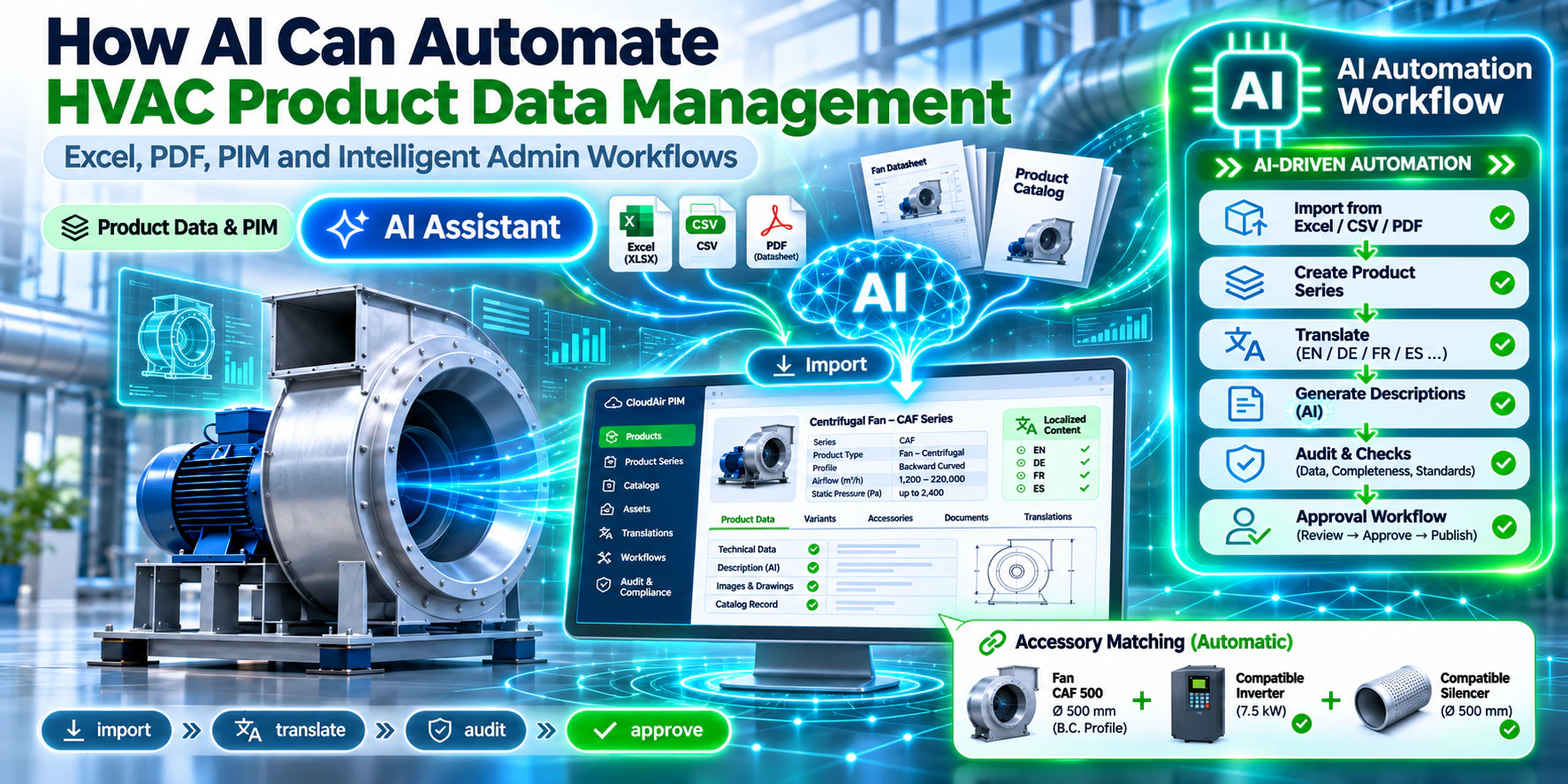
An AI-assisted Product Information Management system can read technical documents, prepare product records, point out missing parameters and take over the repetitive part of catalogue administration. This article looks at how that works in practice, where it genuinely saves time, and where it must not be trusted without review.
1. Why HVAC product data is harder than ordinary product data
An online shop describes a product with a name, a price, a few photos and a short text. HVAC equipment needs engineering information that other systems will calculate with.
Take a manufacturer of industrial fans. One series may contain dozens or hundreds of configurations, each with:
- airflow and static pressure characteristics,
- motor power, efficiency, voltage and frequency,
- impeller diameter and rotational speed,
- materials, operating temperature range and construction variants,
- dimensions, weights and installation arrangements,
- sound power or sound pressure data,
- compatible accessories,
- documentation and product descriptions.
These values have to stay consistent across the selection software, the public catalogue, the internal administration platform and sales documentation. One change can touch several records at once: a new motor option affects electrical parameters, product variants, descriptions and attached documents.
Done through individual forms and spreadsheet imports, that work scales badly. At a hundred products it is tedious. At several thousand it becomes a permanent job.
If your catalogue still lives mostly in documents, the groundwork is a separate subject — we covered it in how to digitize a fan catalogue.
2. Reading Excel and PDF files into structured data
The most practical use of AI in product administration is interpreting the documentation that already exists.
Manufacturers rarely receive standardised files. One spreadsheet calls the airflow column Qmax, another Air Volume, a third V̇. Motor power arrives in watts in one file and kilowatts in the next. Traditional importers need a fixed file structure or a mapping configured by hand for every new source.
An AI-assisted import reads the file as it is and proposes the mapping.
Example: 500 axial fans in one spreadsheet
Suppose a manufacturer receives an Excel file with 500 new axial fan models:
| Model | Airflow (m³/h) | Static pressure (Pa) | Motor power (kW) |
|---|---|---|---|
| AXF-500 | 5,800 | 480 | 0.75 |
| AXF-560 | 7,000 | 490 | 1.10 |
| AXF-630 | 8,450 | 485 | 1.50 |
The assistant identifies the models, interprets the column headings, proposes the matching database fields and converts the units — 0.75 kW becomes 750 W if the database stores rated power in watts. Instead of creating 500 products by hand, the administrator checks the proposed mapping and the converted values, then approves the import.
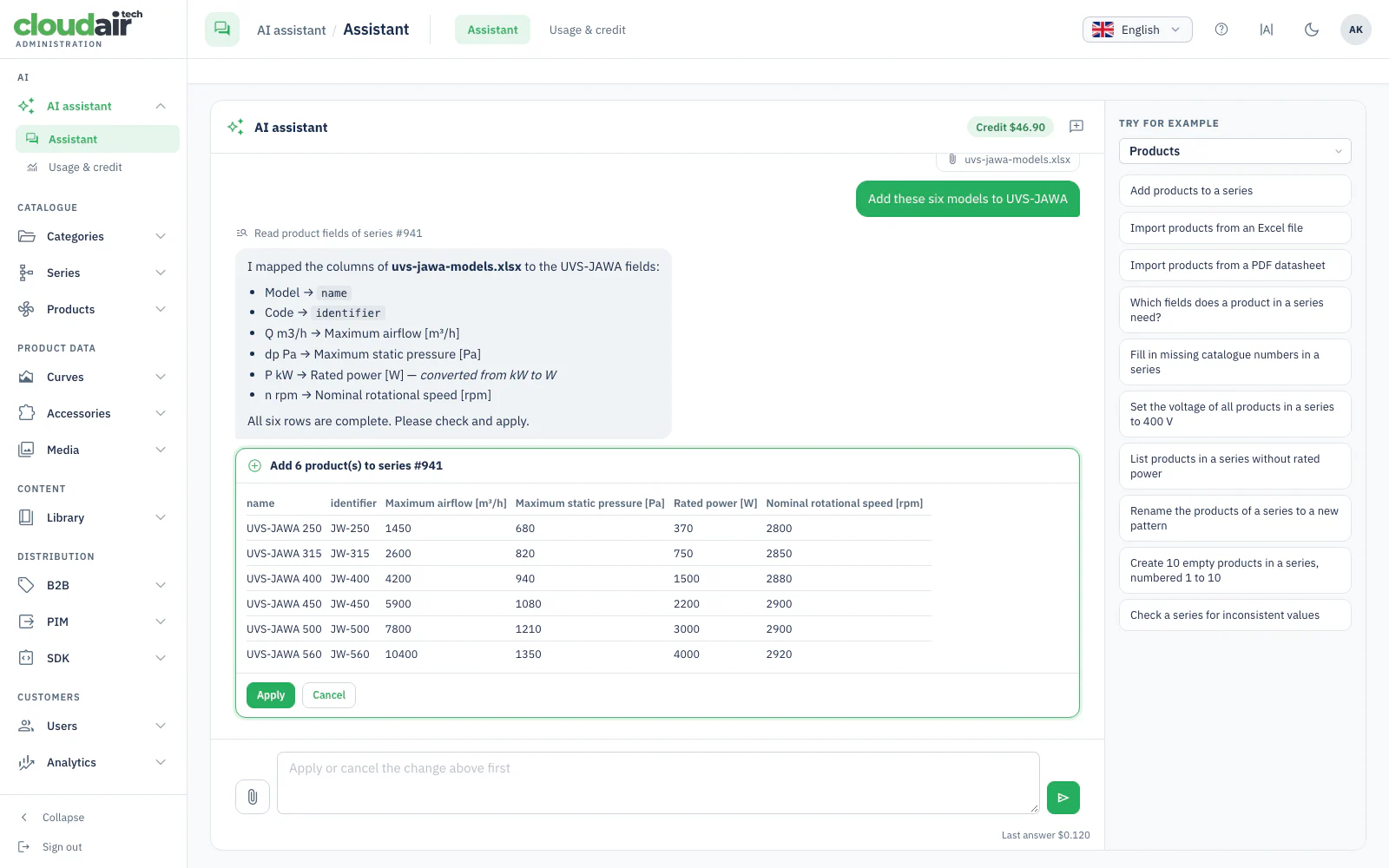
Reading a file correctly is not the same as the file being correct. If the source spreadsheet carries a wrong pressure value, the import will carry it faithfully into the database. Source verification remains an engineering responsibility.
PDF datasheets are a different problem
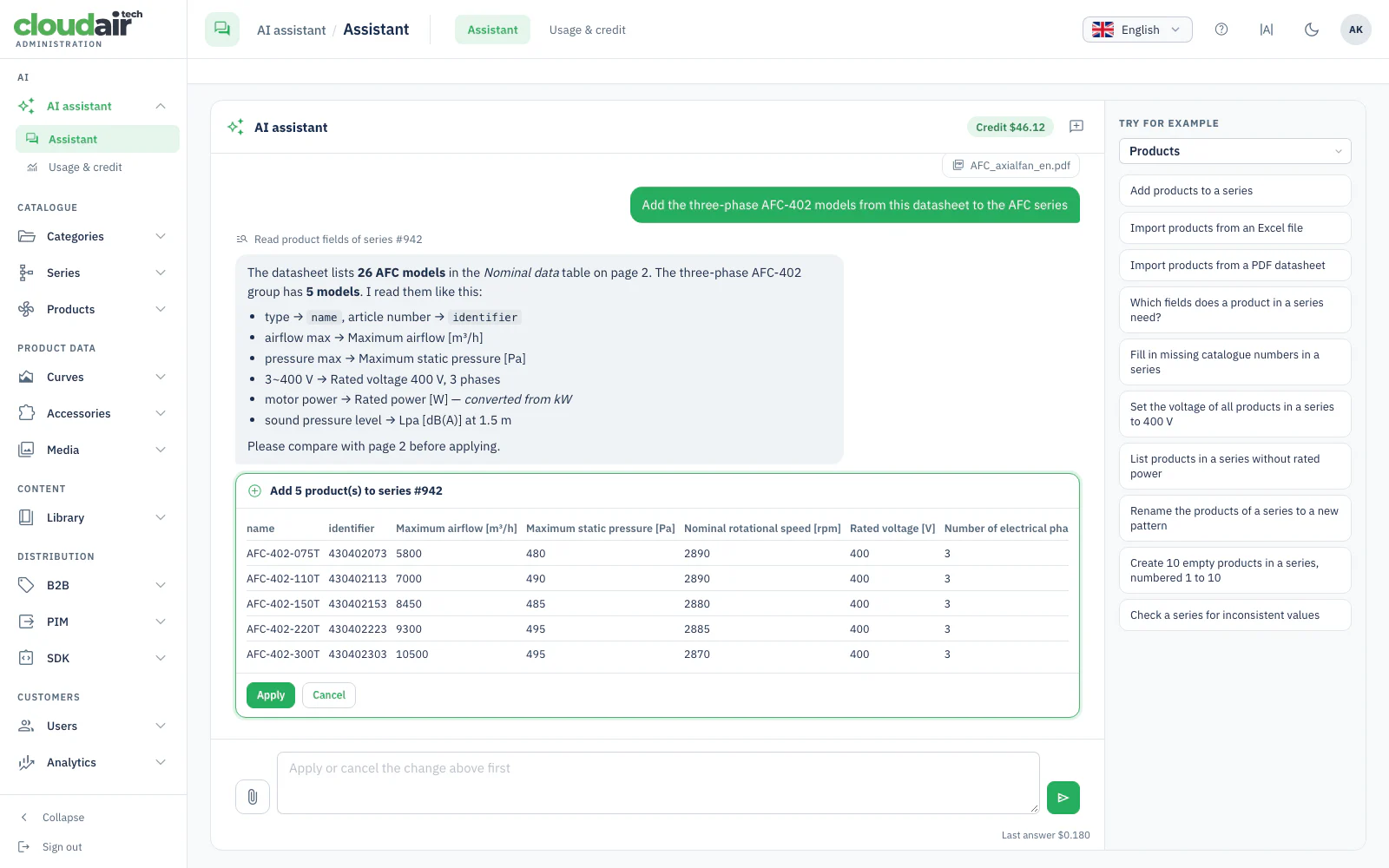
A technical catalogue may run to dozens of pages of tables, dimensions, electrical data and performance charts. AI can locate the relevant table and extract it into structured fields, which removes a great deal of retyping.
But engineering data needs interpretation, not just extraction. Maximum pressure is not the pressure at the best efficiency point. Shaft power is not electrical input power. A value in the "nominal data" table may belong to a different variant than the one being imported.
This is why a trustworthy workflow keeps three things apart: extraction, mapping and approval.
3. Administering hundreds of products with plain instructions
Importing is only the first day of the job. Everything afterwards is maintenance.
Once the data sits in a structured catalogue, the administrator can describe an operation instead of navigating to it:
Set the rated voltage of every model in the AXF series to 400 V.
List all centrifugal fans with no rated power.
Create a new series based on the AXF range and prepare the models for review.
The assistant resolves the instruction into a concrete set of records and a concrete set of changes, and presents both. This is where repetitive work disappears fastest, because the cost of a bulk change stops depending on how many products it touches.
It also changes how a new series gets set up. Rather than filling an empty form, the administrator answers a few questions about where the series belongs and which attribute groups it uses.
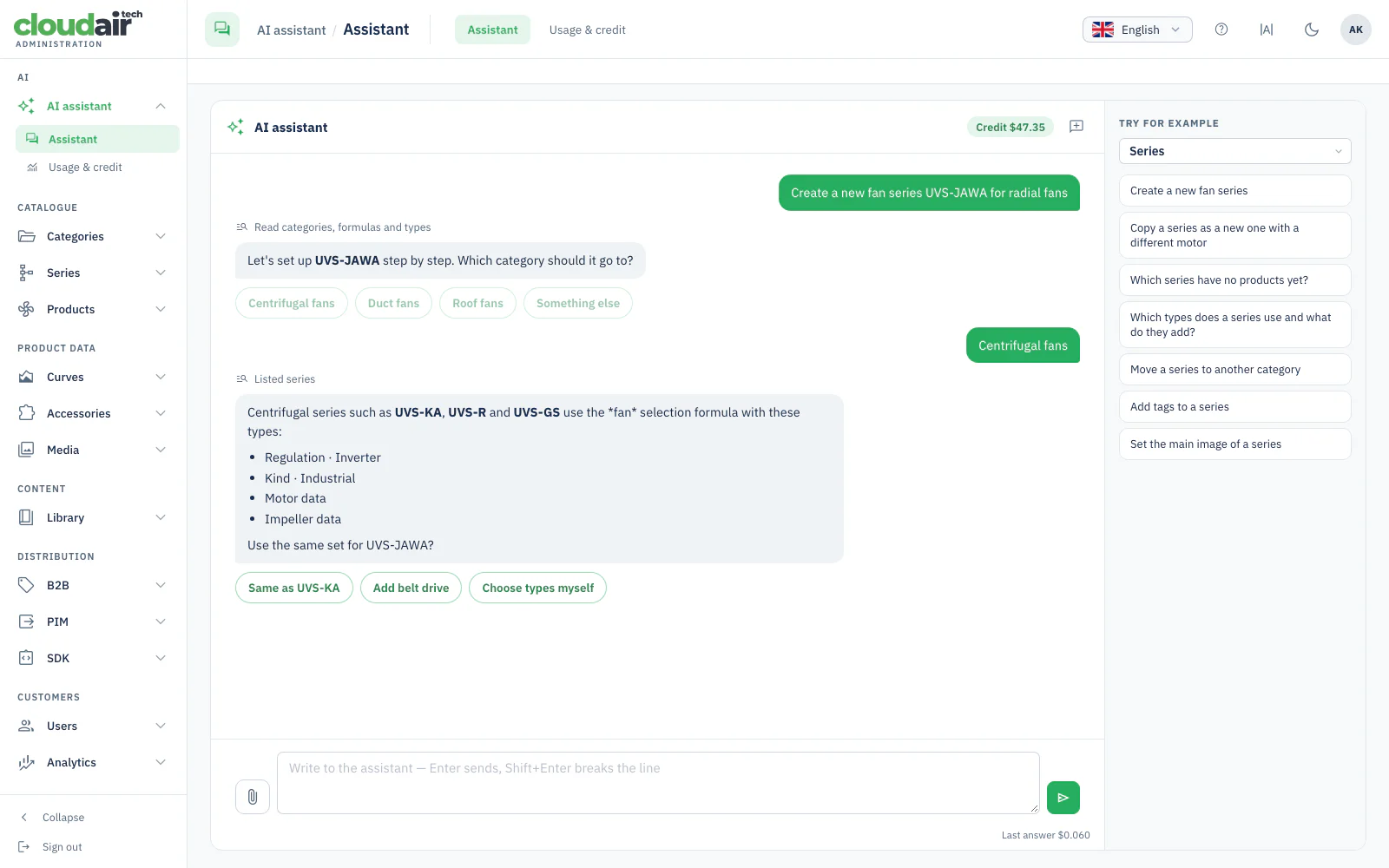
The point is not to remove the technical administrator. It is to stop spending their time on operations that follow a rule.
4. Technical descriptions written from verified data
Descriptions are their own administrative burden. The same product usually needs several: a detailed technical text for engineers, a short one for a listing, and something about applications and installation conditions.
Writing those by hand for hundreds of series is expensive and almost impossible to keep consistent. Generating them is a good fit for AI — on one condition.
The text must be generated from the parameters already stored in the database, not from the product name.
An axial fan series with a documented temperature range, casing material and intended application can have a description built around those confirmed attributes. Asking a general-purpose chatbot to describe "AXF-630" produces fluent sentences with invented facts.
Generated text still needs review, particularly wherever it touches performance, safety, certification or regulatory compliance.
5. Multilingual catalogues without repeating the work
Manufacturers selling across Europe often maintain descriptions in six or more languages. Translating manually creates three recurring problems: terminology drifts between series, model codes and units get "corrected" by the translator, and updates to the source text never reach the translations.
Translating inside the structured catalogue avoids all three, because the system knows which field is a description, which is a model code and which is a unit:
Translate the technical descriptions of the AXF series into German, French and Italian, keeping product codes, units and engineering terminology unchanged.
The proposed translations are reviewed before publication, and the terminology stays consistent across the whole series rather than per document. For manufacturers working through regional distributors and local websites, this is usually where the hours add up.
6. Finding missing, duplicate and inconsistent records
A catalogue is never finished. Models are added, parameters change, products are discontinued, and gaps accumulate quietly.
Auditing is a natural job for an assistant that can query the whole catalogue at once: duplicate article numbers, missing rotational speeds, products with no description, series with incomplete data. The result is a short list to work through instead of a review of every record.
Deeper engineering checks are the next step — comparing power against efficiency, reviewing performance curves, flagging products that need an ErP or FEI assessment. These belong in validated calculation software, not in a language model. The sensible division is that AI finds the records worth checking and the engineering code produces the numbers. The same logic applies to ErP 2026 compliance in selection software.
7. The next step: accessories and product relationships
Beyond individual product records lies a harder problem: the relationships between them.
Fans are rarely sold alone. They come with frequency inverters, silencers, dampers, mounting brackets, flexible connections, guards and electrical components. Each relationship has to be defined somewhere, and in a large catalogue there are thousands of them.
These relationships follow rules, which makes them a natural target for automation. An instruction such as:
Find all fans intended for variable-frequency operation and propose a compatible inverter based on rated power, voltage and current.
…describes work that is mechanical for a person and straightforward for software, provided the compatibility criteria are explicit. Motor power alone is not enough: rated current, supply voltage, overload capacity and operating limits all decide whether an inverter actually fits.
Dimensional matching is simpler and even more repetitive:
| Fan connection | Matching silencer |
|---|---|
| Circular Ø315 mm | Circular silencer Ø315 mm |
| Circular Ø500 mm | Circular silencer Ø500 mm |
| Rectangular 600 × 400 mm | Rectangular silencer 600 × 400 mm |
| Rectangular 1000 × 500 mm | Rectangular silencer 1000 × 500 mm |
Dimensions establish that an accessory can be connected. They do not establish that it is the right one — attenuation, pressure drop and installation conditions still decide the final selection.
The payoff appears downstream. Once relationships are defined correctly, the selection software can offer the compatible accessories for a chosen fan, quotations become complete, and the classic error of quoting an incompatible component disappears.
In the CloudAir platform this is on the roadmap rather than in production: catalogue auditing, imports, descriptions and translations are available today, while accessory relationships, performance curves and ErP review are listed as coming next.
8. What changes compared with a traditional PIM
A classical Product Information Management system organises data into categories, attributes, families and forms. None of that becomes unnecessary — the database remains the foundation. AI adds a different way of operating it.
| Traditional administration | AI-assisted administration |
|---|---|
| Map spreadsheet columns by hand | Mapping proposed from the file itself |
| Create products one form at a time | Prepare many products from one instruction |
| Search manually for incomplete records | Ask for a missing-data report |
| Write every description | Generate drafts from stored technical data |
| Translate description by description | Translate a whole series at once |
| Navigate between administration screens | Describe the operation in plain language |
AI does not replace the PIM architecture. It removes the clicking.
9. How this works in the CloudAir platform
The CloudAir AI Assistant is built into the administration platform rather than bolted on beside it. It works with the same structured product information that feeds the manufacturer's catalogue and selection software, which is what makes field mapping and unit conversion possible at all.
Available today: Excel and CSV import, parameter extraction from PDF datasheets, product and series management, description generation, translation and catalogue auditing.
A typical workflow for a new fan range:
- Upload the Excel workbook or the PDF documentation.
- Ask the assistant to identify the models and extract the technical attributes.
- Review the proposed field mapping, unit conversions and any missing values.
- Organise the prepared products into the right series.
- Generate descriptions or translations if they are needed.
- Approve the changes.
The governing principle is simple: the assistant prepares the operation, the administrator approves it. Every write is shown for review before it reaches the product database. The assistant works inside the user's own permissions and the selected catalogue only, and calculations and database operations stay with the platform's own software.
Cost is visible in the same place: usage and remaining credit are shown per catalogue, so AI spending is a line item rather than a surprise.
10. Why this matters more when the database feeds other systems
The value of better administration grows with the number of systems that depend on the data.
A structured HVAC database typically supplies the fan selection software, the technical catalogue, the public website, B2B portals and external applications through an API. When those systems read the same maintained dataset, one corrected motor parameter propagates everywhere it is published instead of being fixed four times in four places.
That is the real return: not faster typing, but less duplicated maintenance and fewer disagreements between engineering, marketing and sales. Product Information Management for HVAC manufacturers describes how that structure is built; how to build a fan product database goes through the data model itself.
11. How much time does this actually save?
It depends on the catalogue, and honest arithmetic is more useful than a percentage.
Take 1,000 product records. At an average of five minutes each for manual preparation and entry, the initial workload is roughly 83 hours. An AI-assisted workflow cuts the mapping and entry time, but not to zero — documents vary in quality, complex products need judgement, and corrections take time.
A fair way to measure it:
Time saved = manual processing time − (AI-assisted preparation + review + corrections)
The same applies to money, where AI usage charges, software fees and implementation effort belong on the other side of the equation.
For a large catalogue, the largest gain is usually not the first import. It is the recurring work afterwards: the quarterly update, the new voltage variant, the German translation of forty revised descriptions.
12. Where human approval is not optional
AI misreads technical terminology, takes a value from the wrong table and occasionally attaches a parameter to the wrong model. In ordinary content work that is an annoyance. In a product database that feeds engineering calculations, it is a commercial risk: a wrong airflow, efficiency or motor power changes what the selection software recommends and what ends up in a quotation.
Treat AI as an administrative assistant, not an engineering authority. A sound implementation has explicit field mappings, explicit units, validation rules, controlled permissions and a review step before anything is saved. Technical calculations stay inside verified engineering software.
The combination that works is AI for flexibility, structured software for predictability, and engineers for judgement.
13. What comes next
Conversational catalogue administration is an early stage. The interesting direction is not better text generation — it is connecting administration to validation: workflows that identify products needing a regulatory review and hand them to a compliance module, or assemble a technical catalogue from an approved dataset with the right parameters and documents attached.
These are natural extensions of an integrated PIM and engineering platform, and they depend far more on the quality of the underlying data model than on the model doing the talking.
Frequently asked questions
Can AI import HVAC products from Excel automatically?
It can interpret the spreadsheet structure, propose the database field mapping, convert units and prepare the product records. The mapping and the values should be reviewed before the import is approved — the preparation is automatic, the decision is not.
Can AI extract technical specifications from PDF catalogues?
Yes, for tabular data such as airflow, pressure, motor power, speed and dimensions. Extracted values must be checked against the source page, because a datasheet often contains several tables describing different variants or operating conditions.
Does AI replace HVAC product managers or engineers?
No. It removes repetitive administration. Engineering judgement, technical validation and responsibility for published product data stay with people.
What is the difference between AI-assisted PIM and a traditional PIM system?
A traditional PIM stores and organises product data. An AI-assisted PIM adds document interpretation, natural-language operations, content generation and automatic preparation of administrative changes on top of the same database.
Can AI manage fan selection software directly?
It can maintain the catalogue behind the selection software. The selection calculations themselves should remain with the engineering algorithms, which are deterministic and testable.
What happens if the AI gets something wrong?
In a correctly built system, nothing — because no change reaches the database without approval. That is the reason the review step exists, and the reason it should not be configurable away.
Less administration, more engineering
HVAC manufacturers invest heavily in engineering, production and product development, and then maintain the information describing all of it by hand, across several disconnected tools.
AI-assisted product data management is a practical way to cut that work: interpreting existing documentation, preparing catalogue updates, generating and translating technical content, and keeping the database consistent. The benefit appears when AI works inside a structured engineering database — as an isolated chatbot it only produces plausible text.
Done properly, the result is less time spent maintaining spreadsheets and more time spent on the products themselves.
See what the assistant does today on the CloudAir AI Assistant page, or ask us for a demonstration with your own catalogue.