
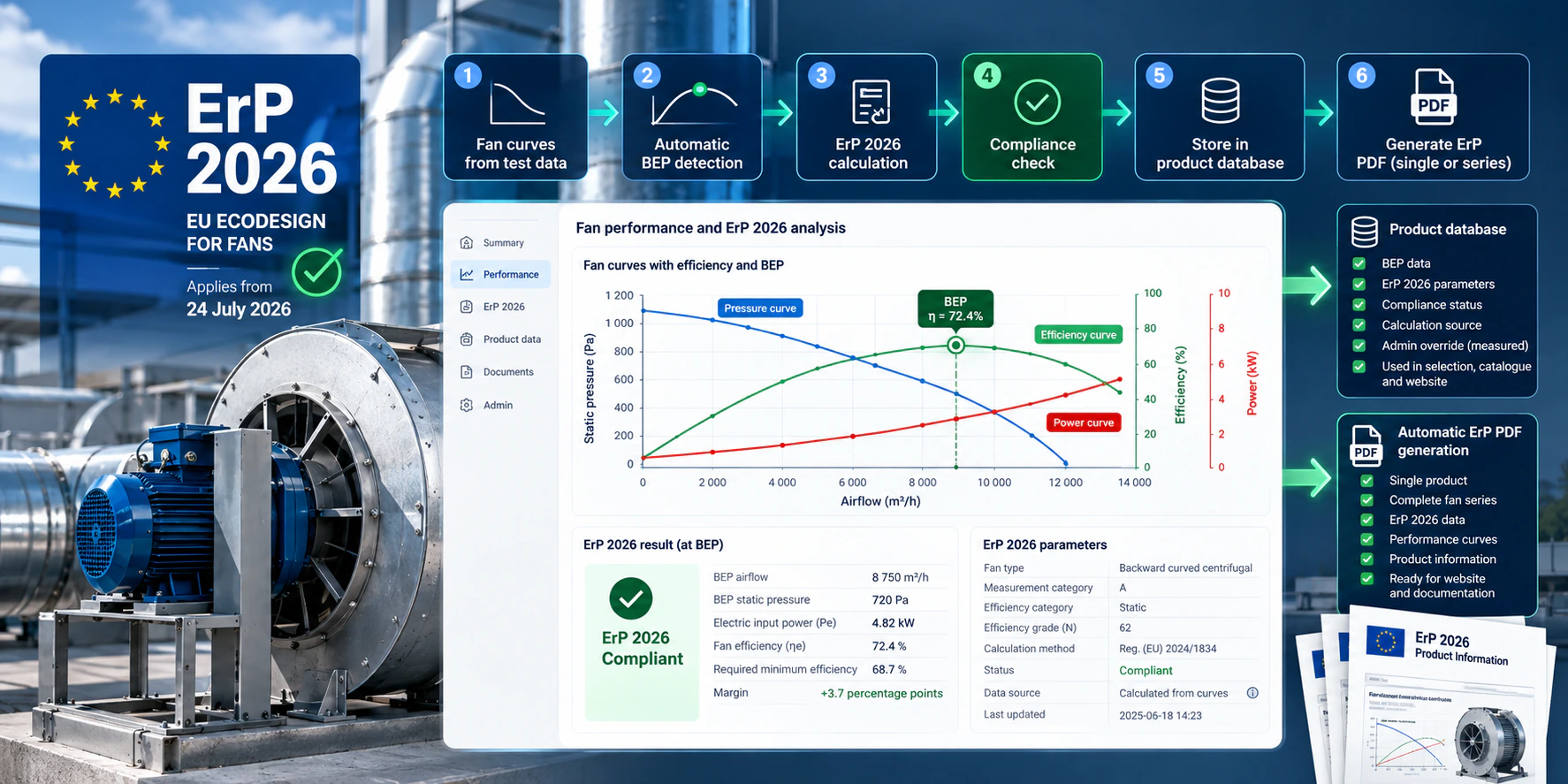
From 24 July 2026, the ecodesign requirements for fans in Commission Regulation (EU) 2024/1834 apply to fans with an electric input power between 125 W and 500 kW at their best efficiency point, including fans integrated into other products. The regulation repeals Regulation (EU) No 327/2011 and brings new efficiency, product-information and documentation requirements.
For a fan manufacturer, ErP 2026 should not be a spreadsheet calculation done once per model. It works far better built into the fan selection software and the product database: the system analyses the performance curves, finds the best efficiency point (BEP), calculates the requirement, checks compliance and stores the result as product data.
Why ErP 2026 should be calculated, not typed in
Many fan databases store ErP information as manually entered values: efficiency grade, efficiency at BEP, electric input power, airflow and pressure at BEP, compliance status. That works until something changes:
- the performance curve is corrected after a laboratory test, and the BEP moves,
- a new motor is introduced, and the electric input power changes,
- the fan is reclassified, and a different efficiency grade applies.
The stored ErP record then no longer matches the product. A better architecture derives it from the engineering data every time:
Step 1: Store the real performance curves
The calculation starts from the fan's measured performance. For each test point the database holds airflow Q, static and/or total pressure, electric (or shaft) power, speed and the motor data. The structure depends on the manufacturer's test data, but the complete curve must be available as numbers, not as a picture. How to get there from legacy catalogues is covered in how to digitize a fan catalogue.
The regulation itself asks for this. Annex II requires that "performance curves shall comprise a sufficient number of test points to permit the characteristic curve to be plotted over the normal operating range", and allows the curves to be provided "in digital form such as selection software or online catalogue".
Step 2: Calculate efficiency along the curve
Depending on the measurement category, the relevant efficiency is static (categories A and C) or total (B and D). The selection engine already has airflow, pressure and power at every point, so efficiency is calculated, not entered:
η = qv × Δp / Peqv in m³/s · Δp static or total pressure in Pa · Pe electric input power in W
For an example backward curved centrifugal fan tested in category A (static efficiency):
| Airflow | Static pressure | Electric input power | Static efficiency |
|---|---|---|---|
| 6,000 m³/h | 1,180 Pa | 3.60 kW | 54.6% |
| 8,000 m³/h | 1,110 Pa | 3.95 kW | 62.4% |
| 10,000 m³/h | 990 Pa | 4.20 kW | 65.5% |
| 12,000 m³/h | 800 Pa | 4.45 kW | 59.9% |
| 14,000 m³/h | 520 Pa | 4.60 kW | 44.0% |
Step 3: Find the BEP automatically
The best efficiency point is the basis of the whole ErP 2026 check: the minimum efficiency is a function of the electric input power at BEP, and the declared airflow, pressure, power and speed are all BEP values. So BEP should not be a point someone picks by eye. The software finds it from the data.
In the example, the highest measured efficiency is 65.5% at 10,000 m³/h, 990 Pa and 4.20 kW. With a fitted curve, the software can also look between the measured points; here the maximum of the fitted curve lies near 9,750 m³/h. Whichever rule the manufacturer uses, it should be the same for every product and recorded with the result.
Step 4: Classify the fan
The required level depends on the fan type, the measurement category (A to E) and the efficiency category (static or total). Table 1 of Annex II sets the minimum efficiency grade N:
| Fan type | Static (A, C) | Total (B, D) |
|---|---|---|
| Axial fans | N = 50 | N = 64 |
| Forward curved centrifugal < 5 kW and backward inclined centrifugal | N = 52 | N = 57 |
| Other centrifugal fans (incl. backward curved) | N = 64 | N = 67 |
| Mixed flow fans | N = 57 + 7 × (α − 45) / 25 | N = 67 |
| Jet fans ≥ 750 W (category E) | N = 50, with their own formula | |
Special characteristics multiply N: × 0.9 for dual-use fans, × 0.85 for reversible fans and × 0.9 for low-noise axial fans of 10 kW and more. The classification is stored once, in the series or product configuration, so nobody has to look it up again.
Step 5: Calculate the minimum efficiency
For most fans, Annex II gives the minimum efficiency as a function of electric input power at BEP (in kW) and N:
Pe < 10 kW: ηmin = 4.56 × ln(Pe) − 10.5 + N [%]
Pe ≥ 10 kW: ηmin = 1.1 × ln(Pe) − 2.6 + N [%]
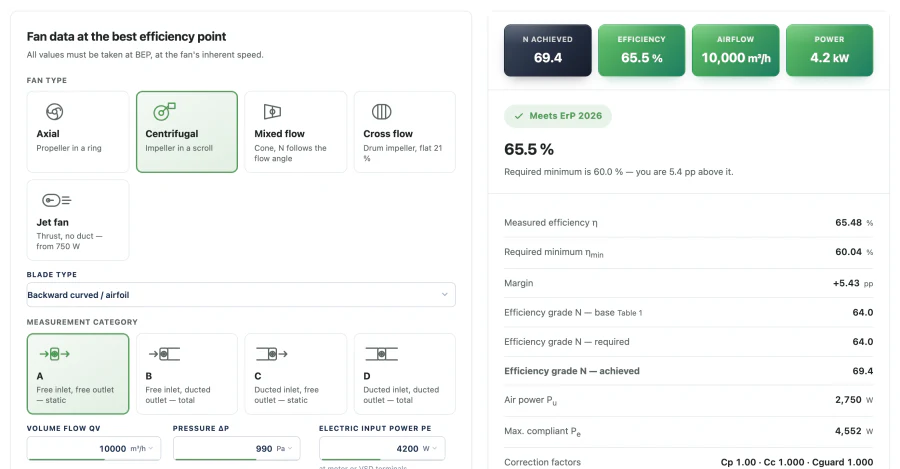
For the example fan (backward curved, static, N = 64, Pe = 4.2 kW):
ηmin = 4.56 × ln(4.2) − 10.5 + 64 ≈ 60.0%
Step 6: Compare, and show the margin
ηBEP ≥ ηmin → 65.5% ≥ 60.0% → pass, +5.4 percentage points
A plain pass or fail is not enough for engineering work. The software should show the actual efficiency, the requirement and the margin, which is exactly what our free ErP 2026 calculator does for a single fan:
Special cases the software must know
Not every fan uses the same rule, which is one more reason to let the software decide from the stored classification:
- Jet fans from 750 W have their own pair of formulas (7.32 ln(Pe) − 21.25 + N below 10 kW, 1.73 ln(Pe) − 8.35 + N above) with efficiency derived from thrust.
- Cross flow fans need at least 21% total efficiency over the whole power range.
- Centrifugal fans with low specific speed (σBEP < 0.12, Pe < 10 kW, category B or D, total efficiency) use ηmin = 2.95 × σBEP + 0.2.
- Mixed flow fans rated on static efficiency take N from the flow angle α.
- Dual-use, reversible and low-noise fans get the reduction factors listed above.
Store the result in the product database
The calculated result becomes ordinary structured product data: BEP airflow, pressure, electric input power, efficiency and speed, measurement category, efficiency category, efficiency grade N, the minimum required efficiency, the compliance status, the calculation date and the regulation version.
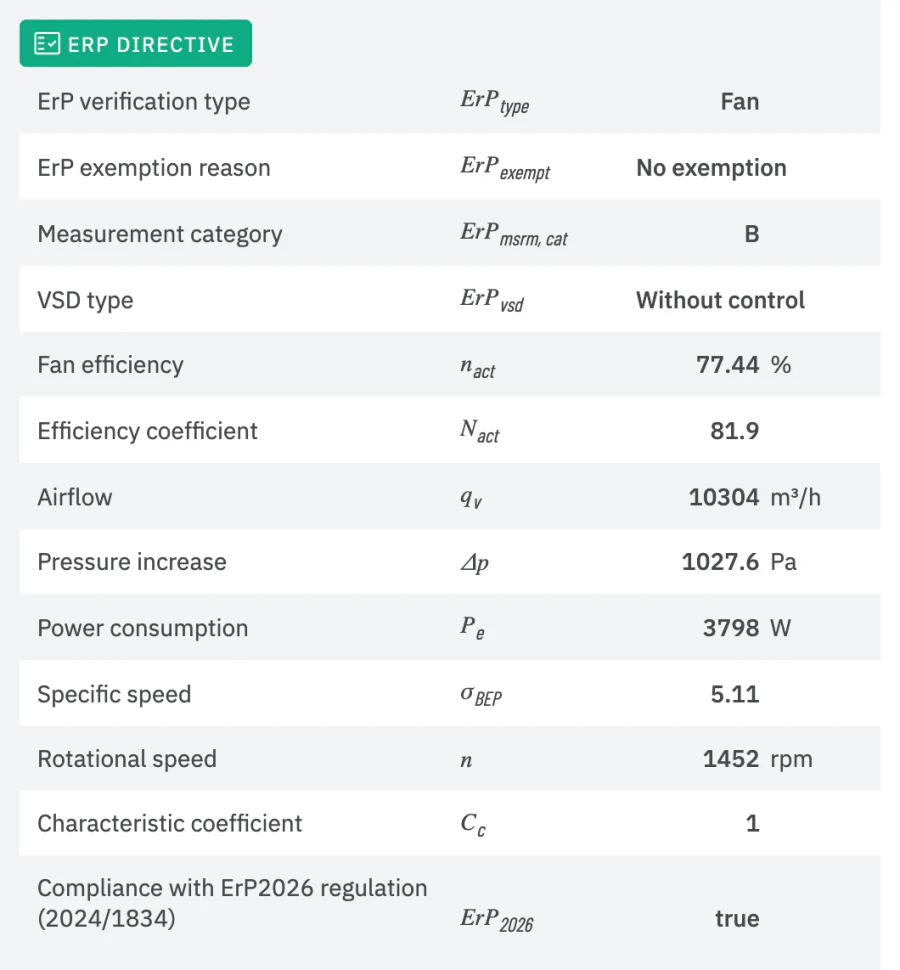
From there, the same values feed the selection software, the product catalogue, the PIM, the PDF generator, the API, the admin panel and the customer portal. More on keeping one source in PIM for HVAC manufacturers.
Let administrators keep laboratory values
Automatic calculation must not stop a manufacturer from publishing verified laboratory data. When a test report gives the official BEP, input power and efficiency, the administrator should be able to replace the calculated value, and the database should record which one it is:
| Parameter | Calculated from curves | Laboratory report |
|---|---|---|
| Airflow at BEP | 10,000 m³/h | 10,050 m³/h |
| Static pressure at BEP | 990 Pa | 995 Pa |
| Electric input power | 4.20 kW | 4.23 kW |
| Static efficiency | 65.5% | 65.7% |
| Source | Performance curves | Test report TEST-2026-184 |
Both values can live side by side, with the manufacturer choosing which one is published. That is especially useful when the curves were imported or digitized, but certification relies on physical measurement.
Recalculate when the data changes
When an administrator edits the pressure curve, the power data, the speed, the motor or the classification, the system should either recalculate the ErP result at once or flag it as "recalculation required". That prevents the most common failure of manual ErP data: a curve that was updated while the published compliance still comes from the old one.
Show compliance in the selection results
Once ErP is part of the product data, it becomes part of the selection: every fan in the results can carry its compliance, and the user can filter to compliant fans only.
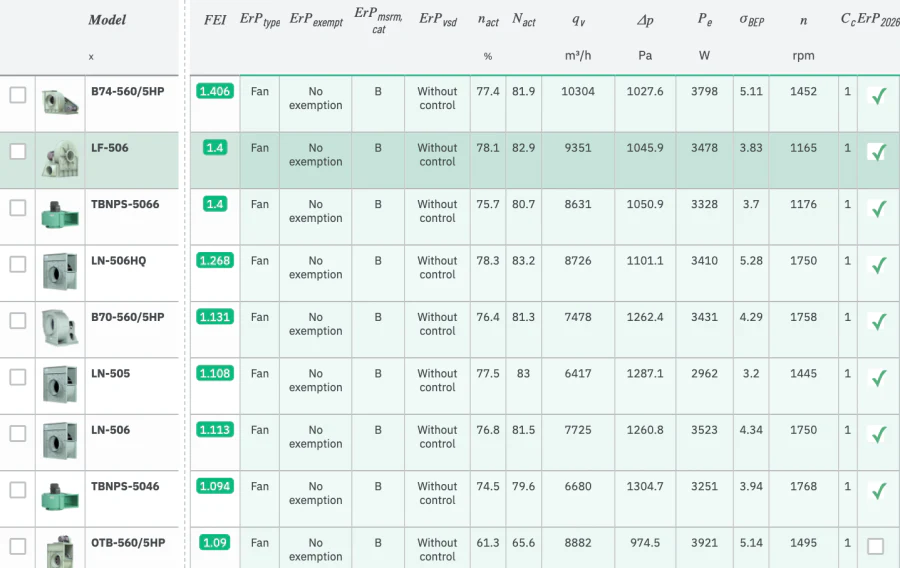
Compliance then stops being something checked after the selection. How this fits the rest of a selection program is described in what is fan selection software.
Use the results to optimize the range
Because the BEP and the margin are calculated for every product, the manufacturer can see the whole range at once. An example series of backward curved centrifugal fans:
| Model | Pe at BEP | η at BEP | ErP minimum | Margin |
|---|---|---|---|---|
| CF-400 | 2.2 kW | 63.6% | 57.1% | +6.5 |
| CF-450 | 3.1 kW | 63.3% | 58.7% | +4.6 |
| CF-500 | 4.3 kW | 62.0% | 60.2% | +1.8 |
| CF-560 | 5.9 kW | 62.4% | 61.6% | +0.8 |
| CF-630 | 8.2 kW | 60.3% | 63.1% | −2.8 |
Engineering effort can then go where it matters: impeller geometry, motor selection, speed, transmission, casing geometry or aerodynamic losses on the models close to or below the limit. The selection software becomes an analysis tool as well as a sales tool. The efficiency side is explained in more depth in fan efficiency explained.
Generate ErP documentation from the database
With all ErP values stored, the documentation can be generated rather than written: product identification, fan type, measurement and efficiency category, efficiency grade N, BEP airflow, pressure, electric input power and efficiency, the required minimum, the compliance status and the performance curves. The same applies to a whole series: select series CF, generate, and every model gets a document built from its own current data.
This matters for the information requirements. From 24 July 2026, Annex II point 2 requires a list of values to be displayed, among them the fan type, the efficiency, the measurement and efficiency category, the efficiency grade N, Pe, qv and Δp at BEP, the special characteristics, the speed at BEP and the specific ratio. They must appear in the technical data sheet or user manual supplied with the fan, unless an internet link or QR code to the manufacturer's free-access website is supplied instead, as well as in the technical documentation and on that website. From 24 July 2027, partial-load performance must also be shown as at least three curves at different speeds for most fans.
Entering the same regulatory data separately in PDFs, on the website, in the catalogue and in the selection software is exactly how inconsistencies appear. A single database avoids it:
Calculate once, store centrally, use everywhere.
When the regulation changes
Because the compliance logic lives in the software, a future amendment means updating the calculation engine once and reprocessing the database, instead of recalculating hundreds of spreadsheets. The result is a report rather than a project: how many configurations were analysed, how many comply, how many are near the limit and which ones fail.
ErP 2026 in fan selection software: the checklist
- Import the fan curves.
- Calculate the efficiencies.
- Find the BEP.
- Identify the fan type, measurement category and efficiency category.
- Determine N, including any reduction factors.
- Calculate the minimum efficiency.
- Compare the required and the actual efficiency.
- Save the result, its source and its date in the product database.
- Allow administrator verification and laboratory overrides.
- Show compliance in the selection results.
- Generate the PDFs automatically.
- Recalculate whenever performance data changes.
Conclusion
ErP 2026 should not be another static field in a fan database. Built into the selection and product-data platform, it becomes a chain: analyse the curves → find the BEP → calculate the requirement → check compliance → store the result. Administrators can review the records or replace them with laboratory values, and the same data feeds the selection software, catalogues, product pages, APIs and automatically generated ErP documents.
Done this way, ErP compliance is more than a regulatory check. It becomes part of the manufacturer's engineering, product optimization and digital data workflow. For the regulation itself, see ErP 2026 for fans: what you need to know; for the related US metric, what is the Fan Energy Index.
Frequently asked questions
When does ErP 2026 apply to fans?
Regulation (EU) 2024/1834 applies from 24 July 2026 to fans with an electric input power between 125 W and 500 kW at BEP, and repeals Regulation (EU) No 327/2011. Partial-load information requirements follow from 24 July 2027.
How is the minimum efficiency calculated?
For most fans: ηmin = 4.56 ln(Pe) − 10.5 + N below 10 kW, and 1.1 ln(Pe) − 2.6 + N from 10 kW, with Pe in kW at BEP and N from Table 1 for the fan type and efficiency category.
What is the efficiency grade N for a backward curved centrifugal fan?
64 for static efficiency (measurement categories A and C) and 67 for total efficiency (B and D), reduced by the applicable factors for dual-use, reversible or low-noise fans.
Can selection software provide the performance curves required by the regulation?
Yes. Annex II allows the information on the curves to be provided in digital form, such as selection software or an online catalogue.
Should the BEP be calculated or taken from the test report?
Both can coexist. Calculating it from the curves keeps every product consistent and up to date; a measured value from a laboratory report can override it, as long as the database records which source is published.