

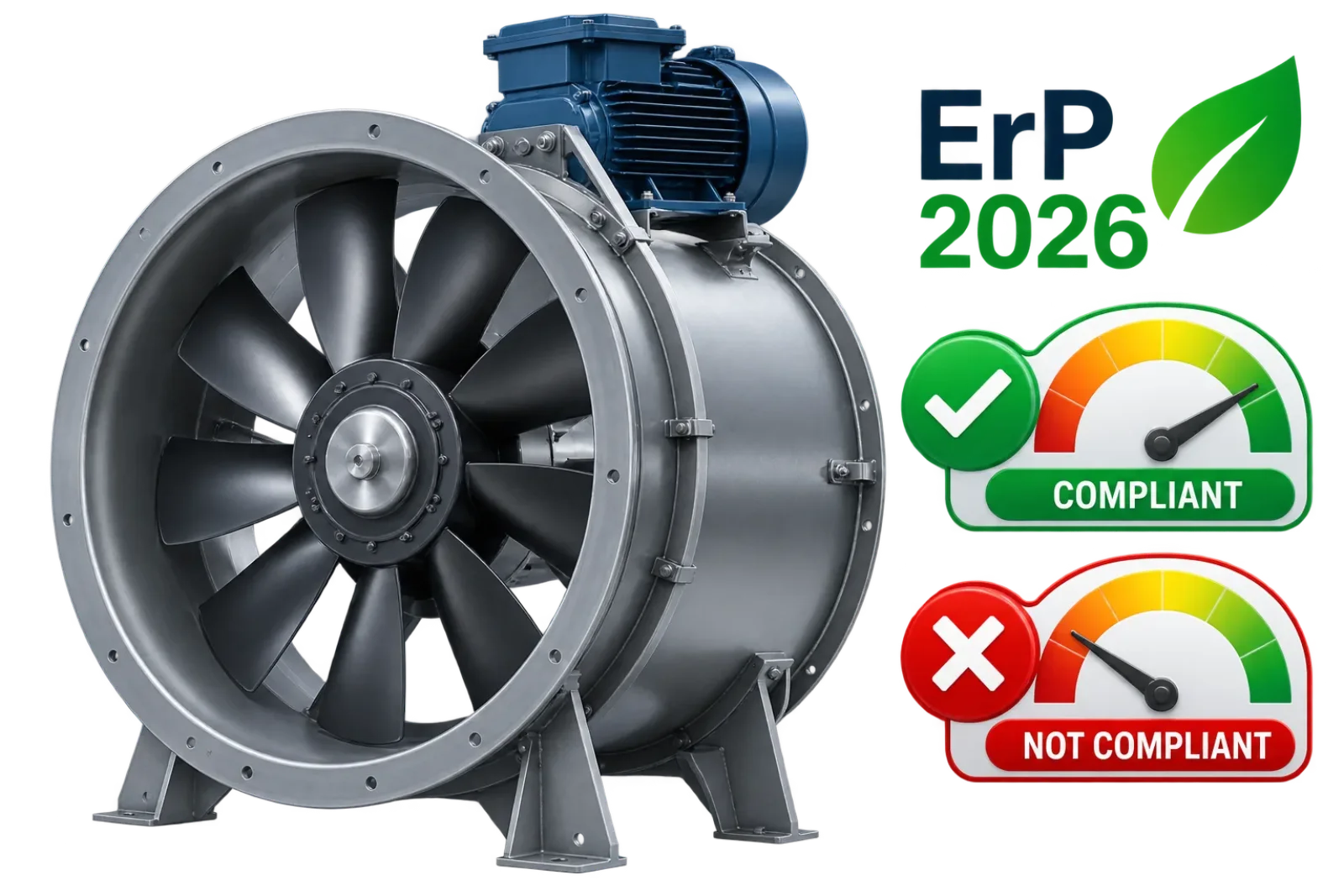
Starting 24 July 2026, a fan that doesn't clear a specific efficiency bar can no longer be legally placed on the EU market. Not "isn't recommended," not "won't qualify for a rebate" — cannot be sold. That's what Regulation (EU) 2024/1834 does, and if you specify, design with, or manufacture fans, this is the regulation that just became the floor everything else sits on.
Here's what actually changed, what the numbers mean, and how to check a fan against it yourself.
What ErP 2026 replaces, and why it exists
The EU has regulated fan energy efficiency since 2011, under Regulation 327/2011 ("ErP" — Ecodesign for Energy-related Products). Regulation (EU) 2024/1834 replaces it, in force from 24 July 2026. The basic idea hasn't changed: fans sold in the EU have to clear a minimum efficiency, and that minimum depends on how big the fan is and what category it's in. What changed is how strict the bar is, and how many fan types it now covers.
Two practical differences stand out. First, the new regulation covers a wider range — from tiny 125 W fans up to 500 kW units. Second, it now explicitly includes jet fans (the ones used for car park and tunnel ventilation), which the old 2011 rule never addressed at all.
What you're actually measuring
The efficiency the regulation checks is a straightforward ratio — how much useful "air power" a fan produces compared with the electrical power it draws to produce it:
η = Cp · Cc · Cguard · Pu / Pe
Pu (air power) is just airflow multiplied by pressure — the physical work the fan is doing on the air. Pe is the real electrical power going in, measured at the motor terminals, or at the speed controller's terminals if the fan has one built in. The three C-factors are small corrections — for the specific measurement setup, any inlet/outlet configuration, and safety guards — that make sure two fans tested slightly differently are still compared fairly.
Everything has to be measured at one specific point: the fan's best efficiency point (BEP) — its own natural sweet spot, not wherever it happens to be installed and running.
A real fan, checked against the regulation
Take a genuine example: a fan moving 17,088 m³/h and drawing 15.4 kW at its best efficiency point. Here's what the check looks like:
- Measured efficiency: 76.68%
- Required minimum for this fan's size and category: 67.41%
- Margin: +9.27 percentage points above the minimum — a clear pass
That "required minimum" isn't one fixed number for every fan — it rises with the size (electrical input power) of the fan, and it depends on an efficiency grade, N, assigned by fan type and blade design. Here's the actual shape of that curve, from 125 W up to 500 kW, with this fan's own point marked on it:
The curve rising steadily and then flattening out is deliberate: small fans are inherently harder to make efficient (less room for the aerodynamics to work with), so the regulation doesn't demand the same efficiency from a 200 W fan as from a 200 kW one — the same fairness principle behind the Fan Energy Index's own reference-fan scaling.
What actually lowers the bar you have to clear
A handful of real fan characteristics reduce the required minimum, because they come with their own genuine engineering trade-offs the regulation accounts for:
- Variable speed drive (VSD) included. A fan sold with its own speed controller as part of the assessed unit gets a different, typically more lenient, comparison.
- Dual-use fans. Fans rated for both normal ventilation and emergency smoke extraction carry design compromises neither pure-ventilation nor pure-smoke fans need to make.
- Reversible fans. A fan that has to perform acceptably running in either direction inherently gives up some peak efficiency compared with one optimised for a single direction.
- Low-noise fans. Meeting a stricter acoustic target is a real efficiency trade-off, not a free feature.
None of these are loopholes — each one reflects a genuine, physical reason that fan can't chase the same efficiency number as a simpler, single-purpose unit.
Does ErP 2026 apply at every operating point?
No. ErP 2026 does not require the minimum efficiency criterion to be satisfied independently at every point along the fan curve. For standard fans, the regulatory efficiency assessment is based on the fan's Best Efficiency Point (BEP).
This is worth stating plainly because it's easy to misread an efficiency curve the wrong way. Looking at a fan's efficiency chart with BEP at 78% and an installed duty point at 60%, it's tempting to read that as "78% PASS, 60% FAIL." That's not how the assessment works — only the BEP figure is checked against Regulation (EU) 2024/1834's minimum efficiency requirement. A fan doesn't become non-compliant simply because its efficiency is lower somewhere else on its curve.
That doesn't make the duty point irrelevant, though — it makes it a separate question. ErP compliance is a market-access gate checked at BEP; how efficiently the fan actually runs in your installation depends on how close your real operating point sits to that BEP. A fan can be fully ErP 2026 compliant and still be a poor energy choice if it's selected to run well away from its best-efficiency point — compliant and well-selected are not the same claim.
Why this matters beyond the compliance certificate
- It's a hard market-access gate, not a rating. Unlike a voluntary efficiency label, failing ErP means the fan cannot legally be placed on the EU market from 24 July 2026 onward — this affects what manufacturers can sell and what specifiers can legally install.
- It has to be checked at BEP, specifically. A fan that looks efficient at its installed operating point can still fail if its actual best-efficiency-point numbers don't clear the bar — and vice versa.
- Jet fans are now in scope for the first time. Any car park or tunnel ventilation project specifying jet fans needs to check compliance that simply didn't exist as a requirement before.
- The category and blade type you select changes the answer. Backward-curved, backward-inclined, forward-curved and radial-bladed fans are graded against different Table 1 rows — the same raw efficiency number can pass in one category and fail in another.
Frequently asked questions
Does a fan have to meet ErP 2026 efficiency requirements at every operating point?
No. For standard fans covered by Regulation (EU) 2024/1834, ErP 2026 compliance is not determined by checking the minimum efficiency requirement at every point on the fan curve. The fan efficiency used for the compliance assessment is established at the Best Efficiency Point (BEP), according to the measurement and calculation methods defined in the Regulation. This means a fan does not automatically become non-compliant simply because its efficiency is lower at another operating point away from BEP. However, the selected operating point still matters for the actual energy consumption and efficiency of the HVAC system.
What is BEP in ErP 2026?
BEP stands for Best Efficiency Point — the operating point at which the fan reaches its maximum efficiency under the specified measurement configuration. ErP 2026 uses parameters determined at BEP for the fan efficiency assessment and for key product information such as electrical input power, airflow and pressure.
Can an ErP 2026 compliant fan operate inefficiently in a real HVAC system?
Yes. ErP compliance and efficient system operation are not the same thing. A fan may comply with ErP 2026 at its BEP but be selected to operate far away from BEP in an actual installation. In that case, its operating efficiency may be considerably lower and its energy consumption higher.
Does the selected HVAC operating point affect ErP 2026 compliance?
Not in the sense of requiring the fan to pass the minimum-efficiency formula independently at every possible duty point. Compliance is based on the regulatory assessment conditions, including BEP. The actual duty point is nevertheless important when selecting a fan because it determines real operating efficiency, power consumption, noise and system performance.
What information is required at the Best Efficiency Point?
For applicable fans, Regulation (EU) 2024/1834 requires product information including the efficiency grade N, electrical input power Pe, volume flow rate qv, and applicable pressure difference Δp at BEP (or Tm where applicable).
Can two fans with the same efficiency have different ErP 2026 results?
Yes. The required minimum efficiency depends on factors including electrical input power, fan type, measurement category and whether static or total efficiency is used. Special characteristics such as reversible, dual-use or low-noise designs can also affect the applicable requirement.
What happens if a fan does not meet ErP 2026 requirements?
From 24 July 2026, fans within the scope of Regulation (EU) 2024/1834 must satisfy the applicable ecodesign requirements to be placed on the EU market or put into service, subject to the regulation's scope, exemptions and transitional provisions.
Check a fan against ErP 2026
CloudAir's ErP 2026 compliance calculator runs the full Annex II and Annex III calculation — fan type, blade type, measurement category, all four special-characteristic corrections — and gives you the measured efficiency, the required minimum, the margin, and a straight pass/fail, with the fan's position plotted against the regulation's full 125 W–500 kW scope. Free, no sign-up, and results export straight to a branded PDF for technical documentation.