

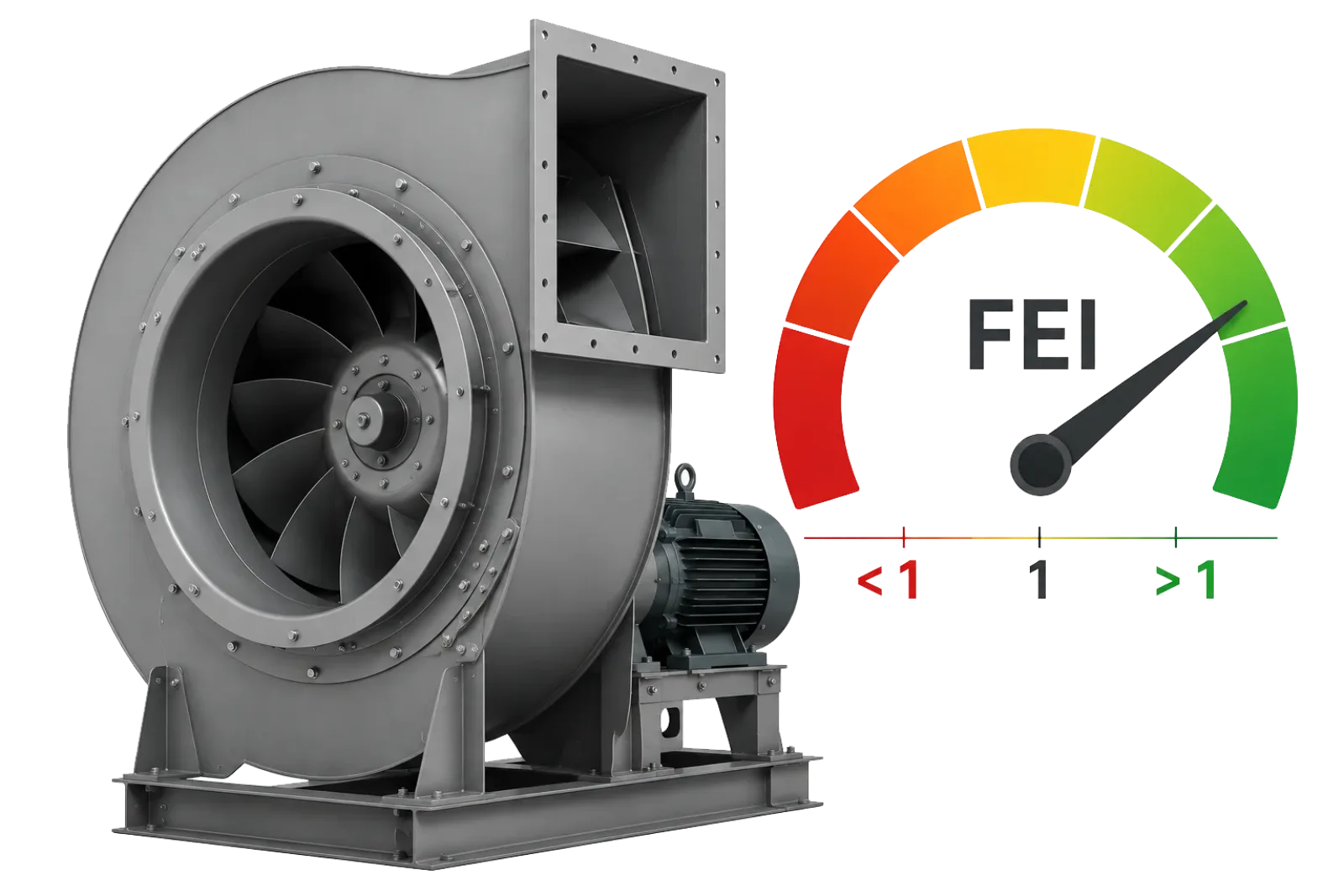
Cars have a fuel economy sticker. Refrigerators have an energy star rating. Fans — the ones running 24/7 in the mechanical room of almost every building — have something similar, and since a few years ago, it's not optional. It's called the Fan Energy Index (FEI), and in a lot of places, a fan simply cannot be installed in a new building unless its FEI clears a legal minimum.
Here's what that number actually means, where it comes from, and why it's become something you can't just skip past on a datasheet anymore.
The problem FEI was built to solve
Before FEI existed, a fan's "efficiency" usually meant one number on a catalogue page — its best possible efficiency, measured at its best possible operating point. The trouble is, almost no fan actually runs at that one perfect point in a real building. It runs wherever the ductwork and the building's actual airflow needs put it — which is very often nowhere near that flattering catalogue number.
That gap let a genuinely inefficient fan look great on paper while quietly wasting energy every single day it ran. FEI closes that gap by refusing to grade the fan in the abstract. It grades it at the exact airflow and pressure it's actually being asked to deliver — its real duty point, not its best day.
What FEI actually measures
Think of it as a simple comparison: "how much electricity does my fan use to do this job, compared with a defined, standardised fan doing the exact same job?"
FEI = (power the reference fan would use) ÷ (power your fan actually uses)
Both sides of that comparison are measured in kilowatts, at the identical airflow and pressure. An FEI above 1.0 means your fan uses less power than the reference — it's beating the baseline. Below 1.0 means it's using more. As a rule of thumb: an FEI of 1.20 means roughly 17% less power than the reference fan; an FEI of 0.90 means roughly 11% more.
Who — or what — is the "reference fan"?
This is the part that trips people up: the reference fan isn't a real product anyone builds. It's a defined mathematical yardstick — a fan built from typical, legally-specified efficiencies for its size, so that a tiny fan and a massive one are judged fairly against different baselines, not the same one.
That matters because small fans are physically harder to make efficient than big ones — there's less room for the aerodynamics to work with. So the standard quietly makes the reference fan proportionally less demanding as airflow drops, and proportionally stricter as airflow rises. A 500 CFM fan and a 50,000 CFM fan are never compared to the same imaginary opponent.
A real example, worked through
Take a fan delivering 10,000 CFM at 2 inches of water gauge pressure — a completely ordinary commercial duty point. Here's what the standard's reference chain says a fan built to the legal minimum would draw at that exact point, versus what a genuinely well-selected fan draws instead:
| Reference (bare minimum) fan | This fan | |
|---|---|---|
| Electrical power drawn | 5.59 kW | 4.50 kW |
| Wire-to-air efficiency | 42.0% | 52.2% |
Divide 5.59 by 4.50 and you get an FEI of 1.24 — comfortably clearing the standard 1.00 minimum, and using about a fifth less electricity than the legal floor allows at this exact duty point, every hour it runs.
The same fan can pass at one point and fail at another
This is the detail that catches people out: FEI isn't a fixed property of a fan, like its weight. It depends on where on its curve the fan is actually operating. Take that same fan's whole performance curve — the familiar shape of falling pressure as airflow rises — and check FEI continuously along it, and a clear pattern appears:
Near the middle of its curve — close to where it's actually most efficient — this fan is well clear of the line. But select it (or let system changes push it) too far toward either end, and the identical hardware fails the exact same check. This is precisely why the standard insists on checking FEI at the real design duty point: a fan's spec sheet can't tell you which zone you're actually going to be operating in.
Why it actually matters — beyond the electricity bill
Saving energy is the obvious benefit, but it's not the sharpest edge of this metric. The sharpest edge is that FEI is now law in most of the United States for the great majority of new and replacement fans, through ASHRAE 90.1-2019 and the 2021 International Energy Conservation Code. Depending on the fan type and size, the minimum is typically FEI ≥ 1.00 (or 0.95 for variable-air-volume systems that spend most of their life throttled back, and 1.10 under the stricter ASHRAE 189.1 green-building standard).
In practice, that means:
- It can block a permit. A fan that fails its required FEI at the design duty point can fail plan review or inspection — the same way an undersized structural beam would.
- It has to be checked at the real operating point, not the catalogue's favourite one. A fan with a fantastic peak efficiency can still fail FEI if it's selected to run somewhere else on its curve.
- It follows the fan through its whole power chain. Motor efficiency, drive losses (belts lose a little power; direct-drive doesn't), and even the speed controller all factor into the actual number — not just the aerodynamic design of the impeller.
Common mistakes worth avoiding
- Checking FEI at the wrong duty point. The code checks the design (or scheduled) operating condition — not the fan's best-efficiency point, and not some arbitrary test condition from a catalogue.
- Forgetting the speed controller. If a fan has a VFD, the actual power measurement is taken at the controller's input, not at the motor — the controller's own losses count too.
- Assuming a bigger, more expensive fan automatically passes. FEI compares against a reference that scales with size specifically so this shortcut doesn't work. An oversized fan running throttled back and inefficient can still fail.
- Using static pressure and total pressure interchangeably. The reference fan's baseline efficiency is different for each basis — mixing them up skews the result in either direction.
Frequently asked questions
What is a good FEI value for a fan?
An FEI of 1.00 means the fan system uses the same electrical input power as the reference fan at the same duty point. Values above 1.00 indicate lower power consumption than the reference. For example, FEI 1.20 means the actual fan requires about 16.7% less electrical power than the reference fan at that operating point.
Is FEI calculated at the Best Efficiency Point (BEP)?
Not necessarily. FEI can be calculated at any point on the fan curve and is specifically intended to evaluate performance at a given duty point defined by airflow and pressure. For design and code compliance, the relevant design or scheduled operating point is typically what matters, not automatically the fan's BEP. This is a real point of difference from ErP 2026, where the regulatory efficiency assessment for standard fans is based specifically on BEP — FEI instead follows wherever your actual duty point sits.
Can the same fan have different FEI values?
Yes. FEI is not a single fixed characteristic of a fan. The same fan can have different FEI values at different airflow and pressure combinations. It may achieve FEI above 1.00 in one part of its operating range and below 1.00 elsewhere.
Does FEI include motor and drive efficiency?
Yes. FEI is a wire-to-air metric that accounts for the electrical input power of the complete fan system, including applicable motor and drive/controller losses. This is one of the important differences between FEI and metrics based only on aerodynamic fan efficiency.
Is a higher FEI always better?
For the same duty point, a higher FEI means lower electrical input power relative to the reference fan, so higher is generally better from an energy-performance perspective. However, fan selection should also consider acoustics, operating range, system effect, reliability, controllability and other application requirements.
What does FEI 1.20 mean?
Because FEI is defined as reference fan power divided by actual fan power, an FEI of 1.20 means the actual fan uses approximately 83.3% of the reference fan's power, or about 16.7% less power, at that same airflow and pressure.
What is the difference between FEI and fan efficiency?
Fan efficiency describes how effectively input power is converted into useful air power. FEI instead compares the electrical input power of the actual fan system with a standardized reference fan at the same duty point. Therefore, two fan selections with similar aerodynamic efficiency can still have different FEI values.
Can a fan pass FEI at one operating point and fail at another?
Yes. Because FEI changes with airflow, pressure and input power, a fan may satisfy a required FEI threshold at one duty point but not at another. This is one of the main reasons FEI is useful for fan selection rather than simply assigning one efficiency number to an entire fan model.
Check your own fan's FEI
CloudAir's FEI calculator builds the entire reference chain for you — shaft power, drive losses, motor efficiency — per ANSI/AMCA Standard 208-18, so you see not just the final index but exactly where the reference number comes from, and how much margin you have (or don't) before falling below the code threshold. Free, no sign-up.