

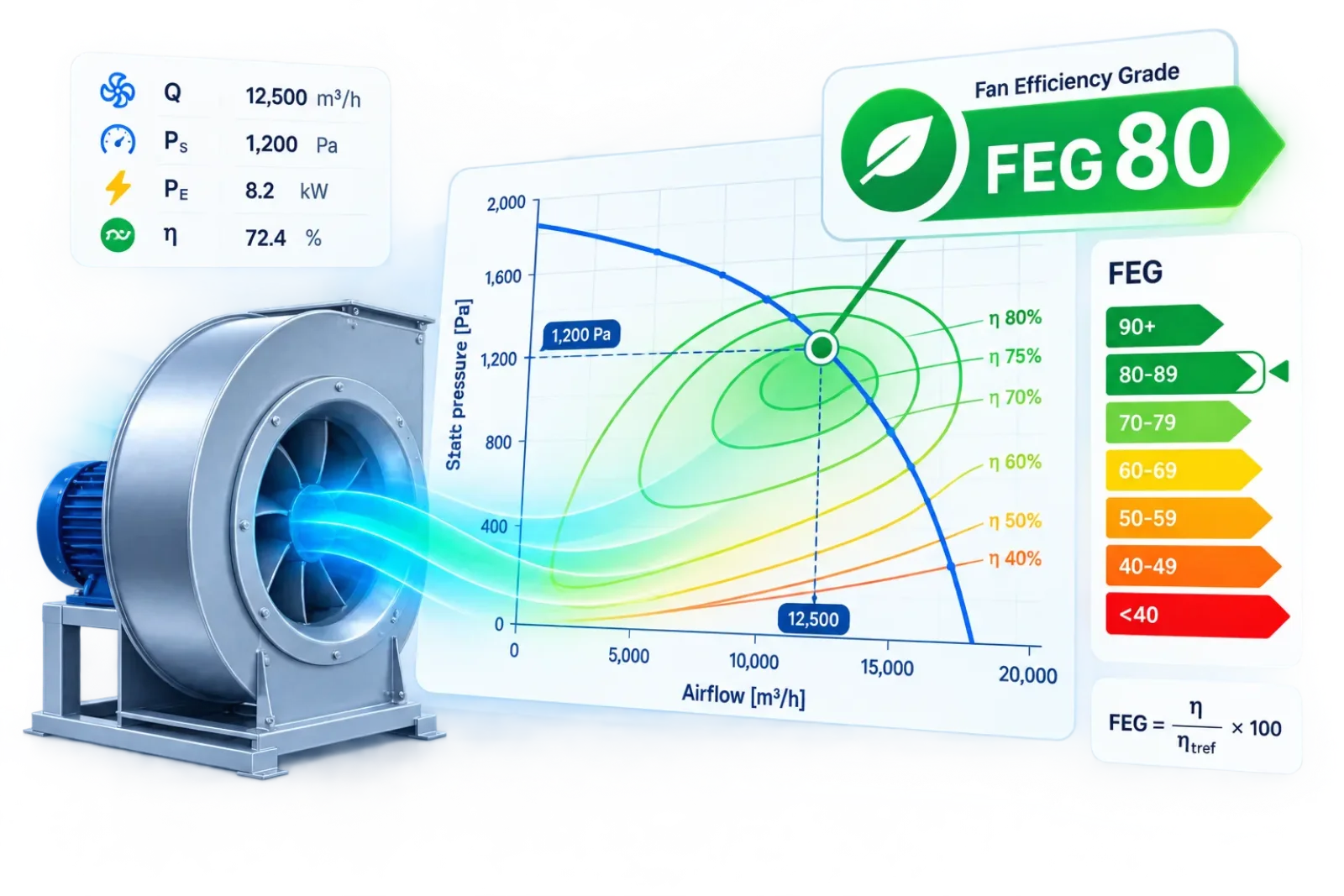
Five different acronyms, all claiming to tell you "how good is this fan": η, SFP, FEG, FEI, and now ErP 2026. They get mixed up constantly, quoted interchangeably in specs and conversations — and they genuinely aren't interchangeable. Two of them can even disagree about the same fan, and both be right, because they're measuring different things.
Here's what each one actually means, and — the part that clears up almost all the confusion — exactly where in the fan's power chain each one draws its line.
The one diagram that explains all five
Electricity goes in at the wall. Useful moving air comes out the other end. In between, power is lost in stages — at the motor, at the drive (if there is a belt), and in the fan's own aerodynamics. Every one of these five metrics is really just asking "how much survives, over which stretch of that journey?" — and they don't all draw the line in the same place:
That one distinction — whole chain versus aerodynamics-only — explains most of the real-world confusion between these metrics. Now the details of each.
η — overall (wire-to-air) efficiency
The simplest of the five: just a plain percentage, no comparison to anything else. It's the fan's own actual power divided by what you paid the electricity meter for:
η = air power ÷ electrical input power
No reference fan, no grade, no legal minimum attached to the number itself — it's a raw measurement. The other metrics build on related concepts of fan efficiency or energy performance, but each uses a different boundary, reference or regulatory methodology.
SFP — Specific Fan Power
SFP flips the question around: instead of a percentage, it asks "how many watts does it cost to move one unit of air?" — usually expressed as W per m³/s.
A real example: a fan moving 10,000 m³/h at 800 Pa, running at 65% overall efficiency, draws 3.42 kW — which works out to an SFP of 1,231 W/(m³/s). Codes that use SFP (this shows up a lot in UK and EU building regulations) often group that number into bands — this example falls in a band commonly labelled "SFP3," roughly 750–1250 W/(m³/s).
Like η, SFP has no reference fan behind it — it's a direct, practical number that's easy to write into a spec ("SFP shall not exceed …") without needing a lookup table.
FEG — Fan Efficiency Grade (AMCA 205)
This is where it gets more structured — and where the aerodynamics-only distinction from the diagram above actually matters. FEG compares a fan's peak total efficiency (at its own best-efficiency point, using shaft power — before the motor and drive) against a reference band that shifts with the fan's physical size:
Two things make FEG different from the others. First, it's evaluated only at the fan's own best point — not wherever it happens to be installed and running. Second, because it's built from shaft power, it says nothing about the motor or drive at all — a beautifully efficient impeller bolted to a poor motor still gets a good FEG.
FEI — Fan Energy Index (AMCA 208)
FEI fixes both of FEG's blind spots. It's evaluated at the fan's actual real-world duty point — not its best point — and it includes electrical input power, meaning the motor and drive are baked into the number:
FEI = reference fan power ÷ your fan's actual power, at the same duty point
An FEI above 1.0 beats the reference; below 1.0 falls short. Because it's checked at the real operating point rather than a flattering best-case point, a fan selected badly for its actual job — oversized, or running far off its own sweet spot — can score poorly on FEI even with an excellent FEG.
ErP 2026 — the EU's legal minimum (Regulation 2024/1834)
ErP looks similar to FEI in spirit — wire-to-air efficiency, compared against a minimum that scales with fan size — but it's a fundamentally different kind of thing: not a voluntary rating, a legal market-access requirement. From 24 July 2026, a fan that doesn't clear its ErP minimum simply cannot be sold in the EU. FEI and FEG are ratings you can quote or specify against; ErP is closer to a car needing an emissions certificate before it can be registered.
Side by side
| Metric | Evaluated at | Power basis | Compares against | Nature |
|---|---|---|---|---|
| η | any point | electrical (wire-to-air) | nothing — raw ratio | measurement |
| SFP | any point | electrical (wire-to-air) | nothing — raw W/(m³/s) | measurement |
| FEG | best efficiency point | shaft (aerodynamic only) | size-scaled grade band | voluntary rating |
| FEI | actual duty point | electrical (wire-to-air) | size-scaled reference fan | voluntary rating / code metric |
| ErP 2026 | best efficiency point | electrical (wire-to-air) | size-scaled legal minimum | legal requirement (EU) |
Which one should you actually care about?
- Selling or installing in the EU? ErP 2026 is non-negotiable — it's the floor, not a nice-to-have.
- Working to ASHRAE 90.1 / IECC (common in the US)? FEI is the metric those codes actually reference, checked at the real duty point.
- Comparing raw fan hardware, independent of the motor you'll pair it with? FEG isolates exactly that.
- Writing a simple spec line, or working to UK/EU building regulations? SFP is the practical, easy-to-verify number.
- Just want the honest underlying number with no code attached? η is that number — everything else is η wrapped in a comparison.
None of these replace the others — a fan can, and often does, get checked against more than one at once. Knowing which question each one is actually answering is what stops the mix-ups.
Frequently asked questions
What is the difference between FEG and FEI?
FEG evaluates the aerodynamic efficiency of the fan at its best efficiency point and does not include motor or drive losses. FEI evaluates the complete fan system at a specific operating point and includes electrical input power. A fan can therefore have a good FEG but a relatively poor FEI if it is selected far from its efficient operating region.
Is FEI calculated at the Best Efficiency Point (BEP)?
Not necessarily. FEI is a duty-point-based metric and can be calculated at different airflow and pressure combinations along the fan curve. This is fundamentally different from FEG, which is based on peak fan efficiency, and ErP 2026 efficiency assessment, which uses parameters determined at BEP.
Does a fan have to meet ErP 2026 efficiency at every operating point?
No. ErP 2026 does not require the minimum efficiency criterion to be independently satisfied at every point along the fan curve. For standard fans within the scope of Regulation (EU) 2024/1834, the regulatory efficiency assessment is based on parameters determined at the Best Efficiency Point (BEP). A fan may therefore operate at lower efficiency away from BEP without automatically becoming non-compliant.
Can a fan have a high efficiency but a poor FEI?
Yes. A fan may achieve high peak efficiency but perform less efficiently at the actual selected duty point. FEI is sensitive to the real airflow, pressure and electrical input power, which makes it useful for identifying fan selections that operate far from their efficient region.
Which fan efficiency metric should I use when selecting a fan?
There is no single metric for every purpose. Use ErP to verify EU regulatory compliance, FEI to evaluate energy performance at a specific duty point, FEG to compare aerodynamic fan efficiency, SFP to assess power consumption relative to airflow, and η when you need the underlying efficiency itself.
Check a fan against any of them
CloudAir has a dedicated calculator for each: Fan Power & SFP, Fan Efficiency Grade (FEG), Fan Energy Index (FEI), and ErP 2026 compliance — or run every one of them from a single duty point with the Fan Operating Point calculator, which computes SFP, FEI and VDI 3731 sound power together. All free, no sign-up.