

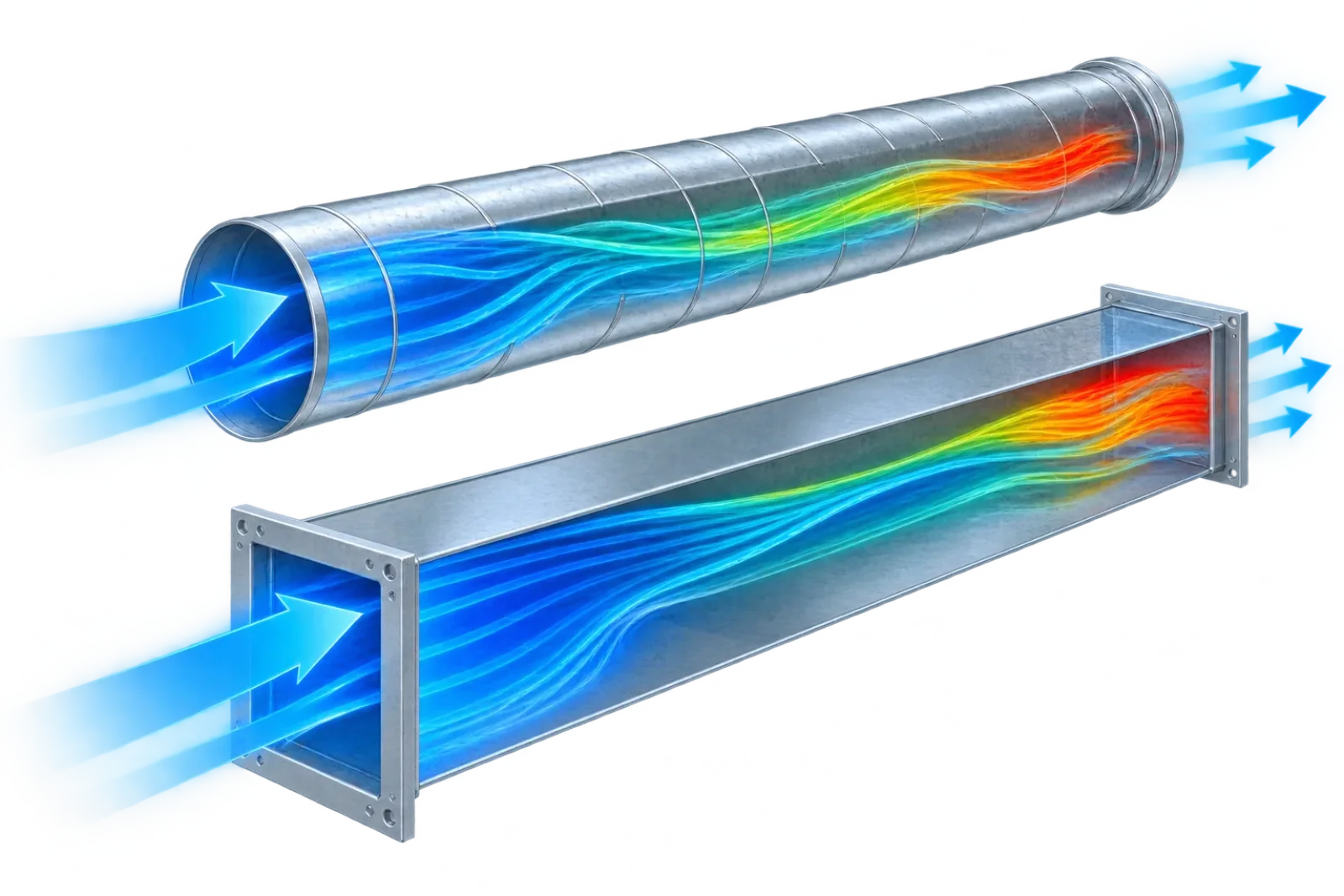
Static pressure, velocity pressure, total pressure — three numbers, one simple equation between them, and yet fan datasheets, selection software and site measurements mix them up constantly. Get the difference clear once and a lot of confusing HVAC behaviour — including why airflow can drop even as a duct gets narrower — stops being confusing.
Three pressures, one equation
Air moving through a duct carries pressure in two different forms at the same time:
- Static pressure (Ps) — the pressure pushing outward on the duct wall in every direction, exactly like the air in a balloon. It exists whether the air is moving or standing still, and it's what does the work of pushing air through resistance: filters, coils, bends, dampers.
- Velocity pressure (Pv) — the pressure that exists only because the air is moving. It's kinetic energy, and it depends on velocity squared: double the air speed and velocity pressure quadruples.
- Total pressure (Pt) — simply the sum of the two:
Pt = Ps + Pv
Total pressure is the true measure of the energy the fan has added to the air. Static and velocity pressure are just two forms that energy can take — and, critically, air can trade one for the other as it moves through a duct, even with no fan anywhere nearby.
How each one is actually measured
The distinction isn't just theoretical — it's built into how a manometer probe is held:
- A probe pointed into the oncoming air (a Pitot tube facing upstream) is stopped by the flow at its tip, so it reads the full total pressure — static plus velocity.
- A small hole drilled flush with the duct wall, with no probe projecting into the airstream, reads static pressure only — the air is moving past it, not into it.
- Velocity pressure is never measured directly on its own. It's calculated as the difference: Pv = Pt − Ps. A standard Pitot-static tube measures both total and static in one insertion and lets the instrument subtract.
Velocity pressure also gives you air velocity directly, through v = 1.29√Pv (v in m/s, Pv in Pa, at standard air density) — which is exactly how Pitot-tube traverses convert a pressure reading into an airflow measurement on site.
A worked example: what happens when the duct gets bigger
Take 5,000 m³/h leaving a fan through a Ø400 mm duct, which then widens to Ø560 mm partway along the run. Four points along that path, all at the same airflow:
| Point | Duct | Velocity | Pv | Ps | Pt |
|---|---|---|---|---|---|
| A — fan discharge | Ø400 mm | 11.1 m/s | 73.5 Pa | 176.5 Pa | 250.0 Pa |
| B — before the expansion | Ø400 mm | 11.1 m/s | 73.5 Pa | 161.5 Pa | 235.0 Pa |
| C — right after the expansion | Ø560 mm | 5.6 m/s | 19.1 Pa | 207.7 Pa | 226.8 Pa |
| D — further downstream | Ø560 mm | 5.6 m/s | 19.1 Pa | 199.7 Pa | 218.8 Pa |
Between A and B, total pressure falls the way you'd expect — plain duct friction, nothing surprising. But between B and C, at the expansion, look at static pressure: it goes up, from 161.5 Pa to 207.7 Pa, even though total pressure keeps falling. That's not a measurement error. As the duct widens, velocity drops, and the velocity pressure that's lost gets partly converted back into static pressure. This is static regain, and it's a completely normal, well-understood effect at any duct expansion, diffuser, or plenum — some of it is always lost to turbulence (which is why Pt still falls even as Ps climbs), but the recovered portion is real and is routinely designed for in large duct systems.
Why this matters when you're selecting a fan
A fan does work on the air and adds total pressure — that's the physically correct quantity for the energy balance. But most fan datasheets and selection tools quote performance as static pressure vs. airflow, not total pressure, because static pressure is what the downstream ductwork and terminal devices actually need to overcome, and it's what's normally measured on site.
The two conventions are both legitimate, but only if you're consistent. Mixing them is where errors creep in:
- Adding up a duct system's resistance (all in terms of static pressure loss through friction and fittings) and then checking it against a fan curve that's actually plotted as total pressure — without subtracting the fan's own outlet velocity pressure — understates the fan's real static output and can lead to an oversized fan being selected.
- Comparing two fans' datasheets where one vendor quotes static pressure and another quotes total pressure at the same duty point, without checking which is which.
- Measuring "pressure" on a commissioning report with a probe that isn't clearly static, total, or velocity — the three numbers can differ by a lot at high velocity, and a mislabelled reading looks like a fan performance problem when it's actually just the wrong pressure being read.
The safest habit: always check which pressure a number represents before comparing it to anything else. At low duct velocities the three values are close enough that the distinction barely matters. At high velocities — small ducts, high-pressure systems — velocity pressure can be a large fraction of the total, and conflating static with total pressure produces a real, consequential error.
Check it on your own system
CloudAir's Fan Operating Point calculator works in consistent static-pressure terms against your actual system curve, and the Duct Pressure Drop calculator and Duct Network Configurator build up total system resistance component by component, so static, velocity and total pressure never get mixed up in the first place. Free, no sign-up.