

There is no fixed price for fan selection software. The cost depends on the manufacturer's product range, the structure and quality of the existing technical data, the engineering calculations the program must perform and the modules it needs, such as acoustics, PDF datasheets, projects, API integration or an administration panel.
A simple selection system can be relatively straightforward. A complete platform with advanced calculations, acoustics, accessories, projects, PDF documentation, integrations and a full administration panel is a much larger project.
In practice, the final price depends less on the number of screens and more on the amount and quality of technical data that has to be prepared. This guide explains what drives the cost, and how to get a first estimate in a few minutes.
What affects the cost of fan selection software?
The main factors are:
- the number of fan series and products,
- the complexity of the selection algorithm,
- the quality and format of the existing product data,
- whether the manufacturer enters the data or CloudAir prepares it,
- performance curves,
- motor data,
- acoustic data,
- dimensions and drawings,
- accessories,
- the number of languages,
- PDF documentation,
- API or DLL integration,
- the administration panel,
- project management,
- custom modules.
Two manufacturers can need a visually similar selection program and still have very different implementation costs, because their source data is completely different.
Who prepares the product data?
This is one of the biggest cost factors.
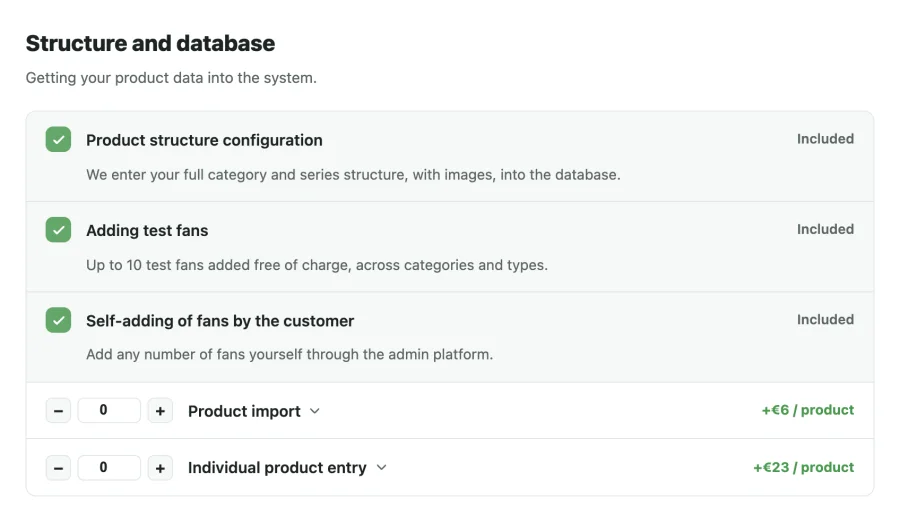
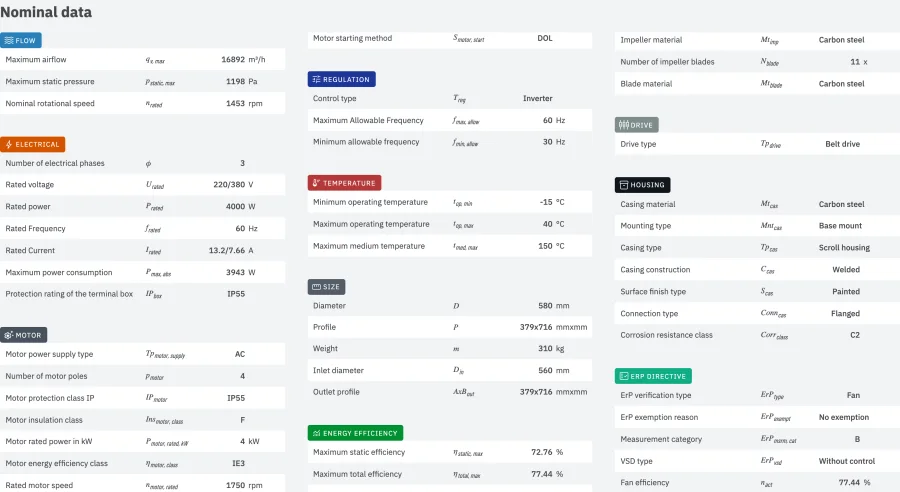
If the manufacturer already has well-structured data in Excel, CSV, SQL or another database format, implementation can be much faster. If CloudAir has to prepare the data, the workload grows. Typical tasks include:
- importing fan performance curves,
- cleaning and normalizing product data,
- connecting motors with fan models,
- preparing acoustic data,
- creating product relationships,
- assigning accessories,
- verifying units,
- preparing translations,
- building calculation tables.
The more structured the manufacturer's existing data is, the lower the implementation cost usually becomes. For what "structured" means in practice, see how to build a fan product database.
Manual data entry vs manufacturer-managed data
There are generally two approaches.
In the first, CloudAir prepares and enters the complete initial product database. This is convenient for the manufacturer, but it increases the implementation cost.
In the second, CloudAir delivers the platform and administration tools, and the manufacturer enters or imports the product data internally. This can significantly reduce the initial cost.
Many projects use a mixed approach. CloudAir prepares the first product range, defines the database structure and verifies the calculation model. After that, the manufacturer's team adds new products independently.
Drawings and dimensional data
Technical drawings can also have a major impact on the cost. Some manufacturers already have:
- SVG files,
- CAD files,
- DXF drawings,
- other vector drawings,
- structured dimension tables.
In this case, integration is relatively simple.
Sometimes, though, the only available material is an old PDF catalog or a scanned drawing. If every dimension has to be redrawn as clean vector graphics, that becomes a separate part of the project. For a manufacturer with 200 fan models, each needing a new vector drawing, the amount of work is significant.
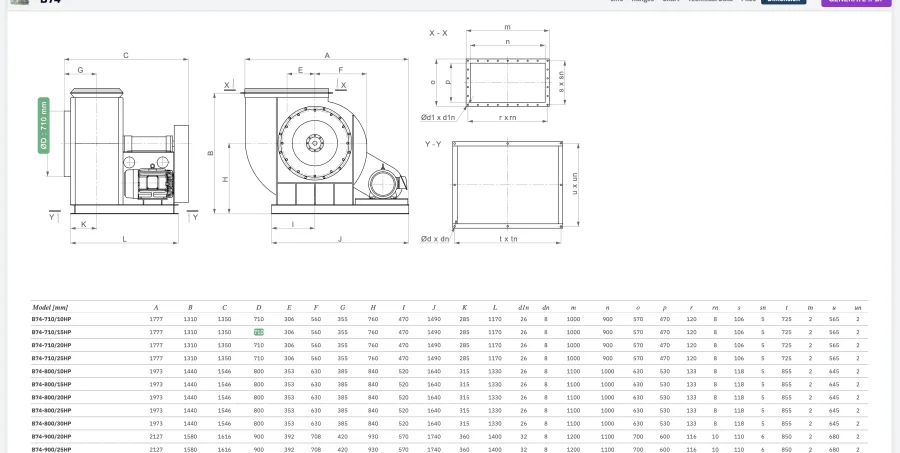
This is why dimensional documentation should always be reviewed before the final quotation.
Performance curves
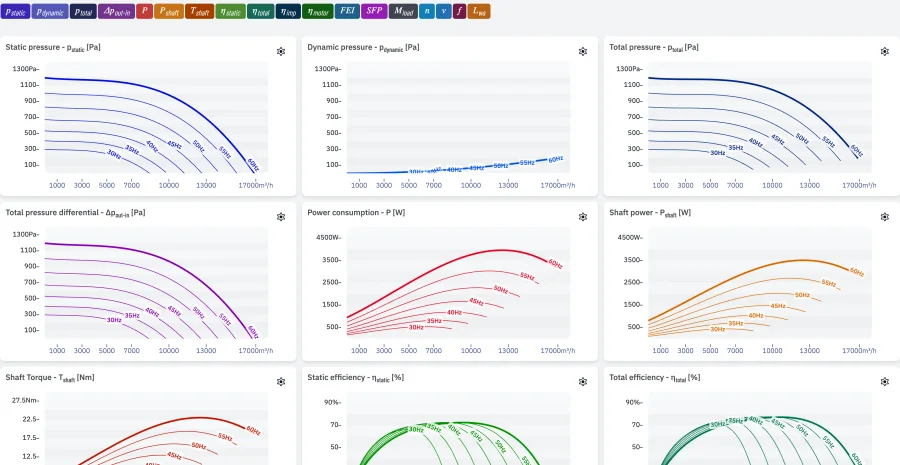
Fan performance curves are the core of the system, and the cost depends on the form they come in.
The best case is numerical test data, for example:
- airflow,
- static pressure,
- total pressure,
- power,
- efficiency,
- speed,
- sound levels.
If this data already exists in structured form, it can usually be imported. If only graphical curves in PDF catalogs are available, the curves may have to be digitized by hand, which can significantly increase the implementation time.
Acoustic data
Acoustics can also affect the price. Some manufacturers provide only one total sound value. Others provide octave-band data for:
- the inlet,
- the outlet,
- the casing,
- radiated sound.
A more advanced acoustic module needs more data preparation and testing. If calculations must follow specific standards, the project becomes more complex. The background is covered in sound power vs sound pressure and octave bands.
Number of products
The number of products matters, but not always the way people expect. A database with 1,000 products is not necessarily ten times more expensive than one with 100. If the data structure is consistent and can be imported automatically, a large catalog can be relatively easy to implement.
The real problem is inconsistent data, for example:
- a different Excel format for every series,
- missing motor information,
- mixed units,
- incomplete curves,
- inconsistent naming,
- missing dimensions.
Cleaning and standardizing this data often takes more time than developing the software itself.
Standard selection vs advanced engineering calculations
A basic fan selection program may only need:
- airflow,
- pressure,
- fan type,
- product filtering,
- performance curves,
- a PDF datasheet.
An advanced system may also include:
- FEI calculations,
- ErP compliance,
- acoustic calculations,
- energy cost calculations,
- variable speed control,
- multiple operating points,
- blade-angle calculations,
- density, altitude and temperature correction,
- custom fan laws,
- product optimization.
Each additional engineering module adds development and validation work.
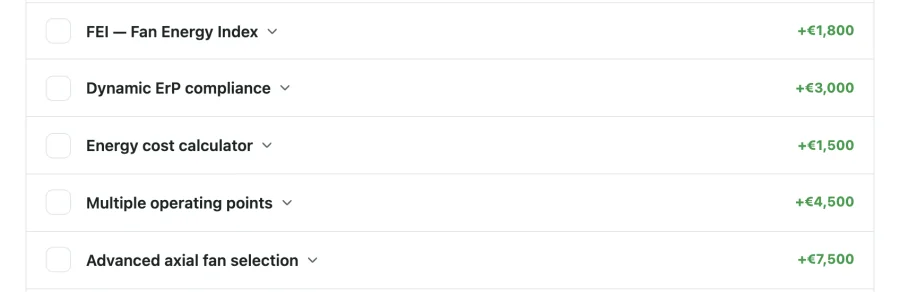
To see what each of these modules does in a working program, read what fan selection software is, which walks through a live example.
Administration panel
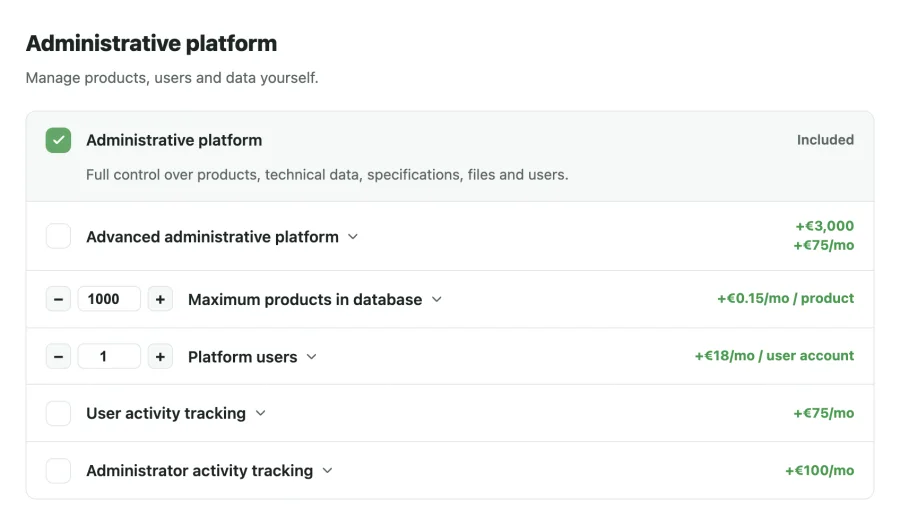
A modern fan selection system should not need a developer every time a product changes. That is why many projects include a full administration platform, in which the manufacturer manages:
- products and product groups,
- curves,
- motors,
- dimensions,
- documents,
- accessories,
- translations,
- users,
- technical attributes.
A more advanced admin system can also include import tools, audit logs, user permissions and activity tracking. This raises the initial cost but usually lowers long-term maintenance costs. See the platform overview for what the admin side covers.
API and DLL integration
Some manufacturers need the selection engine to work inside another system, for example:
- AHU selection software,
- BIM software,
- ERP systems,
- product configurators,
- external engineering tools.
This can be done with:
- a REST API returning JSON or XML,
- a DLL library,
- a custom integration.
API and DLL development is normally priced separately because it needs its own documentation, testing and version management.
PDF documentation
Automatic technical documentation is another common module. The software generates branded PDF selection sheets that contain:
- the selected fan,
- the operating point,
- fan curves,
- motor data,
- acoustics,
- dimensions,
- FEI and ErP information,
- project data.
If the manufacturer needs many different document templates, languages or layout versions, this also affects the final cost.
How is the price calculated?
There is no fixed price for fan selection software, because every project is different. The final cost depends on the scope of the system and, above all, on the quality and structure of the available technical data.
Before preparing a quotation, we usually review:
- the number of product series,
- the number of products,
- the structure of the existing data,
- fan curves,
- motor data,
- acoustic data,
- technical drawings,
- the number of languages,
- the required calculation modules,
- PDF documentation,
- API or DLL integration,
- the administration panel,
- accessories and configuration logic.
Another important factor is who prepares the data. If the manufacturer provides clean, structured data, implementation can be much faster. If CloudAir has to prepare the database, digitize curves, organize product relationships, redraw dimensions as vector graphics or clean up old catalog data, the amount of work increases.
For this reason, two manufacturers with the same number of products can have very different implementation costs.
Use our cost calculator
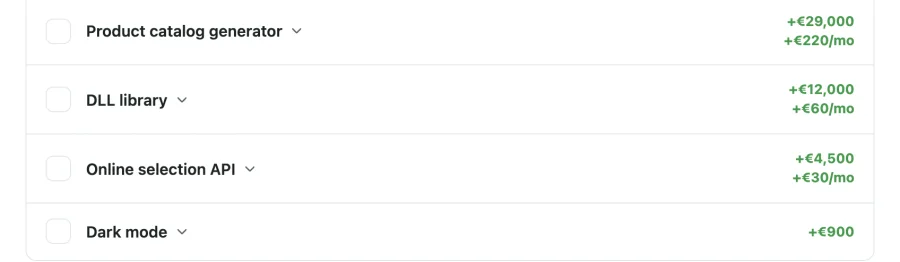
To make the first estimate easier, CloudAir provides a Fan Selection Software Cost Calculator. You start from a preset that matches your company, from a small OEM to an enterprise manufacturer. Then you add or remove modules and set the number of products, languages and admin users. The one-time and monthly totals update with every change.
The estimate is a first indication before a detailed technical review. A final quotation is prepared after we check your product data and agree on the required modules, and you can send your configuration to us straight from the calculator, with no commitment.
Example: same catalog size, different scope
Imagine two manufacturers, each with 500 fan models.
Manufacturer A has:
- structured Excel data,
- numerical fan curves,
- vector drawings,
- complete acoustic data,
- standardized motors.
Manufacturer B has:
- old PDF catalogs,
- graphical curves only,
- scanned drawings,
- incomplete motor data,
- inconsistent product naming.
Both have the same number of products, but Manufacturer B needs significantly more preparation work. This is why the number of products alone is not enough to calculate the price.
Conclusion
There is no universal price for fan selection software. The cost depends mainly on:
data preparation, number of products, complexity of calculations, technical drawings, integrations and required modules.
If the manufacturer already has structured product data, implementation is usually faster. If the project needs manual data preparation, curve digitization, vector redrawing of dimensions or extensive configuration logic, the scope becomes larger.
The most accurate way to estimate a project is to review the existing technical data first and then define the required functionality. For an initial estimate, use the CloudAir Fan Selection Software Cost Calculator, or read more about our fan selection software.
Frequently asked questions
How much does fan selection software cost?
There is no fixed price. The cost depends on the number of products, the quality of the existing data, who prepares it, and the modules required, such as FEI and ErP, acoustics, projects, PDF documentation or API integration. The cost calculator gives a first estimate for your own configuration.
What makes fan selection software more expensive?
Mostly data preparation: digitizing curves from PDF catalogs, redrawing scanned dimensions as vector graphics, completing motor and acoustic data and standardizing inconsistent spreadsheets. Advanced calculation modules and integrations such as an API or DLL add to the scope as well.
Can we enter the product data ourselves to reduce the cost?
Yes. The administration platform lets the manufacturer's team add and import products. A common approach is for CloudAir to set up the structure and the first product range, and for the manufacturer to add the rest.
Does a larger catalog always cost more?
Not proportionally. A large catalog with consistent, structured data can be imported automatically, while a smaller one with mixed formats and missing data may need more manual work.