
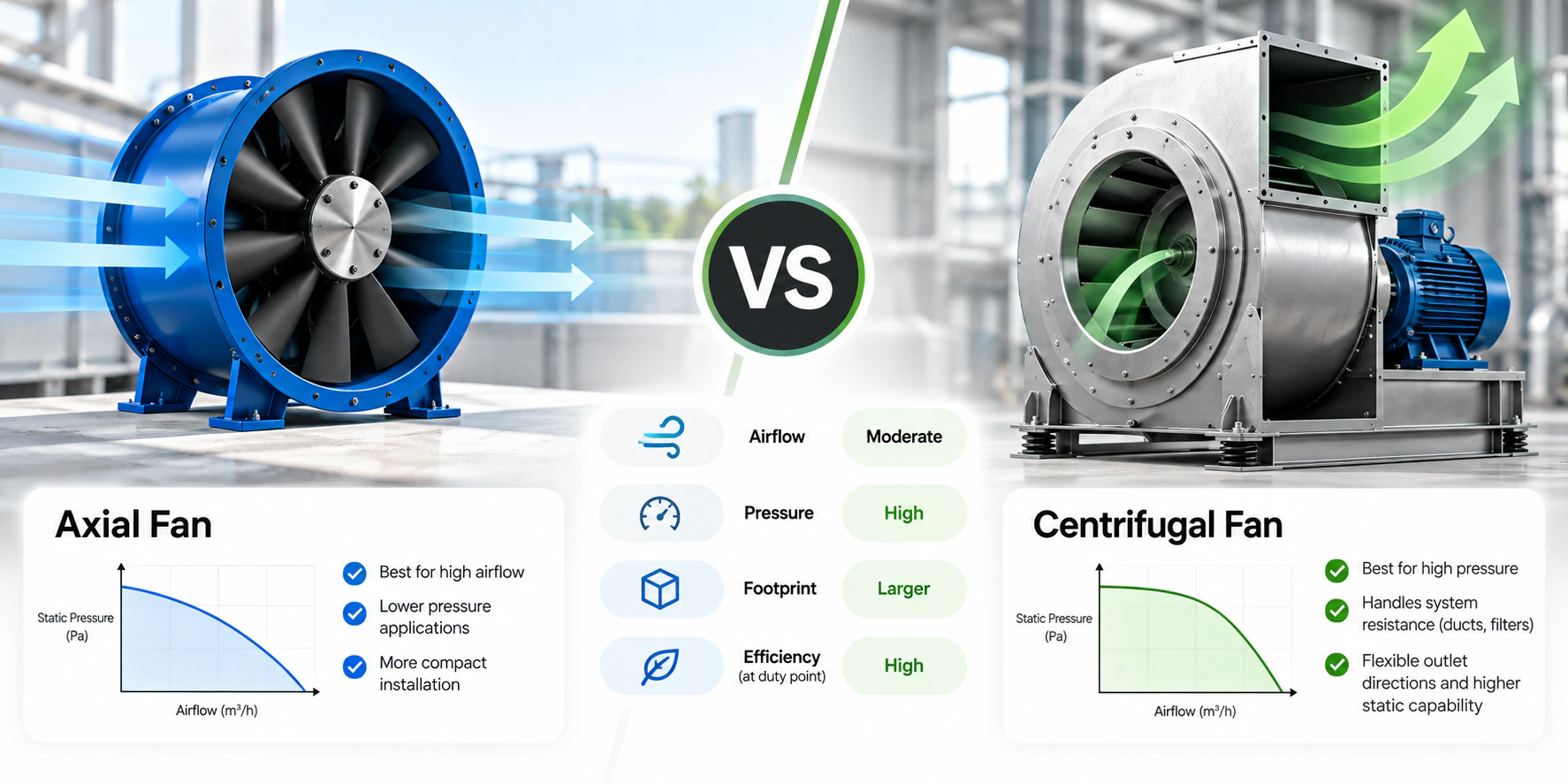
"Axial or centrifugal?" is usually the wrong first question. Both fan types can often reach the exact same airflow and pressure — the real question is which one reaches it at a better operating point: higher efficiency, lower noise, smaller installation, or a more stable pressure curve for your specific system.
This guide walks through the parameters that actually decide the answer — duty point, pressure capability, efficiency at the real operating point, noise, size and installation — with worked numbers, not just adjectives.
Required duty point → Pressure requirement → System resistance → Fan type → Operating point → Efficiency → Noise → Final selection
1. How axial and centrifugal fans work
2. Axial vs centrifugal — quick comparison
| Parameter | Axial fan | Centrifugal fan |
|---|---|---|
| Airflow | Very high | Low → very high |
| Pressure capability | Low → high* | Medium → very high |
| Installation space | Compact | Usually larger |
| Efficiency | High at the correct duty point | High at the correct duty point |
| Noise character | Application-dependent | Application-dependent |
| Ducted systems | Good | Very good |
| High-resistance systems | Possible with suitable design | Usually preferred |
| Direct airflow path | Excellent | Requires a direction change |
| Industrial applications | Excellent | Excellent |
| Pressure stability | Design-dependent | Generally very good |
*A modern axial fan is not automatically "low pressure." Large industrial axial fans (multi-stage, aerofoil blades) can reach significant static pressures — the low-pressure reputation comes from simple propeller fans, not the axial category as a whole.
3. The most important parameter: the duty point
Take a real requirement: 20,000 m³/h at 450 Pa static pressure. Can both an axial and a centrifugal fan deliver it? Usually, yes. But that alone doesn't make them equally good choices — it only means both are capable:
| Axial option | Centrifugal option | |
|---|---|---|
| Overall efficiency η | 74% | 81% |
| Electrical power at this duty point | 3.38 kW | 3.09 kW |
| Relative size | Compact, smaller diameter housing | Larger footprint, scroll housing |
Both reach 20,000 m³/h at 450 Pa. But the fact that both fans can reach the required duty point does not mean both are equally good selections — that's the core idea this whole comparison comes back to.
4. Pressure capability
5. Efficiency — don't compare fan types, compare operating points
It's tempting to write "centrifugal fans are more efficient." It's also too simple to be reliably true. Efficiency should be compared at the required operating point, not by fan category:
ηfan = (Q × Pt) / Pshaft
A centrifugal fan running far from its best-efficiency point (BEP) can easily be less efficient than an axial fan running close to its own BEP at the same duty — and vice versa. The category doesn't decide this; the selection does. CloudAir's Fan Power Configurator and Fan Operating Point Calculator let you check the real number for your actual duty point instead of relying on a rule of thumb.
6. Fan curve and system curve: the actual operating point
A fan's own performance curve only tells half the story. Where the fan actually ends up running is set by the intersection of its curve with the system curve (system resistance rising roughly with the square of airflow):
- Good selection — the operating point lands close to the fan's BEP: high efficiency, low noise, stable performance.
- Poor selection — the same required airflow is delivered, but far from BEP: lower efficiency, often louder, and more sensitive to small changes in system resistance (a slightly dirtier filter can shift the point further still).
This is why "axial or centrifugal?" is really the wrong first question. The right one is: which fan provides the best operating point for this specific system?
7. Energy consumption: a small efficiency gap, a large lifetime cost
Take a fan running 30,000 m³/h at 800 Pa, 8,000 hours a year — typical for continuous industrial or process ventilation. Compare a fan selected at 68% overall efficiency against one at 82%:
| Fan A (η = 68%) | Fan B (η = 82%) | |
|---|---|---|
| Air power | 6.67 kW (same duty point) | |
| Electrical power | 9.80 kW | 8.13 kW |
| Annual energy (8,000 h) | 78,435 kWh | 65,041 kWh |
| Annual cost at €0.20/kWh | €15,687 | €13,008 |
That 14-point efficiency gap is worth roughly €2,680 every year — about €27,000 over a 10-year service life, before any electricity price increases. This is exactly why efficiency at the real duty point deserves more weight in a selection decision than the axial-vs-centrifugal label itself.
8. Noise
Don't select a fan on a single dB(A) number. A complete comparison needs sound power (Lw) and sound pressure (Lp) separately, inlet vs. outlet noise, the octave-band spectrum (not just an A-weighted total), the blade-passing frequency (tonal content can be far more noticeable than the overall level suggests), and installation effects (duct attenuation, silencers, casing radiation). CloudAir's Fan Acoustics calculator (VDI 3731) builds the full octave-band spectrum rather than a single number.
9. Size and installation
Axial fans keep a compact, in-line footprint — duct in, fan, duct out, on the same axis. Centrifugal fans need room for the scroll housing and a 90° change of direction between inlet and outlet, which usually means a larger footprint but often better access for maintenance. Both matter for AHU integration, rooftop placement, duct routing and how much clearance the maintenance team actually gets around bearings and belts.
10. When to choose an axial fan
Consider an axial fan when:
- Very high airflow is required
- Installation space is limited
- A straight-through airflow path is an advantage
- The pressure requirement fits an available axial design (including multi-stage designs for higher pressure)
- A compact installation matters more than a compact footprint diameter
- Reversible airflow is required (some axial designs reverse cleanly; most centrifugal designs don't)
- Tunnel or industrial process ventilation is involved
11. When to choose a centrifugal fan
Consider a centrifugal fan when:
- System resistance is higher
- The fan feeds a duct network rather than a single opening
- It's part of an air handling unit
- Filtration, heat exchangers or silencers add significant resistance downstream
- Process ventilation needs a wide, stable operating range
- Pressure stability across varying conditions matters more than footprint
12. Application matrix
| Application | Axial | Centrifugal |
|---|---|---|
| General ventilation | ★★★ | ★★★ |
| Air handling unit (AHU) | ★★ | ★★★ |
| High-pressure duct system | ★★ | ★★★ |
| Tunnel ventilation | ★★★ | ★ |
| Smoke extraction | ★★★ | ★★★ |
| Industrial process | ★★★ | ★★★ |
| Compact duct installation | ★★★ | ★★ |
| Heavy filtration | ★ | ★★★ |
| Heat recovery unit | ★★ | ★★★ |
| Large air volume, low resistance | ★★★ | ★★★ |
13. A practical selection checklist
- What airflow do you actually need?
- What pressure does the system really demand, static and total?
- Is installation space limited?
- Would a straight-through airflow path help?
- What does the system resistance curve look like?
- Where does each candidate fan's BEP sit relative to that curve?
- Compare efficiency at the actual operating point, not at each fan's best-case rating
- Compare acoustics properly — spectrum, not one dB(A) figure
- Compare the resulting motor power and running cost
- Check FEI / ErP compliance where it applies
- Select
14. Final recommendation
There is no universally better fan type. The correct choice is the fan that delivers the required airflow and pressure at a stable operating point, with high efficiency, acceptable acoustic performance and the lowest practical lifecycle energy consumption for that specific system.
Don't select axial vs. centrifugal first. Define the duty point first.
Frequently asked questions
Are axial fans always cheaper to run than centrifugal fans?
No. Running cost depends on efficiency at the actual operating point, not on fan category. A well-selected centrifugal fan running near its BEP can easily cost less to run than a poorly-selected axial fan running far from its own BEP, and vice versa.
Can an axial fan replace a centrifugal fan in a duct system?
Sometimes, if it can reach the required pressure at that airflow with acceptable efficiency and noise — but ducted systems with real resistance (filters, coils, long runs) usually favor a centrifugal fan's pressure stability across a range of conditions.
Which fan type is quieter?
Neither type is inherently quieter. Noise depends on the specific design, how close the operating point is to BEP, and the installation (ductwork, silencers, casing). Compare full octave-band spectra for the actual candidates rather than assuming by category.
Why do two fans with the same airflow and pressure rating perform differently in practice?
Because a nameplate duty point doesn't describe the whole curve. The same nominal airflow and pressure can sit near one fan's BEP and far from another's — the resulting efficiency, noise and stability differ even though the headline numbers match.
Don't guess. Calculate it.
Airflow → Pressure → Operating Point → Power → Efficiency → FEI → ErP → Acoustics
Explore CloudAir engineering tools →