
Ask three engineers "what's the power of that fan?" and you'll often get three different numbers — and all three can be correct. One is reading the motor nameplate. Another means the actual electricity draw measured at the panel. A third means the pure aerodynamic power delivered to the air. None of them is wrong, but mixing them up is how a "5.5 kW fan" quietly becomes a 6.5 kW electricity bill.
ANSI/AMCA 207, "Fan System Efficiency and Fan System Input Power Calculation", exists specifically to stop that confusion. It doesn't invent new physics — it just insists on naming every stage between the air and the wall socket, so "fan power" stops being a single fuzzy number.
The five numbers hiding behind "fan power"
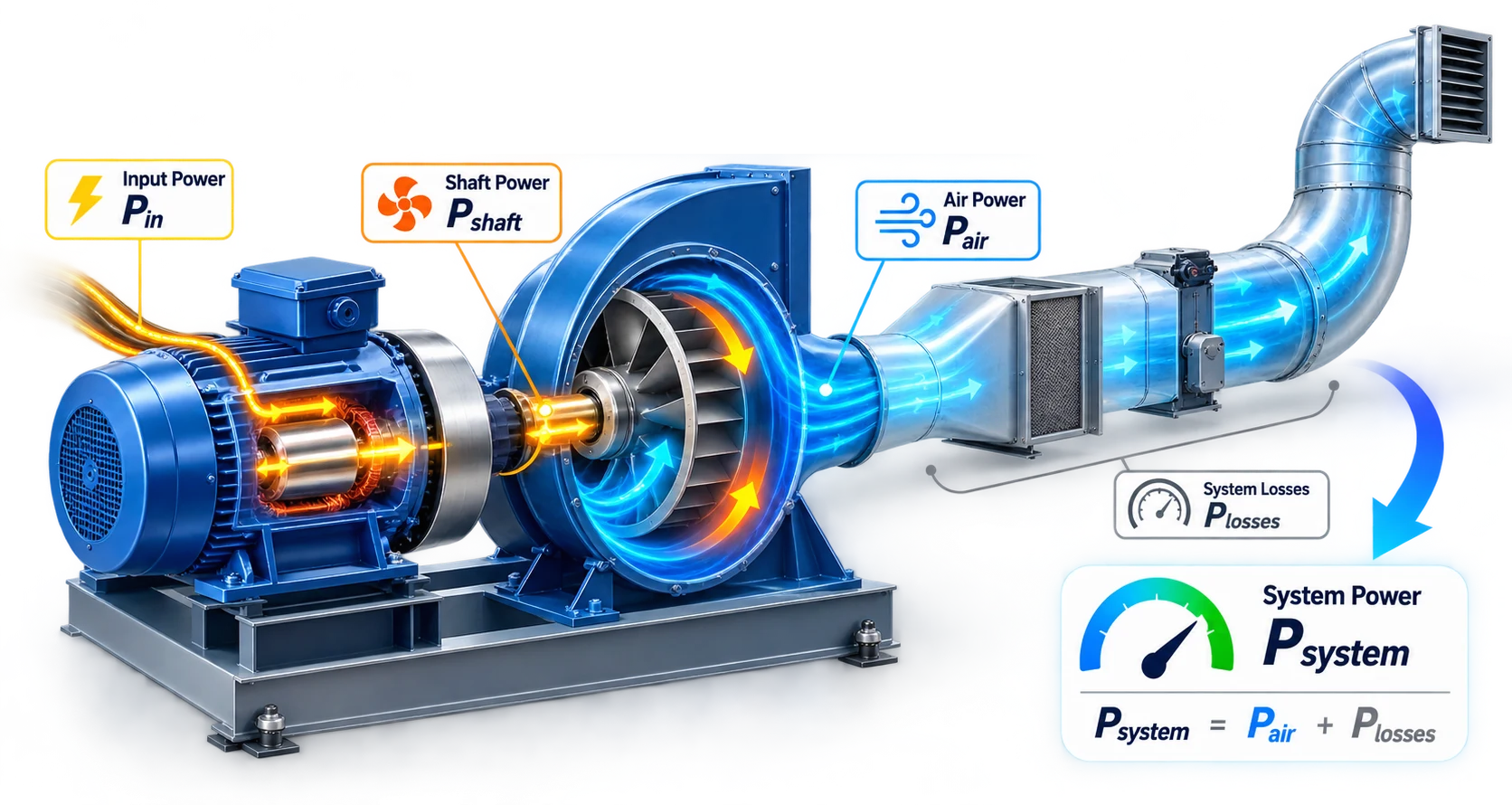
A fan is never just a fan. By the time air actually moves, power has passed through four separate pieces of equipment, and each one takes its own cut:
| Stage | What it represents | Typical loss |
|---|---|---|
| Air power | Pure aerodynamic power: airflow × pressure rise | — |
| Shaft power | What the fan wheel needs at its shaft to produce that air power | Fan (aerodynamic) losses |
| Motor output power | What the motor delivers at its own shaft | Drive losses (belt, coupling) |
| Motor input power | Electrical power the motor actually draws | Motor losses (electrical, magnetic, friction) |
| Grid power | What the meter sees, after the speed controller | VFD/controller losses |
A motor's nameplate rating is motor output power — it says nothing about the drive losses upstream of it or the VFD losses downstream. Confusing the nameplate with what a fan actually costs to run is one of the most common estimating mistakes in HVAC.
The AMCA 207 chain, worked through
Take a fan moving 20,000 m³/h against 800 Pa total pressure — an ordinary commercial duty point. AMCA 207 divides straight down through the chain, each stage getting bigger as it absorbs the next loss:
Air power = Q × Δp = (20,000 / 3600) m³/s × 800 Pa ≈ 4.44 kW

Shaft power = Air power / ηfan = 4.44 / 0.78 ≈ 5.70 kW

Motor output = Shaft power / ηdrive = 5.70 / 0.96 ≈ 5.94 kW

Motor input = Motor output / ηmotor = 5.94 / 0.92 ≈ 6.45 kW

Grid power = Motor input / ηVFD = 6.45 / 0.97 ≈ 6.65 kW
Air power and grid power differ by 50% here — and every one of those four intermediate steps is a real, physical loss that shows up on the electricity bill, not a rounding error. The fan's own aerodynamic loss (1.26 kW) is actually the single biggest one; the drive, motor and VFD losses add another 1.19 kW on top of that.
Where AMCA 207 actually gets used
- Comparing fans fairly. Two fans quoted at the same "kW" can have very different overall (wire-to-air) efficiency if one absorbs its losses in the fan wheel and the other in an inefficient belt drive.
- Specific Fan Power (SFP). SFP is simply pressure divided by the same overall efficiency this chain produces — get the chain wrong and the SFP grade you report is wrong too.
- Energy Efficiency metrics. FEI, ErP and similar compliance metrics are all built on exactly this same wire-to-air chain, just packaged differently.
- Sizing the motor correctly. The motor needs to be sized against motor output power (after drive losses), not against air power or shaft power — undersize here and the drive belt or coupling becomes the weak link.
Common mistakes worth avoiding
- Quoting the motor nameplate as "the fan's power." It ignores drive losses upstream and VFD losses downstream — both real, both on the bill.
- Applying one blended "efficiency" to the whole chain. A single number hides which stage is actually the problem. A poor-efficiency fan wheel and a poor-efficiency VFD need completely different fixes.
- Forgetting direct-drive isn't automatically 100% efficient. It removes belt losses, but shaft misalignment and bearing friction are still real, if small.
- Ignoring the VFD stage entirely when there isn't one. If there's no speed controller, that step in the chain is simply ηVFD = 100% — not "not applicable."
Frequently asked questions
Is AMCA 207 the same as Fan Energy Index (FEI)?
No. AMCA 207 defines how to calculate a fan system's actual input power stage by stage. FEI (ANSI/AMCA 208) then uses that same wire-to-air chain to compare a fan against a standardized reference fan at the same duty point. AMCA 207 is the calculation method; FEI is one metric built on top of it.
What's the difference between shaft power and motor output power?
Shaft power is what the fan wheel itself needs. Motor output power is what the motor delivers at its own shaft, before that power crosses the drive (belt or coupling) to reach the fan. For a direct-drive fan the two are close; for a belt-driven fan, drive losses separate them.
Why does grid power matter more than air power for an energy bill?
Because grid power is what the electricity meter actually measures. Air power is the useful output, but every stage between the air and the meter — fan, drive, motor, controller — adds real losses that the building pays for every hour the fan runs.
Does a VFD always improve overall efficiency?
A VFD adds its own small conversion loss (typically 2–4%) at full speed, so at 100% speed it can never be quite 100% efficient. Its real energy benefit comes from letting the fan slow down to match a reduced load instead of running full speed and throttling — the fan-affinity power savings at part load usually dwarf the VFD's own small loss.
Build your own power-flow breakdown
CloudAir's Fan Power Configurator builds this exact AMCA 207 chain for your own duty point — fan, drive, motor and VFD stages, each loss shown separately — alongside duty-profile energy modeling, motor sizing and a system curve. Free, no sign-up.